

A co-investment can bring investors together around one asset without giving them equal control. It allows an investor to participate alongside a sponsor’s main fund in a specific portfolio company, often through a separate vehicle such as an SPV. The co-investment governance structure sets out how investors participate, who makes decisions, and how exit rights and conflicts are handled.
That distinction matters: sharing an investment does not necessarily mean sharing influence, information, or a route to liquidity. Governing documents shape the relationship, from allocation and voting arrangements to the treatment of expenses and a potential sale.
This article explains how co-investments and SPVs are commonly structured, who holds decision-making authority, and which governance terms can affect an investor’s position. It also examines exit provisions, conflicts between a main fund and co-investors, and investment risks, helping you assess the framework before committing capital.
Key Takeaways
- Review exit provisions for how a sale, transfer or continuation vehicle could affect your timing, consent rights and liquidity.
- Assess how investment allocations, expenses and decision-making are handled between the sponsor’s main fund and co-investors.
- Consider funding timing, concentration and expense allocation when weighing the risks of a deal-specific investment.
- Compare direct investment, shared acquisition vehicles and SPVs by their implications for governance, administration and investor influence.
- Distinguish the sponsor’s management role from the co-investor’s rights, then assess whether the arrangement aligns with your investment objectives.
1.4 What are the types of exit rights afforded to co-investors?
Design starts with the sponsor and co-investors defining authority, allocation, reporting, conflicts, and exit outcomes. They then set out those decisions in fund documents, SPV agreements, subscription materials, and company-level arrangements, assigning each right to a decision-maker and a clear trigger.
Exit rights determine how an investor can participate when a portfolio company is sold, transferred, or placed in a continuation vehicle. A co-investor may negotiate consent over specified transactions, transfer restrictions, or the right to participate alongside the sponsor’s fund. These rights are different from an automatic right to sell independently, which vehicle documents or company ownership arrangements may restrict.
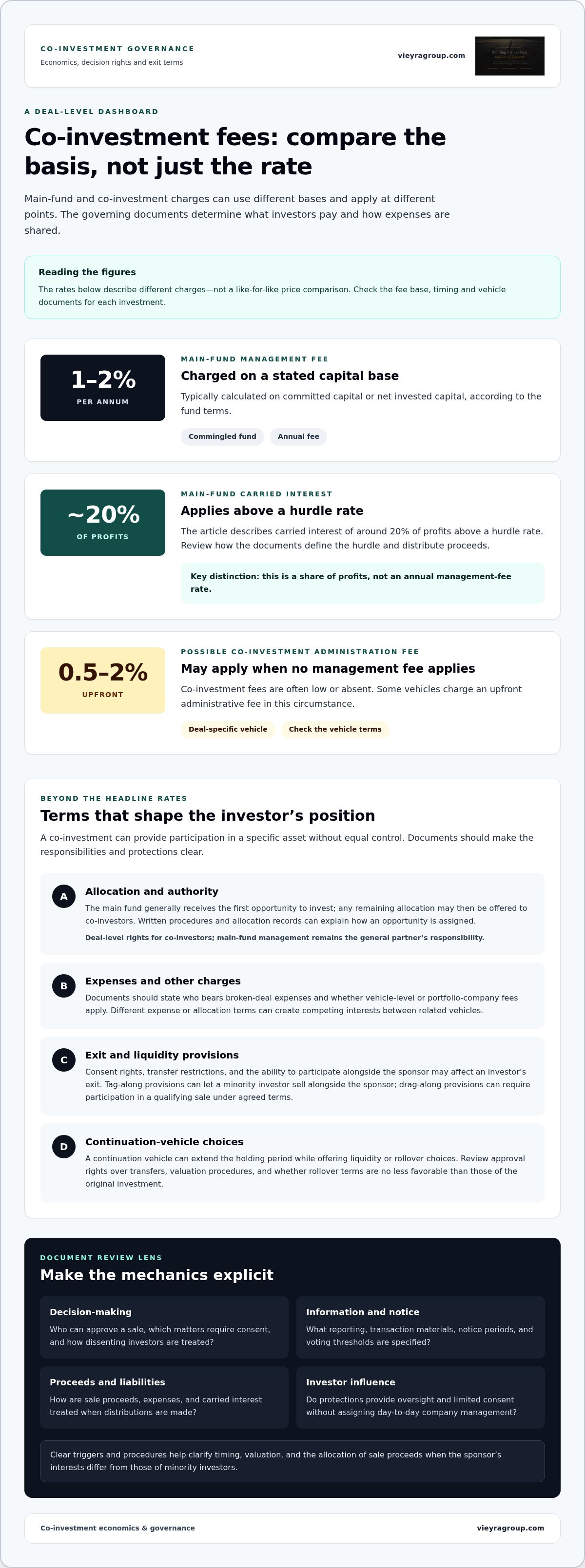
Tag-along provisions can let a minority investor sell alongside a sponsor that transfers its interest. Drag-along provisions can require minority holders to participate in a qualifying sale under agreed terms. For example, documents can specify who initiates a sale, which investors must cooperate, and how proceeds and liabilities are allocated. These mechanics matter when the sponsor controls the sale process but co-investors hold separate interests.
Continuation vehicles warrant close attention because they can extend the holding period while offering liquidity or rollover choices. Co-investors may negotiate approval rights over transfers into such a vehicle, valuation procedures, and terms for investors who retain their exposure. A fairness opinion or independent valuation process may help address competing interests. Rollover terms can specify whether continuing co-investors receive terms no less favorable than those of their original investment.
Governance rights shape the information and influence available before an exit. Negotiated protections can include board director or observer rights, portfolio-company reporting, consent over major decisions, anti-dilution protection, and key-person or removal rights. Regular operating reports, for instance, can help an investor assess whether an asset’s performance supports a sale. Consent rights can address material changes to the proposed transaction.
Protections should distinguish oversight from control. A co-investor may receive information and limited consent rights without directing daily company management. Documents should also clarify voting thresholds, notice periods, access to transaction materials, and how carried interest or expenses are treated when proceeds are distributed. Without clear terms, investors may disagree about timing, valuation, or the allocation of sale proceeds.
During a liquidity event, compare the sponsor’s proposed terms with the rights in the investment documents. The co-investment governance structure should clarify who can approve a sale, how dissenting investors are treated, and whether proceeds follow the same economic terms as the main fund. Clear triggers and procedures reduce ambiguity when the sponsor’s interests diverge from those of minority investors.
Governance conflicts between the main fund and co-investors
Conflicts can arise when a private equity sponsor allocates opportunities, expenses, or decision rights across related vehicles. Governing documents should explain how a limited partner can participate while preserving clarity about the main fund’s authority.
Main-Fund and Co-Investment Terms
Main-fund terms govern the commingled vehicle, while co-investment terms govern an investor’s separate participation in a specific asset. Alignment matters because different allocation, reporting, or exit provisions can create competing interests. For example, a fund-of-one may be designed for a single investor, while an overage structure can place amounts exceeding the main fund’s allocation in a separate vehicle. Each arrangement needs clear rules for participation and expenses.
Governance Structure Differences
Co-investment governance assigns rights for a specific deal; main-fund governance covers the fund’s broader portfolio and operations. The main fund generally receives the first opportunity to invest, with any remaining allocation then offered to co-investors. This distinction means co-investors may have deal-level rights, while the general partner remains responsible for managing the main fund. Allocation records and written procedures can explain why an opportunity went to one vehicle rather than another.
Allocating Fees, Expenses, and Carried Interest
Fee and expense allocation depends on the vehicle documents and the investment arrangement. Main funds typically charge management fees of 1-2% of committed capital or net invested capital, per annum, and carried interest of around 20% of profits above a hurdle rate. Co-investment fees are often low or absent, but some vehicles charge an upfront administrative fee of 0.5-2% when no management fee applies. Documents should state who bears broken-deal expenses and whether any vehicle-level or portfolio-company fees apply.
Conflicts can also arise when the sponsor considers follow-on capital, leverage, or a sale. For example, the main fund may prioritize a portfolio-wide decision, while co-investors assess the impact on one asset. Agreements can define consent rights, reporting duties, allocation principles, and procedures for notifying limited partners or the advisory committee when an opportunity moves outside the main fund.
Vehicle design shapes these relationships. A traditional private equity fund pools commitments across investments, while a co-investment SPV holds an interest tied to a particular deal. Sponsor-managed aggregation vehicles can simplify administration, but their voting rights, economics, reporting obligations, and allocation mechanics need clear definitions. A written policy should also explain how the sponsor handles broken-deal costs and records allocation decisions.
For investors assessing how governance connects with long-term capital decisions, investment management considerations can provide a broader framework for evaluating portfolio alignment.
Co-investment risks and drawbacks
A co-investment can provide direct exposure to one private company, but that concentration also magnifies deal-specific risk. If the portfolio company misses its operating plan, the co-investor cannot rely on unrelated assets to offset the result. A passive minority position may also limit influence over management, even after substantial due diligence before committing capital.
In the United States, investment managers’ failure to establish formal written policies and procedures for allocating co-investment opportunities and broken-deal expenses constitutes a breach under the Investment Advisers Act of 1940. Preferential allocation can create conflicts, so investors should understand the sponsor’s allocation process, how exceptions are documented, and how expenses are assigned when a transaction does not close.
Execution risk begins with the decision to participate. A sponsor’s due diligence can inform an investor’s assessment, but it does not replace analysis of the company’s financial position, debt, operating assumptions, and exit prospects. A direct investment, for example, may require the investor to assess company-level information and governance rights, while an SPV places those rights in a separate vehicle’s documents.
Liquidity is another important constraint. Co-investment vehicles often require a substantial share of committed capital soon after signing or closing. Wet closings and immediate draw mechanics can put pressure on cash planning. Before signing, map the expected funding sequence against existing commitments and possible follow-on needs. Assuming funding can be delayed may leave an investor unable to meet a capital call on schedule.
Costs also affect net returns. Co-investments often carry low or no management fees, but a co-investment fund may charge an upfront administrative fee of 0.5-2% when no management fee applies. The governing documents should identify which expenses are borne by the vehicle, which are allocated to investors, and whether carried interest or portfolio-company-level fees change the economics.
Single-asset exposure can make valuation and exit timing especially consequential. A sponsor may favor a longer holding period to pursue operational improvements, while an investor may prefer earlier liquidity. Review transfer limits, sale procedures, leverage provisions, and continuation-vehicle terms together, since each can affect the ability to exit or retain exposure on favorable terms.
A disciplined assessment separates risks arising from the asset from those created by the structure. Examine the investment thesis, sponsor allocation, funding schedule, expense policy, information access, and exit provisions as connected elements. If the co-investment governance structure leaves broken-deal costs or decision-making authority ambiguous, that ambiguity is itself a governance risk, regardless of the investment’s performance.
Co-investment structures and SPVs
A co-investment lets external investors invest alongside a private equity sponsor in a portfolio company. Unlike a commitment to a traditional buyout fund, where investors become limited partners in a pooled vehicle, a co-investment targets a specific opportunity. Investors may hold company equity directly, join the sponsor’s acquisition vehicle, or invest through a special purpose vehicle. Each route shapes exposure, administration, governance, and the investor’s relationship with the sponsor.
An SPV commonly holds co-investment interests for a particular transaction. A sponsor-managed SPV can pool capital from several co-investors, giving the transaction one investment vehicle rather than multiple direct holders. This can streamline execution and administration, while concentrating key terms in the SPV documents. Before committing, investors should understand how those documents define voting rights, economics, reporting obligations, and allocation mechanics.
Investing through the same acquisition vehicle as the sponsor’s main fund can align the parties around one asset and simplify administration. However, co-investors in that arrangement typically have less direct governance involvement. Their influence may depend on the vehicle’s voting arrangements and the sponsor’s authority. An investor, for example, may participate in the acquisition without having a separate right to direct the portfolio company’s daily operations.
Direct equity co-investment creates a different balance. An investor acquires equity in the portfolio company itself, potentially gaining greater governance participation and control. That position also requires internal due diligence, transaction execution, and ongoing oversight capabilities. Investors considering this approach should assess whether they can review company-level information, exercise their rights, and monitor the investment throughout the holding period.
Fund design also affects diversification. A main fund typically invests across a portfolio, while a co-investment fund usually focuses on one investment or a few investments alongside the main fund. An SPV tied to one transaction can therefore concentrate exposure in a single company. Investors seeking exposure across sectors may need to assess each opportunity separately rather than assume one vehicle provides broad diversification.
Allocation rules determine how co-investors receive investment opportunities. The main fund generally has the primary right to invest, and co-investors are typically offered participation after the fund’s allocation. If the sponsor uses an SPV to pool the remaining allocation, governing documents should explain how capital amounts, voting, expenses, and follow-on participation are handled. A clear structure connects the investment vehicle to the rights investors actually receive.
The practical distinction is simple: an SPV can simplify shared execution, while direct ownership may require greater investor capability and oversight. Neither structure alone guarantees alignment. Compare the vehicle documents with the sponsor’s main-fund arrangements, focusing on governance, economics, information, and exit mechanics. These terms show whether the structure suits the investor’s intended exposure and strategy.
Who typically participates in co-investment governance and what are their roles?
Governance usually involves the general partner, the main fund’s limited partners, co-investors, and portfolio-company leadership. Their influence differs: the general partner manages the fund, while co-investors commonly hold passive minority positions. Identifying each participant’s authority clarifies who selects investments, oversees the asset, and receives information.
The general partner manages the private equity fund, makes investment decisions, and directs its operations. In a co-investment, the sponsor typically determines which opportunity the main fund takes first and what allocation remains. It also coordinates execution and communicates investment information through agreed channels. If the fund takes only part of a transaction, for example, the sponsor may offer the remainder to co-investors.
Limited partners provide capital to the main fund and entrust day-to-day management to its general partner. In a traditional blind-pool fund, they generally do not select individual investments. Their governance influence instead comes through the fund documents and applicable advisory arrangements. Co-investors can choose which offered deals to join, but remain dependent on the sponsor’s access and allocation process.
Co-investors contribute capital to a particular transaction and typically hold passive minority positions. Their negotiated rights may include reporting access, consent over specified major decisions, or board observer participation. An observer, for instance, may receive board materials and attend meetings without voting as a director. A direct investor can take a more active role, but that requires internal due diligence, execution, and ongoing oversight.
Family offices participate in direct and syndicated transactions alongside traditional institutional investors. In a syndicated deal, several investors join the sponsor’s investment, with each participant’s influence shaped by the vehicle documents. One family office might seek regular portfolio-company reporting, while another may prioritize consent rights over a sale or continuation transaction. Specific rights depend on the negotiated documents, not on investor category alone.
A limited partner advisory committee may also be involved when allocation decisions create conflicts. A manager may notify the committee or limited partners when an investment opportunity is allocated away from the main fund. The committee’s role depends on the governing documents; notification alone does not give every investor approval authority. Written allocation procedures help distinguish oversight from operational control.
Portfolio-company directors and executives govern daily operations, rather than the co-investment vehicle. A co-investor with board rights may contribute to oversight, while a passive minority investor relies on contractual information and consent protections. For example, company leadership executes an operating plan, the sponsor monitors performance, and co-investors receive reports under their agreed rights. Clear boundaries keep ownership participation distinct from management responsibility.
To align investment decisions with institutional objectives, explore global investment management as part of a disciplined capital strategy.
Vieyra Family Office: Global Investment Management
Vieyra Family Office offers Global Investment Management for investors assessing how co-investment decisions fit within a broader portfolio and long-term capital strategy. This perspective is relevant when considering whether a deal-specific commitment aligns with other asset classes, risk exposures, and investment objectives.
For investors evaluating opportunities connected to African industrialization, African Industrialization Capital and Strategic Capital Solutions support consideration of long-term growth and economic development. The Vieyra Foundation is also part of the institution’s work. These offerings sit alongside the governance questions addressed in this guide, including investment alignment, decision rights, and capital allocation.
To discuss how these considerations relate to your investment priorities, contact Vieyra Family Office or visit vieyragroup.com.
Bring Governance Into Your Long-Term Capital Strategy
Treat governance as part of capital allocation, not an administrative matter to address only at signing. Before advancing an opportunity, establish how its decision rights, information flow, and exit provisions align with the investment’s intended role in your wider portfolio. This helps distinguish an attractive asset from an arrangement whose governance may not suit your objectives.
A well-considered co-investment governance structure can also inform how investors evaluate capital deployment across distinct markets and long-term priorities. Vieyra Family Office offers Global Investment Management, African Industrialization Capital, and Strategic Capital Solutions for investors considering these broader questions of investment strategy and growth.
For a considered discussion of your investment priorities and next steps, contact Vieyra Family Office. A deliberate governance framework can help you approach future opportunities with greater clarity and purpose.
Frequently Asked Questions
What Are Co-Investments?
Co-investments let an investor join a sponsor’s investment in a specific private company, rather than commit capital solely to a pooled fund. For example, a limited partner may review a separate opportunity and decide whether to invest alongside the sponsor in that company. This deal-by-deal choice can offer greater selection flexibility, while concentrating exposure in the selected asset and requiring a separate assessment of its terms.
What is a co-investment governance structure?
A co-investment governance structure is the framework of documents and decision rights governing the sponsor, investment vehicle, and participating investors. It specifies how investors receive information, exercise consent or voting rights, and share economic outcomes. For example, an SPV agreement can distinguish decisions reserved for the manager from matters requiring investor approval. Read the framework alongside the main fund documents and relevant company-level arrangements.
How are co-investment decisions approved and voting rights allocated?
Approval authority follows the governing documents, which identify the decision-maker and any required investor vote. The sponsor may retain authority over routine management, while investors receive voting rights over defined matters, such as amendments affecting their interests. For a proposed follow-on investment, documents can specify whether the manager decides, investors vote, or each investor makes a separate election. Review voting thresholds, notice requirements, and the consequences of not participating.
What governance terms are common in co-investment agreements?
Agreements commonly address investor reporting, consent over major decisions, transfer restrictions, expense allocation, and procedures for a sale or continuation vehicle. They may also set out board observer rights, anti-dilution protections, and key-person or removal provisions. An investor considering a transfer, for example, should understand whether sponsor consent applies and how a proposed buyer qualifies. These terms define practical rights beyond headline economics.
How are conflicts of interest managed in co-investments?
Conflicts are managed through written allocation policies, disclosure, consistent expense procedures, and documented decisions. A sponsor allocating an opportunity among its main fund and co-investors should be able to explain the rationale and record how broken-deal expenses are assigned. Advisory committee or limited partner notification may also apply when an opportunity is allocated away from the main fund. These mechanisms help investors assess whether treatment follows established procedures.
What reporting, disclosure, and oversight requirements apply to co-investments in the United States?
In the United States, investment managers’ failure to establish formal written policies and procedures for allocating co-investment opportunities and broken-deal expenses constitutes a breach under the Investment Advisers Act of 1940. Investors should also examine the reporting and disclosure commitments in their governing documents, including information delivery, expense allocation, and conflict procedures. Those documents establish the practical oversight available to investors; the written allocation policy addresses a central manager responsibility.


