

Only 6% of the projects in Africa’s continent-wide infrastructure portfolio are under construction. Funding Africa’s infrastructure gap therefore depends not only on capital, but on institutions and project pipelines that can turn financing into delivery. African governments accounted for over 40% of total infrastructure finance, while donors accounted for about 35% of commitments.
The scale of the need is clear, but the path from funding commitments to functioning infrastructure is less straightforward. Capital must be matched with viable, well-governed projects that can sustain long-term investment, while existing assets also need maintenance.
This article explains how governments, development finance institutions, private partners and domestic investors contribute, and why their roles depend on more than the availability of funds. It examines institutional quality, maintenance, public-private partnerships, domestic capital and project preparation. Together, these factors clarify who pays, how financing is structured and what helps investment deliver durable infrastructure.
Key Takeaways
- Assess whether institutions can convert available finance into durable investment by examining governance, regulation and the strength of domestic financial markets.
- Understand how development finance institutions and multilateral banks can help structure projects and mobilize capital alongside public funding.
- Consider maintenance and lifecycle responsibilities when evaluating public-private partnerships, not only the initial construction plan.
- Identify how pension funds, insurers and other domestic investors may contribute when financial markets and investment structures support long-term participation.
- Examine project preparation and feasibility to see why a strong infrastructure pipeline matters as much as announced funding.
Institutional quality as a condition for finance to support investment
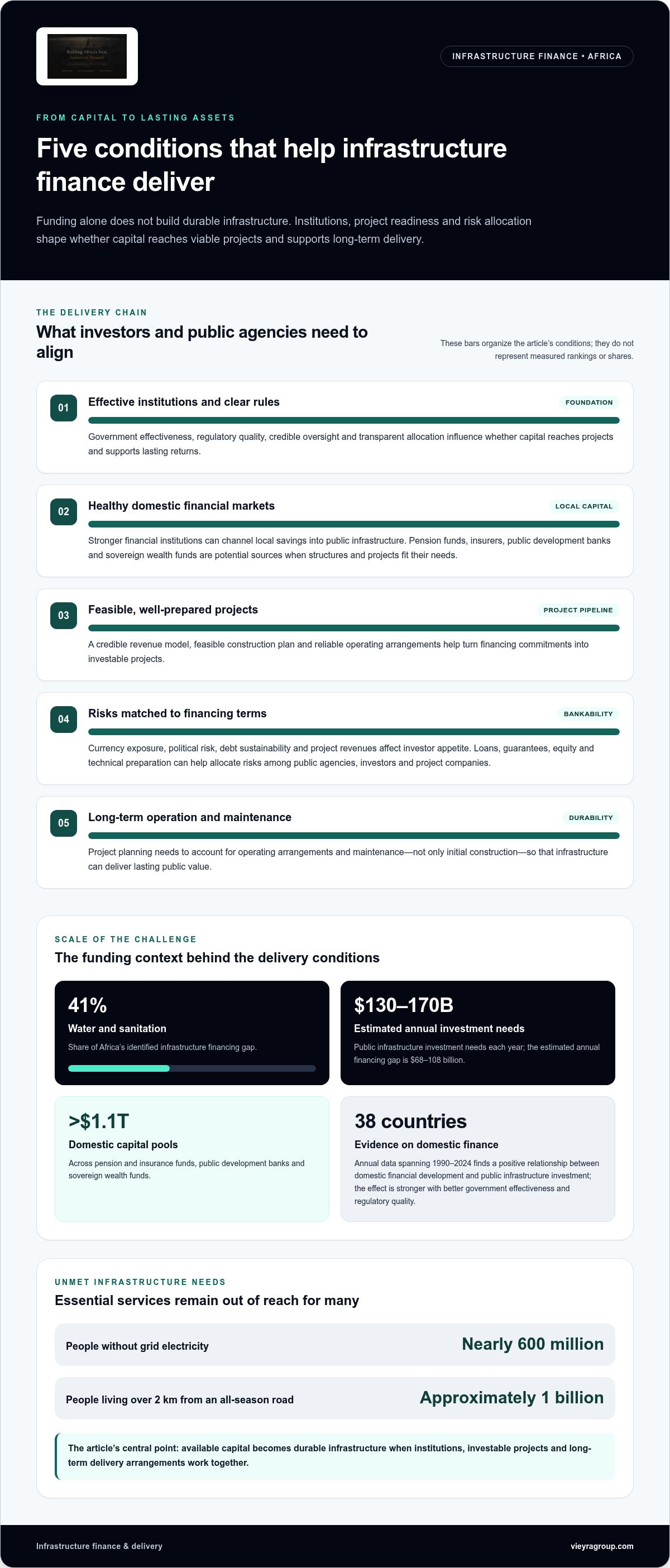
Water and sanitation account for the largest identified share, representing 41% of Africa’s infrastructure financing gap. Energy, transport and digital infrastructure remain vital priorities, with nearly 600 million people lacking grid electricity and approximately one billion living more than two kilometers from an all-season road.
Domestic Financial Development
Domestic financial development means expanding the institutions and markets that channel local savings into productive investment. It matters because stronger domestic finance can support public infrastructure investment and reduce reliance on external sources. African pension funds hold over $1 trillion in assets, while Africa holds over US$1.1 trillion in domestic capital across pension and insurance funds, public development banks and sovereign wealth funds. Mobilizing these resources requires investable projects and financial institutions able to assess long-term risks.
Evidence from annual data for 38 African countries spanning 1990 to 2024 finds a positive relationship between domestic financial development and public infrastructure investment. The effect is stronger where government effectiveness and regulatory quality are also stronger. This means financial deepening alone is insufficient: institutions influence whether capital reaches projects, is allocated transparently and supports lasting economic returns.
Risks Affecting Infrastructure Finance
Governance and regulation shape how reliably a project is approved, contracted and overseen. Currency risk affects the value of revenues relative to foreign-currency obligations, while political risk can alter policy or contract conditions. These factors influence financing terms and investor appetite because infrastructure requires stable, long-term commitments. Clear rules, credible oversight and sound risk allocation can strengthen a project’s bankability.
The Partnership for Global Infrastructure and Investment aims to mobilize $600 billion for infrastructure in emerging economies, according to The White House. Such commitments can expand available capital, but institutional quality remains central to converting announced finance into completed assets. Public infrastructure investment also faces a substantial financing constraint: annual needs are estimated at $130-$170 billion, against an annual financing gap estimated at $68 billion to $108 billion.
Renewable energy investment shows how institutional conditions interact with project design. Investors assess whether a project has a credible revenue model, a feasible construction plan, reliable operating arrangements and a regulatory environment that supports long-term delivery. Grid connections and currency exposure also affect bankability. A project with strong development value may still struggle to attract finance if these elements are poorly aligned.
Fintech can strengthen the channels through which domestic savings and institutional capital reach infrastructure opportunities. Digital financial systems may widen access to financial services and improve transaction handling. Pension funds can provide patient investment when projects meet their mandates and risk requirements. For financing to support investment, capable institutions must connect these sources with projects that have clear governance, viable economics and lasting public value.
Development finance institutions and multilateral development banks
Development finance institutions and multilateral development banks provide long-term finance, expertise and risk-sharing structures for infrastructure. Their role is important when national budgets and private investment cannot meet project requirements on their own.
External Financing Risks
External infrastructure financing is capital provided across borders by governments, development institutions or investors. It can expand project capacity, but foreign-currency borrowing exposes borrowers to exchange-rate movements when project revenues are collected locally. Debt sustainability also matters: as of 2025, eight African countries were in debt distress and a further fifteen were at high risk. Financing terms must therefore reflect repayment capacity and project revenues.
Development finance institutions can support projects through loans, guarantees, equity and technical preparation, helping allocate risks among public agencies, investors and project companies. The African Development Bank invested more than $50 billion in infrastructure over the past eight years. The European Union’s Global Gateway initiative pledged 150 billion for Africa, according to the European Commission. These commitments contribute to financing, while implementation depends on credible project design, procurement and oversight.
The Annual Financing Gap
The annual financing gap is the difference between infrastructure investment needs and financing commitments available for projects. It indicates the scale of capital that remains to be mobilized, rather than a single funding source that can close the shortfall. Closing the infrastructure financing gap can require a mix of public budgets, development finance and private investment.
Chinese infrastructure finance has contributed to transport and storage networks, though its scale has shifted. China implemented 305 such projects in Africa, valued at US$47.3 billion, from 2003 to 2023; Chinese infrastructure investment in Africa dropped by 55% in 2022. These figures illustrate why governments benefit from a diversified financing base and careful assessment of debt obligations, currency exposure and the economic returns of each project.
Attracting Foreign and Institutional Capital
Africa can attract foreign direct investment and institutional capital with well-prepared projects, clear revenue models, transparent procurement and credible governance. Investors also assess currency exposure, regulatory stability, construction readiness and plans to maintain completed assets. These features help distinguish financeable opportunities from proposals without a credible path to sustainable operation.
Local governments shape urban infrastructure finance through land-use planning, reliable project prioritization and coordination with national agencies. Water systems, transport links and digital networks need integrated plans because their value often depends on connections across municipal boundaries. Development finance institutions can strengthen project preparation and institutional capacity, while domestic and foreign investors assess projects against their investment mandates.
For urban projects, financing structures should match an asset’s useful life and revenue profile. A transport corridor may rely on user charges or public payments, while essential water services may require a different balance of public funding and investment. The distinction matters: financing terms should reflect affordability, maintenance needs and the public service the project provides.
Infrastructure maintenance and public-private partnerships
Infrastructure finance must cover both new construction and the upkeep of existing assets. Ghana and Malawi illustrate how public debt can limit the capacity to fund both.
Maintenance protects the value of earlier investment and supports reliable services. A road budget, for example, should include routine inspections, drainage repairs and resurfacing, not just initial construction. When maintenance is deferred, assets deteriorate and rehabilitation can compete with new projects for scarce public funds. Planning these obligations across an asset’s life helps governments assess the full fiscal commitment before construction begins.
Public-private partnerships, or PPPs, assign defined responsibilities to public authorities and private partners through a long-term project agreement. A port concession might place operations and maintenance with a private operator, while the government retains oversight and agreed public responsibilities. Strong PPP models specify performance standards, risk allocation, payment arrangements and how assets return to public control. Clear terms matter because uncertainty about political or operating responsibilities can undermine service continuity.
Debt and Fiscal Constraints
Public debt and fiscal constraints describe limits on a government’s capacity to borrow and spend while meeting existing obligations. They matter because infrastructure commitments can affect budgets beyond the construction period. Ghana’s total public and publicly guaranteed debt was 82.9 percent of GDP at the end of 2023, including external debt of 44.3 percent of GDP. Malawi’s comparable debt reached 76 percent of GDP in 2022.
These figures make project sequencing important. Governments can compare expected public value, maintenance needs and repayment commitments before choosing which assets to build. Tanzania’s total public and publicly guaranteed debt was 46.7 percent of GDP in 2023, a reminder that fiscal conditions differ across countries. External debt also exposes public budgets to currency movements when obligations and revenues use different currencies.
Blended Public-Private Financing
Blended public-private financing combines public resources and private capital to fund projects whose risks or returns may not attract private investment alone. A public contribution might support enabling infrastructure, while private partners finance construction or operations under agreed terms. Public support should address a defined project need without obscuring the government’s long-term payment and maintenance responsibilities.
For example, a government could fund access roads to an industrial zone while a private partner develops and operates shared facilities. The agreement should set out construction milestones, service standards, maintenance duties and how revenues or public payments are determined. Each party’s responsibilities should match its ability to manage the relevant risks. This makes the arrangement more transparent and helps authorities compare proposals by their full public cost.
Digital public infrastructure can also benefit from shared investment models. A common digital identity or payment platform can serve several public agencies, reducing duplicated systems and supporting connected services. Financing should clarify who governs the platform, protects data and funds ongoing operations. Like physical assets, shared digital infrastructure needs maintenance planning. Budgets should include upgrades and support after launch, rather than treating implementation as the endpoint.
Africa is entering a third wave of port privatisation, making maintenance and public accountability especially important in concession design. Clear performance measures can connect private operations with public service objectives while preserving oversight of essential assets.
Unlocking domestic capital for African infrastructure
Africa’s domestic savings are estimated at nearly $4 trillion, yet savings do not automatically become infrastructure investment. The central task is to connect local capital with credible projects through effective financial institutions and markets.
No country can be ranked as the infrastructure-financing leader on GDP growth alone: Tanzania’s real GDP growth averaged 6.1 percent over the past 10 years. More broadly, approaches that strengthen local financial markets, project preparation and public institutions can help turn domestic resources into long-term investment.
Policy Reforms for Domestic Finance
Policy reforms for domestic finance help local institutions direct savings toward productive investment. They matter because clear rules and effective oversight can make infrastructure opportunities more accessible to domestic investors. Governments can strengthen market confidence by improving disclosure, setting predictable project-selection processes and coordinating national investment priorities with capital-market development.
Financial intermediation connects savers with borrowers and investment opportunities. For infrastructure, banks and long-term investors need project information to assess cash flows, risks and public value. Consistent procurement and transparent reporting can help them distinguish investable projects from proposals lacking clear governance or a durable operating plan.
Domestic Savings and Capital Markets
Domestic savings become infrastructure capital when financial institutions and markets channel them into suitable long-term investments. This connection matters because Sub-Saharan Africa’s average savings rate was 19 percent from 2010 to 2021, while the continent’s estimated savings pool remains substantial. Capital markets can provide routes for national investors to participate in projects through appropriately structured instruments.
That process depends on investment vehicles that match the needs of savers and projects. Pension funds, insurers and other institutions manage capital according to their obligations and investment mandates. A long-duration infrastructure asset may suit patient capital when its governance, expected revenues and operating responsibilities are clearly presented. Strong domestic markets can broaden these financing channels and support greater local participation.
Progress and Approaches Across Countries
Progress in infrastructure finance is best assessed through the strength of local financing channels and project delivery, not economic growth alone. Tanzania’s growth figure provides context, but does not show how much infrastructure its domestic capital financed. Effective approaches include linking national priorities to prepared projects and strengthening the institutions that assess and allocate investment.
Countries can strengthen domestic participation by coordinating public development banks, pension institutions and capital markets around viable project pipelines. Clear project selection, consistent disclosure and credible oversight help investors evaluate risks and expected returns. These measures do not replace external finance; they build stronger connections between local savings and infrastructure investment across the continent.
Africa’s infrastructure project pipeline
Africa’s infrastructure pipeline shows why announced capital and delivered assets are not the same. The continent-wide portfolio includes approximately 130 transnational projects and programs across energy, transport, digital infrastructure and water. Only 6% are under construction, making project preparation and execution central to infrastructure investment.
The Programme for Infrastructure Development in Africa, or PIDA, provides a continental framework for coordinating projects across countries. Its scale makes prioritization essential: projects need clear regional benefits, defined responsibilities and a credible path from planning to construction.
A pipeline moves through distinct stages: identifying a strategic need, assessing feasibility, structuring finance, securing approvals and preparing for construction. Each stage resolves a different barrier. Feasibility work tests whether technical design, demand, costs and operating arrangements can support delivery. An estimated 80% of infrastructure projects in Africa fail at the feasibility stage, underscoring the importance of preparation before capital commitments.
Project selection should account for connections between assets. A power plant needs transmission capacity and a route to users; a transport corridor may depend on border procedures, ports and roads in several countries. PIDA’s regional approach matters because coordinated infrastructure can connect markets and support emerging industrial activity beyond a single national boundary.
Large projects demonstrate both the opportunity and the financing demands of the pipeline. The Grand Inga Dam in the Democratic Republic of the Congo has a theoretical capacity of 40,000 MW and is described as requiring $80 billion in financing. Such an undertaking requires more than a headline funding commitment: investors assess development phases, delivery structures, regulatory conditions and the project’s ability to attract finance over time.
For governments seeking foreign or domestic investment, project preparation can clarify scope, technical requirements, governance and revenue arrangements. Clear sequencing also helps capital providers distinguish early concepts from projects prepared for financing or construction. These distinctions allow institutions to direct development resources toward work that moves projects through the pipeline.
The practical measure of pipeline strength is therefore not the number of proposals alone. PIDA’s 69-project plan and the broader portfolio’s low construction share illustrate the distance between selection and delivery. Governments can narrow that distance by coordinating project sponsors, regional authorities and financiers, while maintaining consistent oversight through preparation and implementation.
For investors considering long-term African industrial investment, examining project readiness alongside strategic value can help clarify where capital may contribute to durable infrastructure.
Vieyra Family Office: Global Investment Management
Vieyra Family Office manages global investments and focuses on African industrialization through strategic capital and a long-term perspective. Its African Industrialization Platform develops industrial parks, energy and telecom infrastructure, and refining and recycling capacity to build localized capacity and reduce external dependency across key continental nodes.
Turn to Vieyra Family Office when considering how infrastructure investment relates to industrial growth, capital allocation and long-term development. Its role is to support a strategic perspective on these connected priorities, rather than to replace public authorities responsible for project selection or delivery.
To explore a strategic discussion about African infrastructure investment, contact Vieyra Family Office or visit vieyragroup.com.
Shape the Next Generation of Infrastructure Investment
Durable infrastructure depends on decisions made before capital is committed: which outcomes take priority, how risk is governed and what capabilities must endure after construction. A long-term investment perspective can connect these choices to productive capacity and generational development, rather than treating each asset as an isolated transaction. From this perspective, funding Africa’s infrastructure gap can move beyond capital allocation toward lasting economic value.
An effective next step is to frame investment around mandate, time horizon, risk considerations and intended development contribution. This keeps the purpose of capital central to decisions about its deployment. Vieyra Family Office offers Global Investment Management, African Industrialization Capital and Strategic Capital Solutions, relevant to investors considering how long-term capital may align with industrial growth and broader economic development.
To explore this alignment, contact Vieyra Family Office. Deliberate investment choices can help shape a more connected and productive future.
Frequently Asked Questions
How large is Africa’s infrastructure financing gap, and how is it estimated?
Estimates of funding Africa’s infrastructure gap vary with the period and scope measured. Current estimates include an annual financing gap of $68 billion to $108 billion, while another estimate places the gap at $60 billion in 2025 alone. Researchers may compare projected infrastructure needs with available finance; separate studies assess public investment using government gross fixed capital formation as a percentage of GDP. The measures answer related, but not identical, questions.
How much infrastructure investment does Africa need annually, and how much is currently funded?
Africa’s annual infrastructure needs are estimated at $130-$170 billion, while about $80 billion was committed to African infrastructure annually in recent years. Commitments indicate planned financing, not necessarily money already disbursed or projects completed. The difference between needs and commitments helps explain the financing shortfall, but comparisons depend on the estimates’ coverage and timing. Assessing delivery also requires distinguishing funds pledged, funds allocated and capital reaching construction.
What are the main public and private sources of infrastructure funding in Africa?
Funding comes from national governments, donors, development finance institutions, multilateral development banks, domestic investors and private capital. Governments accounted for over 40% of total infrastructure finance in Africa, while donors accounted for about 35% of commitments. Domestic sources include pension and insurance funds, public development banks and sovereign wealth funds. Private participation may enter through project companies, infrastructure funds or partnerships that assign defined investment and operating responsibilities.
How do African governments, development banks, and institutions like the AfDB finance infrastructure projects?
Governments finance projects through public budgets and borrowing, while development banks can provide long-term capital and support project preparation. The African Development Bank invested more than $50 billion in infrastructure over the past eight years. In practice, project sponsors align national priorities, feasibility work and financing terms before construction. This coordination helps establish which public body oversees delivery, how funding is disbursed and what obligations remain after the asset enters service.
What role do private investment, public-private partnerships, and infrastructure funds play in Africa?
Private investors can provide capital and operational expertise, while public-private partnerships assign responsibilities between public authorities and private participants. Infrastructure funds pool investor capital across projects or assets, offering a structure distinct from direct ownership of a single project. Their contribution depends on project revenues, risk allocation and credible governance. For example, a transport concession needs clear operating duties and payment terms before investors can assess its long-term financial profile.
What are the costs, benefits, and risks of infrastructure debt and public-private partnerships in Africa?
Debt can finance construction before a project generates public or economic returns, but repayment commitments put pressure on future budgets. Foreign-currency borrowing also creates exposure when project income and debt obligations are in different currencies. PPPs can assign construction and operating responsibilities to private partners, yet long-term payment commitments and maintenance duties still require public scrutiny. Assessing the full lifecycle, including upkeep and contingent obligations, helps governments compare financing models by their lasting fiscal effects.
What innovative financing mechanisms can help close Africa’s infrastructure gap, including green bonds and blended finance?
Green bonds can direct investor capital toward projects with environmental objectives, while blended finance combines public or development funding with private investment. These mechanisms can broaden funding sources when project preparation, governance and reporting support investor assessment. A financing structure might pair public capital for enabling works with private funding for construction or operations. Pension funds and domestic capital markets can also participate when investment terms suit their mandates and the project’s risk profile.


