

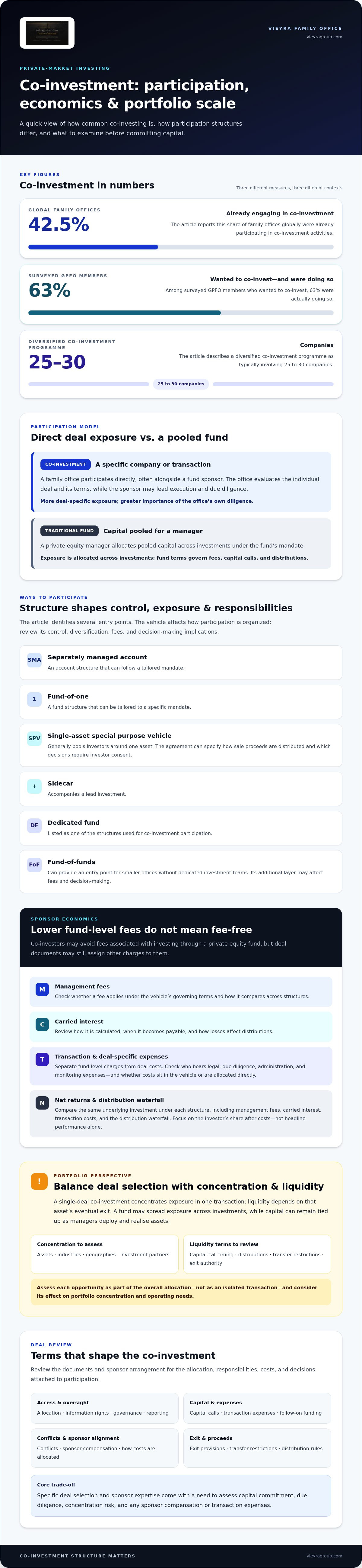
Globally, 42.5% of family offices were already engaging in co-investment activities, making co-investment opportunities for family offices a significant part of private-market investing. The appeal is clear: a family office may invest alongside an established sponsor while gaining more direct exposure to a particular asset or company. Yet the economics depend on the structure, and lower fund-level fees do not mean every co-investment is fee-free.
Family offices may value co-investments because they can select specific opportunities, draw on a sponsor’s expertise, and work with trusted partners. The key question is whether these benefits justify the capital commitment, due diligence, concentration risk, and any sponsor compensation or transaction expenses.
This article explains why family offices pursue co-investments, how deal structures can affect fees and sponsor economics, and what to consider when weighing co-investments within a portfolio. It distinguishes direct participation alongside a fund from arrangements involving management fees or carried interest, making the trade-offs clearer before evaluating an opportunity.
Key Takeaways
- Distinguish direct participation alongside a sponsor from investing through a private equity fund, since access, control, and investment responsibilities can differ.
- Assess the full sponsor economics by examining management fees, carried interest, transaction expenses, and how each cost is allocated.
- Consider how each opportunity affects portfolio concentration across assets, industries, geographies, and investment partners.
- Compare private equity with other alternatives in light of the portfolio’s liquidity needs, investment horizon, and capacity for direct oversight.
What do you know about family offices’ interest in co-investments?
Interest in co-investment opportunities for family offices reflects a desire to select individual private-market deals and invest alongside sponsors. Globally, 42.5% of family offices were already co-investing, though structures and responsibilities differ.
Co-Investments Versus Traditional Private Equity Funds
A private equity co-investment gives a family office direct exposure to a specific company or transaction, often alongside a fund sponsor. By contrast, a traditional private equity fund pools capital for a manager to allocate across investments under its mandate.
This distinction lets a family office evaluate each deal separately, but also increases the importance of its own diligence. Among surveyed GPFO members who wanted to co-invest, 63% were actually doing so.
Co-Investment Structures and Entry Points
Structures include separately managed accounts, funds-of-one, single-asset special purpose vehicles (SPVs), sidecars, and dedicated funds. Accounts and funds-of-one can follow tailored mandates. An SPV generally pools investors around one asset, while a sidecar accompanies a lead investment.
A fund-of-funds can provide an entry point for smaller offices without dedicated investment teams. Its additional layer may affect fees and decision-making, so assess control, diversification, and internal capacity before choosing this vehicle.
Investing Alongside Private Equity Funds
In a fund co-investment, a family office participates alongside a private equity manager in a specific company or transaction. The sponsor may lead execution and due diligence, while the family office independently assesses the asset and terms.
Review allocation, information rights, governance, expenses, capital calls, and exit provisions. Participation may involve fees or unequal terms. A trusted sponsor relationship can support monitoring, but it does not replace transaction-specific review.
United States Co-Investment Opportunities and Rules
In the United States, co-investment opportunities for family offices include fund co-investments, SPVs, sidecars, separately managed accounts, funds-of-one, and fund-of-funds. Legal, tax, and regulatory treatment depends on the vehicle, transaction documents, investor circumstances, and relevant jurisdictions.
Negotiated terms should define allocation, expenses, reporting, conflicts, follow-on funding, governance, and exit rights. For example, an SPV agreement can specify how sale proceeds are distributed and which decisions require investor consent. Entity structure and investment terms also shape tax allocation and reporting.
Co-investment fees, expenses, and sponsor economics
Co-investment economics depend on the vehicle, sponsor, and negotiated allocation. Compare every charge with the investment’s expected holding period, liquidity profile, and potential net returns.
Co-Investment Fees and Deal Selection
Co-investment fees and expenses are the charges attached to participation, while sponsor economics reflect compensation for sourcing and managing a deal. Family offices can often invest alongside private equity funds without paying the fees associated with investing through the fund. However, deal documents may still assign transaction expenses or other charges to co-investors.
For each opportunity, separate fund-level charges from deal-specific costs, then assess how the sponsor earns its return. A lower-fee allocation is not automatically preferable: access, due diligence quality, alignment, and asset suitability also matter.
Fund Fees and Liquidity
Fund fees compensate managers under the vehicle’s governing terms, while liquidity describes how readily an investor can access committed capital. A fund commitment may spread exposure across investments, but capital can remain tied up while managers deploy and realise assets. A single-deal co-investment concentrates exposure in one transaction, and liquidity depends on that asset’s eventual exit.
Review capital-call timing, distribution rules, transfer restrictions, and the manager’s authority over exits. These provisions show when capital may be needed and when proceeds could be returned. They also help families align commitments with operating needs and other obligations.
Fees and Net Returns
Net returns are the proceeds remaining after investment costs, expenses, and sponsor compensation. To compare alternatives, model the same underlying investment under each structure, applying its management fees, carried interest, transaction costs, and distribution waterfall. This shows how the economics affect the investor’s share, rather than relying on headline performance.
Review who bears due diligence, legal, administration, and monitoring expenses, and whether costs are charged to the vehicle or allocated directly. Define how carried interest is calculated, when it becomes payable, and how losses affect distributions. These terms can materially change the capital ultimately returned to each partner.
A disciplined review of allocation, exposure, and liquidity can inform long-range decisions. Explore portfolio investment management as one consideration in that assessment.
Portfolio diversification
Co-investments can broaden a family office portfolio when opportunities span companies, sponsors, countries, and industries. A diversified co-investment programme typically involves 25 to 30 companies. Co-investment opportunities for family offices should therefore be assessed as components of an overall allocation, rather than as isolated transactions.
Key risks include concentration in one asset or sector, limited liquidity, and reliance on a sponsor’s due diligence and execution. Direct participation also requires operational capacity for evaluation and ongoing oversight. If a large holding shares risks with existing assets, its performance may weigh heavily on the portfolio, even if the family holds a broader range of companies.
Geographic and factor exposure influence the portfolio’s risk profile. In a Dentons survey, 74% of family offices aimed to diversify across geographies, while 85% aimed to diversify across different factors. For example, holdings in several technology companies may remain concentrated if they share similar economic sensitivities or depend on one market.
Investment-team resources also shape diversification choices. In 2026, 80% of global family offices outsourced at least part of their investment function. External resources can support analysis, but a family office still needs defined allocation criteria, decision rights, and oversight arrangements for each commitment.
Before adding a deal, map its exposure against existing holdings by sector, geography, sponsor, and underlying risk driver. An industrial investment might broaden a technology-heavy portfolio by sector, yet increase exposure to the same country or economic cycle. This comparison helps distinguish genuine diversification from simply adding another asset.
For co-investment opportunities for family offices, the practical question is how each commitment changes total exposure and monitoring demands. Consider the asset’s relationship to current holdings, available liquidity, and the staff or external resources needed to oversee it. A global allocation plan can show where a new investment adds distinct exposure and where it deepens existing concentrations.
Private equity and other alternative investments
Family offices participate in private markets through funds, direct equity investments, and co-investments. The right approach depends on governance capacity, investment expertise, and the role alternatives play within the wider portfolio.
Family Offices in Private Markets
Family offices can supply patient capital to private equity, private debt, real estate, infrastructure, and other alternative markets. Around 42% of family-office assets were allocated to alternative investments in 2026. This breadth can support long-term strategies, but each asset class brings distinct liquidity, valuation, and oversight considerations.
Private equity exposure among family offices reached 30% in 2023. Some offices invest through funds, while others invest directly or invest alongside experienced managers. Building a dedicated investment team requires capabilities in sourcing, valuation, legal review, and portfolio monitoring. To compete for investment professionals, family offices may offer carried interest or other performance-based rewards.
Direct Private Equity Investments
A direct private equity investment gives a family office an ownership interest in a company rather than exposure solely through a pooled fund. More than half of family offices allocate capital directly to some degree, and 83% of single-family offices worldwide consider direct allocation. Direct investing can increase influence over selection, but it also places greater diligence and monitoring responsibilities on the investor.
Before committing, assess the company’s financial position, governance, competitive environment, and proposed value-creation plan. For a private equity fund, due diligence should examine the fund strategy, manager track record, and operational risks, including cybersecurity and compliance. These reviews help distinguish demonstrated capabilities from assumptions about future performance.
Direct investments also require sustained oversight after closing. Define reporting expectations, decision authority, and performance measures before committing capital. For example, an investment in an industrial company calls for attention to operating performance and the sponsor’s execution plan, not just projected returns. A clear mandate helps align internal expertise with each investment’s demands.
Vieyra Family Office: Global Investment Management
Vieyra Family Office offers Global Investment Management for families assessing how private-market commitments fit within broader portfolios. Its perspective connects global investment considerations with a focus on African industrialisation, framing capital allocation alongside long-term development priorities.
For family offices weighing direct investments, co-investments, or fund exposure, start by clarifying investment objectives, risk tolerance, liquidity needs, and desired oversight. Vieyra Family Office also provides Strategic Capital Solutions and African Industrialization Capital, which can be relevant when capital decisions intersect with long-term growth projects and economic development. These offerings connect investment strategy with African industrialisation priorities, rather than treating each opportunity in isolation.
Contact Vieyra Family Office to discuss investment management and strategic capital considerations.
Shape the Next Stage of Your Investment Strategy
The next decision is not simply whether to pursue another transaction, but how each commitment advances the family’s long-term investment mandate. For co-investment opportunities for family offices, that means aligning capital deployment with governance, internal capacity, and the outcomes the family intends to sustain across generations.
Vieyra Family Office’s Global Investment Management, African Industrialization Capital, and Strategic Capital Solutions speak to different dimensions of that work, from global portfolio considerations to capital supporting African industrialisation and long-term growth. A considered discussion can help clarify how these priorities relate to your investment direction and where strategic capital may fit.
Contact Vieyra Family Office to discuss your investment priorities and the path ahead. Deliberate choices today can provide a stronger foundation for the next generation.
Frequently Asked Questions
What do they mean by co-investment?
A co-investment is a direct investment in a specific company or asset made alongside a lead investor, often a private equity sponsor. Rather than relying only on a manager to allocate pooled fund capital, the family office considers an identified transaction separately. For example, it may participate in a sponsor-led acquisition while independently assessing the opportunity and its terms.
How do family offices find and access co-investment deals?
Family offices commonly encounter deals through existing sponsor relationships, investment managers, and introductions from other family offices. Access often depends on a sponsor’s allocation process, the family office’s investment mandate, and its ability to assess an opportunity within the required timeframe. A standing investment framework can help the office quickly assess strategic fit, available capital, conflicts, and internal approval requirements.
What are typical minimum investment amounts and fees for family office co-investments?
Minimum commitments and fees are set by the particular deal structure and negotiated documents, rather than by a universal co-investment standard. Some family offices can invest alongside private equity funds without paying the fees associated with investing through the fund. Still, transaction expenses, administration costs, or sponsor compensation may apply, so compare each allocation’s full economics and distribution terms.
How do co-investments compare with investing through private equity or venture capital funds?
A co-investment gives an investor exposure to a selected transaction; a private equity or venture capital fund pools commitments across investments chosen under its mandate. Fund investing can provide manager-led selection and broader exposure, while co-investing lets the family office make a separate decision on each offered deal. Venture capital typically targets earlier-stage companies, while private equity often involves more established businesses.
What due diligence should family offices perform before co-investing?
Review the company’s financial statements, debt obligations, competitive position, leadership, and assumptions behind its business plan. Assess the sponsor’s relevant investment history, the proposed capital structure, conflicts of interest, and rights granted to co-investors. Examine cybersecurity, compliance, valuation methods, and exit scenarios. For example, compare forecast cash flows with operating performance and identify what could weaken the investment thesis.
What are examples of family office co-investment networks and platforms in the United States?
Common access channels include private equity sponsors’ investor groups, family-office peer networks, and investment platforms that circulate private-market opportunities. These channels differ in how they source deals, screen investors, distribute due diligence materials, and allocate participation. A family office can use existing sponsor relationships or peer introductions to identify relevant opportunities, then assess each transaction’s governance, documentation, and fit with its investment mandate.


