

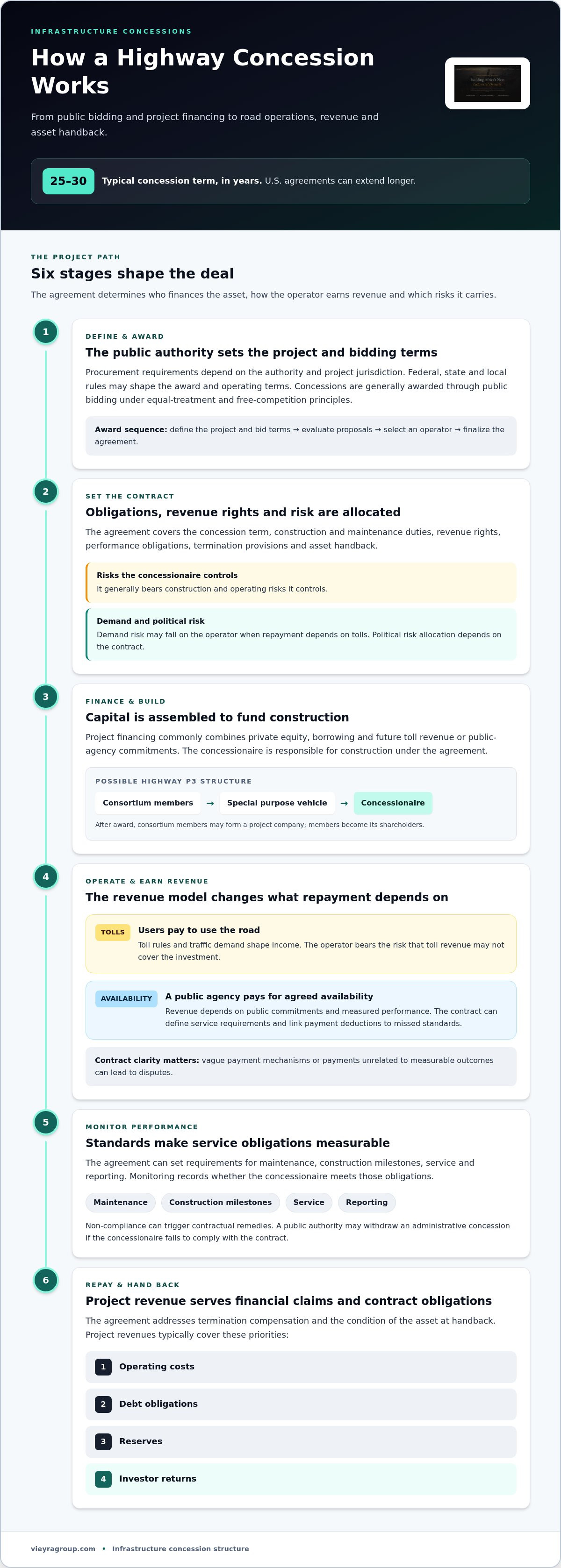
The defining feature of an infrastructure concession is not simply who builds the asset, but who finances it and carries the risk of earning that investment back. A concession agreement for infrastructure projects is a long-term arrangement in which a public authority grants a private operator the right to build or manage infrastructure and sets the obligations, revenue model, and risk allocation that govern the relationship. Infrastructure concessions typically run for 25-30 years.
A concession agreement for infrastructure projects is more than a public contract with an extended term. The key distinction is how the operator earns revenue: generally through the right to use or operate the asset, rather than payment solely for delivering specified works.
This article explains how construction, tolls, and public-agency payments shape an infrastructure project’s financial structure. It compares concessions with public contracts and outlines how project revenues typically cover operating costs, debt obligations, reserves, and investor returns.
Key Takeaways
- Assess how construction, operation, maintenance, and toll collection are assigned to the concessionaire, and how those obligations shape project risk.
- Distinguish user-funded toll revenue from availability payments, which depend on public-agency commitments and defined performance measures.
- Compare a concession with a public contract by examining who finances the work, how the operator is remunerated, and who bears investment risk.
- Trace project revenue through operating costs, debt service, reserves, and investor returns to understand which claims take priority.
Highway concession construction, management, and tolls
A highway concession assigns construction or management responsibilities to a private operator under a public agreement. Infrastructure concessions typically have a term of 25-30 years, while U.S. agreements can extend longer.
Applicable Laws and Regulations
In the United States, applicable procurement legislation and the concession agreement govern how a public authority awards and administers a highway concession. The rules depend on the authority and project jurisdiction, so federal, state, and local requirements may shape procurement and operating terms. The agreement must align the award process, construction duties, and highway operations with the requirements that apply to the project.
Performance Standards and Penalties
Performance standards specify the required condition and operation of the highway, while monitoring records whether the concessionaire meets its obligations. The agreement can set measurable requirements for maintenance, construction milestones, service, and reporting, and connect non-compliance to remedies. A public authority may withdraw an administrative concession if the concessionaire fails to comply with the contract. Clear measures support accountability throughout the operating term.
Agreement Terms and Award Negotiation
Key terms include the concession term, construction and maintenance duties, revenue rights, risk allocation, performance obligations, termination provisions, and asset handback. Concessions are generally awarded through public bidding under equal-treatment and free-competition principles. The authority defines the project and bidding terms, evaluates proposals, selects an operator, and finalizes the agreement. The concessionaire generally bears the construction and operating risks it controls. Demand risk may also fall on it when repayment depends on tolls, while political risk allocation depends on the contract. The agreement addresses termination compensation and asset handback condition.
Fees, Tolls, and User Charges
The agreement determines whether the operator may collect tolls and how user charges are set or adjusted. In a toll-funded highway concession, the operator earns revenue from road users and bears the risk that income may not cover the investment. The public authority and bidders account for project financing and obligations when establishing the contractual revenue arrangement. Traffic demand affects repayment capacity, while charge rules shape project income and users’ costs over the concession term.
Toll-funded and availability-payment concessions
Revenue design determines how a concession funds construction and repays capital. The agreement typically relies on tolls paid by users or commitments from a public agency.
Toll-Funded Concessions
A toll-funded concession uses charges paid by road users as a principal source of project revenue. This places traffic demand and the contractual toll rules at the centre of the financing model. In Spain, toll rates were reported as the lowest among European countries at 12.8% in 2021. Many Spanish motorway concessions reached their stipulated deadlines beginning in 2018, leading to toll abolition on many roads.
Availability-Payment Concessions
An availability-payment concession pays the operator through public-agency payments tied to making an asset available under agreed conditions. Rather than relying mainly on tolls, revenue depends on public commitments and measured performance. For example, the contract can define service requirements and link payment deductions to missed standards. Clear measures matter: vague mechanisms or payments unrelated to measurable outcomes can lead to disputes.
BOT Toll Projects
A build-operate-transfer, or BOT, toll project gives a private concessionaire responsibility for constructing an asset, operating it, and transferring it under the agreement’s terms. Toll revenue can support construction financing and repayment during operation, making traffic assumptions central to the project’s financial structure. India’s Model Concession Agreement for a BOT (Toll) Project is dated 26.05.2023, providing a sector-specific contractual model.
Concession Structure and Financing
Project financing commonly combines private equity, borrowing, and future toll revenue or public-agency commitments. In highway P3 projects, consortium members may form a special purpose vehicle after award; that project company becomes the concessionaire, and members become its shareholders. Lenders assess the revenue commitments and contractual protections against repayment obligations. These elements help investors evaluate long-term capital allocation across infrastructure projects.
Concessions compared with public contracts
The central distinction is how the private party earns revenue and carries investment risk. Under a concession, remuneration mainly comes from permission to manage and use a public work or service, while the operator bears the risk of possible investment losses. A public contract generally pays for specified works or services rather than granting operating rights. For a highway project, this difference determines who depends on traffic revenue.
Financing also shapes the arrangement. Concessionaires usually finance at least part of their projects, using private capital that must be repaid from future revenue. In a conventional public contract, the authority pays for contracted delivery, while financing the broader asset remains primarily a public responsibility. The precise division depends on the contract, so focus on the payment source, operating rights, and allocation of losses.
Risk transfer is more than a label. A concession agreement allocates risk, defines performance obligations, and governs financial exposure across the project. When the operator’s return relies on user charges, for example, lower-than-expected demand can reduce the revenue available to recover investment. The public authority may retain other obligations or provide support, so the specific allocation in the agreement matters more than the project’s general classification.
Private financing can also carry a higher return requirement than tax-exempt municipal bond investment. That difference can affect the public project’s overall financing structure, even where private capital provides upfront funding. Transaction costs are another consideration: P3 financing may be inappropriate for smaller infrastructure projects when the cost and complexity of structuring the arrangement outweigh its value.
To compare proposals, examine these contractual features:
- Remuneration: identify whether payment comes mainly from public funds, user revenue, or both.
- Financing: determine which party funds construction and bears repayment obligations.
- Risk: trace demand, operating, and investment exposure to the party assigned responsibility.
- Accountability: compare performance obligations and remedies across the project term.
A public contract purchases defined delivery; a concession links delivery to operating rights, revenue, and risk. That distinction helps determine whether an arrangement fits the project’s financing and governance needs.
Cash flow waterfall priorities
A concession’s cash-flow waterfall determines the order in which project revenue meets obligations. For an infrastructure project, this sequence prioritizes essential operations and debt repayment before residual value is distributed to investors or the public sector. It also clarifies lenders’ and equity holders’ positions if revenue falls short.
The agreement typically directs incoming revenue through a contractual order such as:
- Operating costs and taxes: fund essential project operations and required tax payments.
- Operations, maintenance, and rehabilitation: preserve service and address asset renewal or reconstruction needs.
- Senior debt: meet scheduled payments to lenders with the highest repayment priority.
- Subordinate debt: repay lower-priority borrowing after senior obligations.
- Reserves: set aside funds for specified future obligations and contingencies.
- Equity and public sharing: distribute remaining cash to investors or share surplus with the public sector under agreed provisions.
This order affects every party’s exposure. If toll income declines, operating requirements and senior debt still rank ahead of equity distributions. Gross revenue is therefore not the same as investor return: actual distributions depend on the contractual sequence and the cash remaining after prior claims. A public authority’s revenue-sharing provision may also apply only after specified project costs, debt, and reserves are funded.
For lenders, the waterfall clarifies how revenue supports repayment and which claims take precedence. For public authorities, it shows whether maintenance and rehabilitation are funded before surplus sharing. For investors, it defines when residual cash may flow to equity. Reviewing each tier helps establish whether obligations are measurable, reserve funding is defined, and the agreement addresses revenue shortfalls.
Assessing infrastructure investment priorities alongside this sequence can help clarify how project cash flows support long-term capital commitments.
Vieyra Family Office: Global Investment Management
Vieyra Family Office brings a long-term capital perspective to infrastructure investment decisions. Its global investment management spans asset classes, while its African Industrialization Platform supports industrial parks, energy and telecom infrastructure, and refining and recycling capacity. The Office also offers structured finance solutions, sovereign infrastructure financing, and strategic capital deployment.
For investors assessing a concession, this perspective can help frame project exposure within wider investment objectives and economic development priorities. It complements, rather than replaces, analysis of revenue sources, risk allocation, debt obligations, and public responsibilities.
To discuss investment priorities, contact Vieyra Family Office or visit vieyragroup.com.
Shape the Next Investment Decision
The next step is to assess whether a proposed concession aligns with the project’s long-term purpose, capital structure, and development priorities. A concession agreement for infrastructure projects is not only a contractual framework; it is also part of a broader decision about how capital can support durable economic capacity and public value.
Vieyra Family Office offers global investment management, African industrialization capital, and strategic capital solutions. Its work spans investment management, industrial development, and capital deployment for long-term project considerations. The right focus depends on the investment objectives and the role the project is intended to play. Institutional matters are Access by Invitation.
To discuss how these priorities relate to your investment perspective, contact Vieyra Family Office. A considered approach can help bring contractual discipline and long-term ambition into alignment.
Frequently Asked Questions
What is a concession?
A concession is a long-term agreement in which a public body grants a private operator rights to manage or use public infrastructure or services. Depending on the project, it may cover an existing asset, a new asset, or both. For example, a highway concession can authorize the operator to build and operate a road while assigning investment and revenue risks under the contract.
What’s the difference between a concession and a public contract?
A concession generally remunerates the operator through rights to manage or use a public work or service, with possible investment losses borne by the operator. A public contract typically pays for specified works or services. For a proposed project, compare what the authority is purchasing with the operator’s revenue rights and financial exposure. The substance of the contract matters more than its label.
What is a concession agreement for an infrastructure project?
A concession agreement for an infrastructure project is a binding arrangement that grants an operator defined rights and sets obligations across the asset’s development or operation. It can establish rules for changes in law, lender step-in rights, termination compensation, and environmental responsibilities. These clauses determine how the project responds to disruption, protects continuity, and handles obligations beyond routine construction and service delivery.
How do public-private partnership concessions compare with traditional public procurement?
A public-private partnership concession can combine private financing with design, construction, operations, maintenance, and revenue collection under one long-term arrangement. Traditional public procurement more commonly contracts for defined works or services, with the authority retaining greater responsibility for financing and coordinating the asset’s stages. The distinction affects how project responsibilities connect, how revenue supports investment, and whether the arrangement’s complexity is proportionate to the project.
How do concession agreements handle termination, compensation, and asset handback?
The agreement sets termination provisions, including any termination compensation and the required asset handback condition. A public authority may withdraw an administrative concession if the operator fails to comply with the contract.
What are recent U.S. infrastructure concession projects and their contract terms?
Gulftainer agreed to a 35-year concession to upgrade and operate Port Canaveral’s cargo terminal.


