

The most protective currency position can be the wrong long-term position. Currency hedging for long-term projects is a risk-allocation decision, not an automatic safeguard: hedge when greater certainty in home-currency outcomes matters more than retaining potential gains from favorable currency movements. For international portfolios held over several years, complete hedging can increase return variance, while hedging may reduce it over shorter horizons.
It is reasonable to seek protection from exchange-rate movements that could affect a project’s value or cash flows. But a hedge can also limit gains if currencies move in your favour. The key question is not simply whether currencies may fluctuate, but how that exposure interacts with the project’s duration, portfolio diversification and tolerance for uncertainty.
This article offers a practical framework for weighing those factors. It explains how partial and full hedging affect currency exposure and what historical results can, and cannot, tell you about future decisions. The aim is to support a measured choice that fits the project’s financial structure, not to predict exchange rates.
Key Takeaways
- Match the hedge to the project’s time horizon and tolerance for currency risk; full coverage is not automatically the most suitable long-term position.
- Consider how exposure across several currencies may offset some exchange-rate movements before deciding how much to hedge.
- Use historical hedged and unhedged results to understand possible differences in returns and volatility, not as a forecast of future performance.
- Assess the project’s cash flows, currency exposures and investment objectives together to establish a deliberate hedging approach.
Choosing whether to hedge based on time horizon and diversification
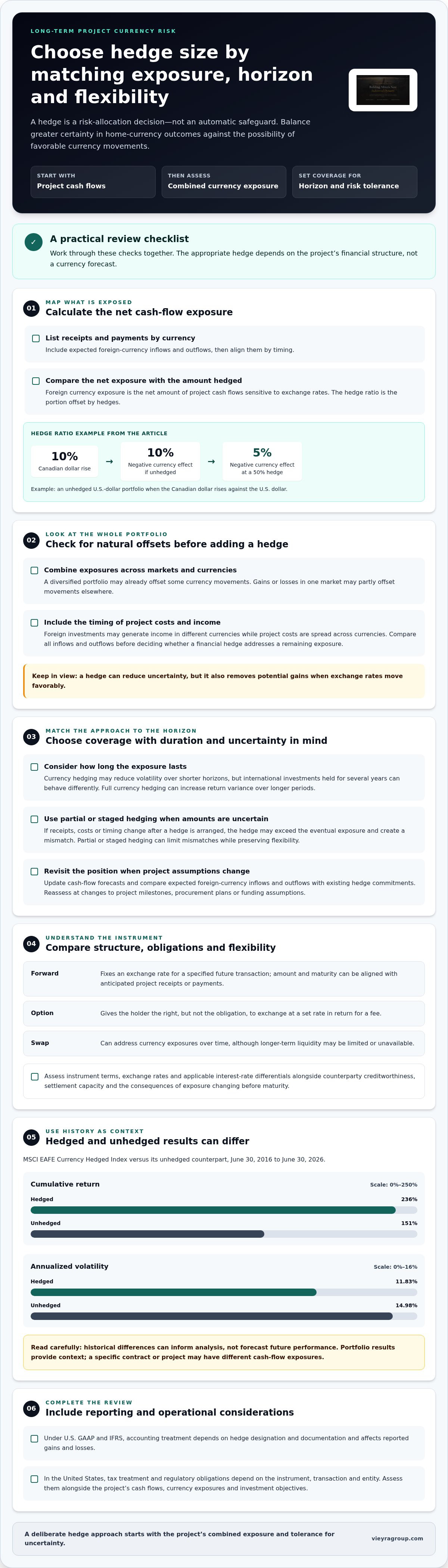
For currency hedging for long-term projects, hedge size should reflect cash-flow timing, currency exposure and tolerance for exchange-rate risk. A diversified portfolio may already offset some currency movements, so assess the combined exposure rather than looking at each market position in isolation.
Hedged and Unhedged Performance
Hedged performance removes some currency effects; unhedged performance retains both potential losses and gains. That distinction matters because long-term outcomes can differ from shorter-term results. From June 30, 2016, to June 30, 2026, the MSCI EAFE Currency Hedged Index returned 236% cumulatively, against 151% for its unhedged counterpart. Annualized volatility was 11.83% hedged and 14.98% unhedged. Historical differences inform analysis, not forecasts. Under U.S. GAAP and IFRS, accounting treatment depends on hedge designation and documentation, affecting reported gains and losses.
Foreign Currency Exposure and Hedge Ratios
Foreign currency exposure is the net amount of project cash flows sensitive to exchange rates; the hedge ratio is the portion offset by hedges. Calculate expected foreign-currency receipts and payments, align them by timing, then compare the net exposure with the amount hedged. This ratio matters because a partial hedge preserves some currency participation. If the Canadian dollar rises 10% against the U.S. dollar, an unhedged U.S.-dollar portfolio faces a 10% negative currency effect; a 50%-hedged portfolio faces 5%.
In the United States, tax treatment and regulatory obligations depend on the instrument, transaction and entity. Assess these alongside counterparty creditworthiness, settlement capacity and the consequences of exposure changing before maturity.
Forecast Uncertainty and Changing Cash Flows
Forecast uncertainty arises when project receipts, costs or timing change after a hedge is arranged. If the hedge exceeds the eventual exposure, the project may face a mismatch. Regularly update cash-flow forecasts and compare expected foreign-currency inflows and outflows with existing hedge commitments. When amounts remain uncertain, staged or partial hedging can limit mismatches while preserving flexibility. Reassess the position when project milestones, procurement plans or funding assumptions change.
Currency Hedging: how has it worked and how might it work going forward?
Hedging can affect both currency-driven returns and portfolio volatility, but the impact depends on the investment horizon and exposure. For multi-year projects, the choice of instrument, cash-flow certainty and diversification all matter.
Currency Hedging and Portfolio Volatility
Currency hedging offsets selected exchange-rate movements, but can either reduce or increase overall volatility. International investments held for several years may behave differently from short-horizon portfolios: full currency hedging can increase return variance over longer periods. For long-run portfolios, low hedge ratios that minimize return variance have no perceptible impact on it. A hedge also removes potential gains when exchange rates move favourably.
Natural Hedging Through Diversification
A natural hedge occurs when exposures to several currencies interact within a diversified portfolio. Gains or losses in one market may partly offset movements elsewhere, reducing the need for a separate financial hedge. For example, foreign investments may generate income in different currencies while project costs are spread across currencies. Compare all inflows and outflows, including their timing, before deciding whether an additional hedge addresses a remaining exposure.
Long-Term Hedging Instruments and Costs
Forwards, swaps and options manage currency risk through different contractual structures. A forward fixes an exchange rate for a specified future transaction. An option gives the holder the right, but not the obligation, to exchange at a set rate in return for a fee. Swaps can address currency exposures over time, although longer-term liquidity may be limited or unavailable. Costs depend on instrument terms, exchange rates and applicable interest-rate differentials. Forecasts can inform decisions but cannot establish future costs.
Forward Contracts for Long-Term Exposure
A forward contract sets an exchange rate for exchanging a fixed currency amount on a future date. Companies can align the amount and maturity with anticipated project receipts or payments, then review their exposure as cash-flow forecasts change. Forwards may reduce uncertainty about contracted amounts, but project changes can create mismatches. Currency swaps, forwards and options differ in flexibility, obligations and exposure to changing project plans.
For a long-horizon investment perspective, integrated investment analysis can help place currency exposure alongside broader portfolio objectives.
How currency fluctuations affect international equity returns
An international equity return measured in U.S. dollars reflects both local-market performance and currency movements. If a foreign currency strengthens against the dollar, it can raise the translated value of a holding; depreciation can reduce it, even when the local share price rises. A specific contract or project may have different cash-flow exposures, so portfolio returns provide context, not a direct forecast.
Time horizon changes how currency effects appear in results. A one-year comparison can be sensitive to the exchange rate at the period’s endpoints, while repeated periods show how equity and currency movements interact over time. A comparison of rolling one-year S&P 500 returns, calculated monthly, examined Canadian-dollar and U.S.-dollar results as of February 28, 2022. Such windows help reveal variation across periods, rather than relying on one starting and ending date.
Correlation matters because currency and local equity returns may reinforce or offset one another. In the framework described, the currency-correlation breakeven level was around -0.28 over the decade ending June 30, 2026. This level illustrates that the effect of foreign exposure depends partly on the relationship between currency movement and local investment returns, not only on currency direction. A hedge decision therefore benefits from considering both sources of return together.
Long-term spot-return history also challenges simple assumptions about persistent currency gains or losses. Since the euro’s inception on January 1, 1999, its spot return versus the U.S. dollar was -3.2% through June 30, 2026, equivalent to an annual spot return of -11 basis points. Since 1967, the U.S. Dollar Index’s spot return was around -1 basis point per annum over nearly six decades. The MSCI EAFE Currency Index spot return depreciated around 3% from June 30, 2016, to June 30, 2026. These records describe past intervals, not future movements.
Currency-hedging decision framework
No single strategy suits every long-term project. Match hedge coverage to the project’s currency exposure, cash-flow certainty, investment horizon and tolerance for exchange-rate movements. Partial hedging, staged coverage or remaining unhedged may each suit different exposures.
Start by mapping the project’s currencies, expected receipts and payments, and their timing. Separate contracted cash flows from forecasts that may change, then identify which exchange-rate movements could materially affect project viability. A foreign-currency payment due under a signed contract, for example, differs from projected revenue that depends on future market demand. That distinction helps determine which amounts merit greater protection.
Next, consider how much uncertainty the project can absorb. A forward can lock an exchange rate for a defined amount and date, supporting more predictable cash flows. But coverage should match the exposure: if costs or delivery schedules shift, the hedge may no longer match the underlying transaction. Staged hedging can align commitments with project milestones, while partial coverage preserves some currency exposure.
Then assess the wider portfolio. Existing assets, income and liabilities across currencies may naturally offset part of the project’s exposure. Review these relationships alongside the project’s duration: full hedging can increase return variance for international portfolios held over several years. Avoid basing a long-term decision on a forecast that a currency will strengthen or weaken. Instead, test how different currency movements could affect cash flows and financing capacity.
Finally, establish review points tied to meaningful changes, such as revised budgets, procurement commitments or milestone delays. Record the exposure, chosen hedge proportion and rationale, then compare them with updated forecasts. This creates a decision framework that can adapt without turning every market movement into a reason to trade. For projects requiring coordinated capital planning, explore Strategic Capital Solutions as part of the wider financial approach.
Vieyra Family Office: Global Investment Management
Vieyra Family Office provides Global Investment Management for investors considering currency exposure within a wider portfolio. For a long-term project involving international assets, cash flows or financing, the assessment should go beyond an individual exchange-rate position to include how that exposure relates to investment objectives and broader portfolio construction.
Vieyra Family Office’s focus on African industrialisation and long-term growth projects connects investment considerations with development capital requirements. Its Strategic Capital Solutions can bring a project’s funding structure and strategic objectives into the same assessment. This is a natural point to consider currency risk as part of the wider strategy, rather than treating hedging as an isolated decision or assuming one approach suits every project.
To explore Vieyra Family Office’s investment perspective, contact the office or visit vieyragroup.com.
Give Currency Risk a Continuing Mandate
A currency policy should evolve with the project it serves. As investment priorities, financing arrangements and operating assumptions change, the framework remains useful when it makes responsibilities, review triggers and acceptable exposure explicit. This makes currency hedging for long-term projects part of financial governance, rather than a one-time response to exchange-rate movements.
The next step is to connect the policy with the project’s wider capital strategy. Consider how currency exposure affects funding resilience, investment objectives and the capacity to sustain development through changing market conditions. A deliberate review helps decision-makers distinguish changes that warrant action from market noise, while preserving a clear rationale for the chosen position.
For a considered discussion of your investment and capital priorities, contact Vieyra Family Office. A well-governed approach can support confident, enduring decisions as the project advances.
Frequently Asked Questions
What is hedging?
Hedging is a financial position intended to offset a potential loss elsewhere. For example, an organization expecting to pay a supplier in a foreign currency may arrange an opposing currency transaction, reducing uncertainty about the amount due in its home currency. A hedge does not remove every business risk: it addresses a defined exposure, while operating costs, demand changes and project delays remain separate considerations.
What is the optimal level of currency hedging?
There is no universally optimal hedge ratio. The appropriate level depends on the exposure and the consequences of adverse currency movements. A project earning and spending in the same foreign currency, for example, may have less net exposure than one with foreign-currency costs but domestic-currency revenue. Compare net obligations, timing and effects on financing capacity, then set coverage in line with the organization’s risk tolerance.
What is currency hedging for long-term projects?
Currency hedging for long-term projects means using financial positions to manage how exchange-rate changes affect project investments, funding or future cash flows over an extended period. Unlike a hedge for a single transaction, a project-wide approach must account for exposures that emerge during construction, procurement and operations. A practical policy distinguishes committed payments from later estimates and revisits coverage as the project’s financial structure develops.
What steps should a company follow to create a long-term foreign exchange hedging policy?
Establish the policy in sequence: assign decision-making responsibility, identify currencies and exposure categories, define eligible transactions, and set permissible instruments and coverage limits. Specify how forecasts are documented, who approves exceptions and how open positions are reported. Then set review triggers, such as revised budgets or changed project milestones, so the policy stays aligned with actual obligations rather than outdated assumptions.


