

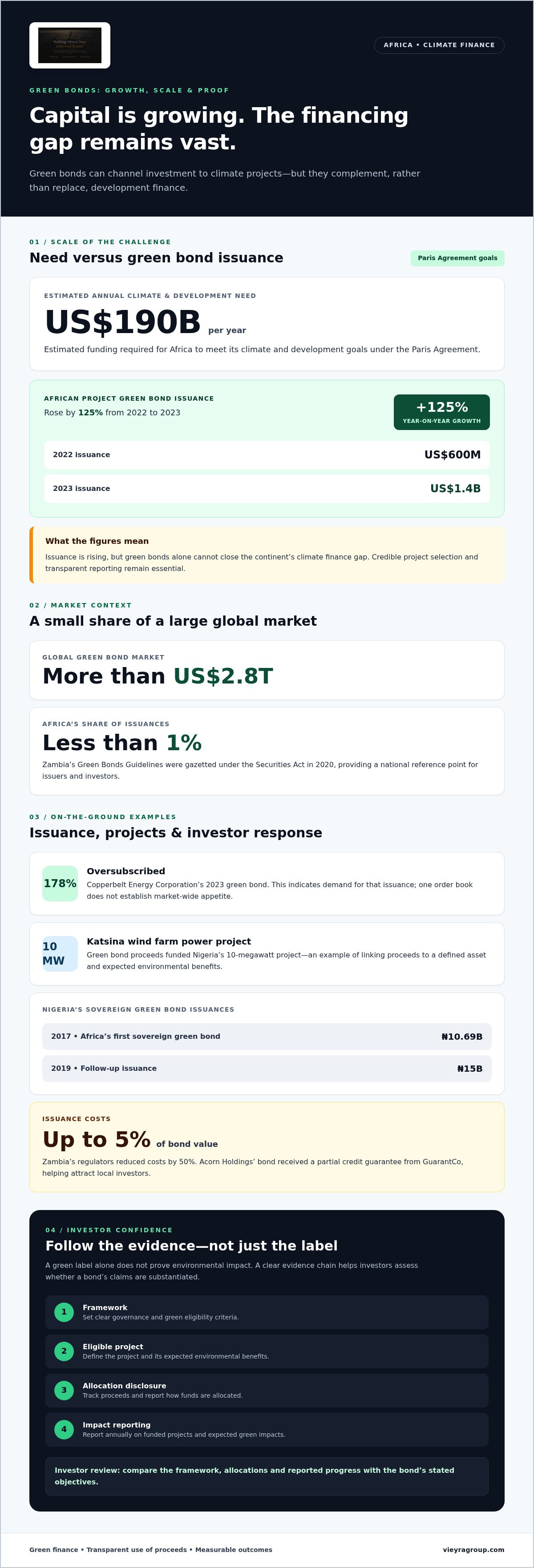
Green bonds can help finance African climate projects, but they cannot close the climate finance gap on their own. Issuance of green bonds for African projects in Africa rose by 125%, from US$600 million in 2022 to US$1.4 billion in 2023, while the continent needs an estimated US$190 billion annually to meet its climate and development goals under the Paris Agreement. The scale of the gap makes credible project selection and transparent reporting as consequential as the capital raised.
That opportunity raises a central investor concern: will the proceeds deliver measurable environmental benefits, or simply carry a green label? To build lasting confidence in green bonds for African projects, investors need clear eligibility criteria, credible oversight, and ongoing disclosure of how funds are used and what outcomes projects are expected to achieve.
This article explores how green bonds for African projects can contribute to climate finance in Africa, what can strengthen investor confidence, and how guidelines and reporting can help address greenwashing risks. It also considers market growth and the practical conditions that determine whether a bond can support durable, locally relevant projects.
Key Takeaways
- Map eligible projects to a clear green bond framework, with transparent governance and a defined pipeline, before seeking investment.
- Use credible guidelines and regular reporting on proceeds and expected environmental impacts to help investors assess whether a bond’s green claims are substantiated.
- Assess how credit support and locally relevant project design can influence investor appetite; Copperbelt Energy Corporation’s 2023 green bond was oversubscribed by 178%.
- Distinguish a green label from evidence of impact by following funds from allocation through delivery and examining the outcomes disclosed over time.
Easing Africa's climate crisis: Can green bonds help close the climate finance gap?
Green bonds can channel capital to climate projects, but they complement rather than replace development finance. Unlike conventional loans, a green bond earmarks its proceeds for eligible projects; a sustainability-linked bond ties financing terms to the issuer’s performance against targets. Development finance can provide funding or risk support, while bond issuance mobilises investor capital.
The scale of the challenge remains substantial: Africa needs an estimated USD 190 billion annually to meet climate and development goals under the Paris Agreement. Issuance grew by 125%, from US$600 million in 2022 to US$1.4 billion in 2023. Governance can help build a credible pipeline: establish a green framework, define eligible projects, track proceeds, and report allocations and expected impacts.
Nigeria issued Africa’s first sovereign green bond in 2017, valued at ₦10.69 billion, and followed with a ₦15 billion issuance in 2019. Other examples include Cape Town’s water-resilience bond and Acorn Holdings’ 2019 bond for certified student housing in Nairobi.
Issuance costs can reach five percent of bond value, while Zambia’s regulators reduced costs by 50%. Acorn’s bond also received a partial credit guarantee from GuarantCo, helping attract local investors. These examples show how issuance design and credit support can influence project financing.
Currency is another key structuring consideration. Nigeria’s sovereign bond values were reported in naira, while other African issuances were reported in US dollars. Issuers need to consider the currency of the proceeds alongside project funding needs and repayment capacity.
Documented institutional participants include the African Development Bank, which issued a green bond, and the European Investment Bank and African Export-Import Bank, which made business financing available, with a quarter earmarked for climate mitigation and adaptation. Cape Town’s bond was listed on the Johannesburg Stock Exchange.
For US investors, the bond’s listing and offering documents are the starting points for understanding its terms and access. Tax treatment depends on the instrument, income, and investor circumstances, so assess these under applicable US tax rules.
Green bond guidelines and greenwashing risks
A green bond raises debt for projects with environmental benefits and directs its proceeds to defined uses, such as renewable energy or water infrastructure. In Africa, this financing can support public or corporate projects, while investors receive bond payments under the instrument’s terms. The label alone does not prove impact: project eligibility and transparent use of proceeds matter.
The global green bond market has grown to more than US$2.8 trillion, while Africa accounts for less than one percent of issuances. This contrast makes credible frameworks important for a market seeking to attract investment. Zambia’s Green Bonds Guidelines were gazetted under the Securities Act in 2020, providing a national reference point for issuers and investors.
Guidelines can help address greenwashing by linking a bond’s environmental claims to specific projects, allocation records, and expected outcomes. Issuers can strengthen accountability by reporting annually on funded projects and their expected green impacts. Investors can then compare stated objectives with reported allocations and progress, rather than relying on the bond’s name or marketing.
Nigeria offers a practical project example: proceeds from green bonds funded the 10-megawatt Katsina wind farm power project. For a project like this, clear documentation should identify how proceeds relate to the asset and what environmental benefits are expected. The World Bank assesses all IBRD projects for climate co-benefits when identifying projects eligible for its Green Bond funding, illustrating how structured assessment can inform selection.
For investors, the key review is a chain of evidence: framework, eligible project, allocation disclosure, and impact reporting. A break in that chain can leave environmental claims difficult to assess. Those evaluating long-horizon African investments can also consider a strategic investment perspective alongside bond-specific disclosures.
Investor confidence and market appetite
Copperbelt Energy Corporation’s 2023 green bond was oversubscribed by 178%. That indicates substantial demand for this issuance, but one order book cannot establish market-wide appetite. Investors also assess issuer credit, project execution, and bond terms before committing capital to green bonds for African projects.
When assessing demand, distinguish interest in a bond’s environmental purpose from confidence in repayment. Review the issuer’s financial position, project readiness, planned use of proceeds, and currency of obligations. Investor awareness matters, too: clear explanations show how financing supports sustainable development and how environmental objectives relate to the funded assets.
Institutional investors can assess each bond against their investment mandates, portfolio risk limits, and sustainability objectives. Pension funds and insurers, for example, may weigh duration and credit exposure alongside environmental outcomes. Issuers can make this assessment more practical by presenting the framework, financing structure, project pipeline, and performance measures consistently.
Impact reporting gives investors evidence to compare stated aims with capital deployment. As of March 2025, 95.44% of proceeds from Nigeria’s 2019 green bond had been deployed to approved green projects. That allocation figure shows how much funding reached eligible projects, but does not establish the environmental results achieved.
Investors should therefore examine two distinct records: where proceeds went and what environmental benefits followed. Review the project baseline, intended outcomes, implementation progress, and explanations of material changes. For institutional portfolios, comparable reporting can support oversight across issuers. For issuers, accessible disclosures can build understanding of how green bonds for African projects connect capital to measurable objectives, helping investors distinguish project evidence from broad sustainability claims.
Greenwashing risks
A green label does not prove that a bond delivers climate benefits. Greenwashing risk arises when an issuer’s claims exceed the projects selected, the proceeds allocated, or the outcomes reported. Compare the bond framework with actual project records instead of relying on promotional language alone.
Start with the use-of-proceeds framework. Identify which activities qualify, how projects are selected, and who oversees allocation. Then trace the proceeds from issuance through project accounts to disbursement records. A gap between stated eligibility and actual spending can undermine environmental claims, even when the financed activity appears broadly climate-related.
Next, distinguish financial allocation from environmental impact. A report may show that proceeds reached an eligible project, but that does not establish the project’s results. Review its baseline, expected climate benefits, measurement method, and progress against stated objectives. If a project changes scope, reporting should explain how the change affects its original environmental rationale.
Annual reporting on funded projects and expected green impacts gives investors a way to evaluate performance and identify unsupported claims. A practical review asks whether the issuer names funded assets, reports allocated proceeds, explains unallocated balances, and describes expected outcomes. Consistent answers make disclosures easier to compare across bonds and over time.
For an African project, assess the full evidence chain: eligibility criteria, selection decisions, allocation records, and impact disclosures. Treat missing links as a due-diligence issue, not as proof of environmental performance. This distinction protects investors from confusing a financing label with verified progress, while encouraging issuers to make claims specific, measurable, and traceable. To consider capital approaches for African development, assess strategic investment options alongside project-level disclosures.
Vieyra Family Office: Global Investment Management
Vieyra Family Office manages global investments and deploys strategic capital to support African industrialization and long-term development. Its work is relevant when the question extends beyond a bond’s environmental label to the wider investment context, including industrial growth, project development, and economic value over time.
Through Strategic Capital Solutions, Vieyra Family Office supports long-term growth projects and economic development. This provides a point of engagement for those assessing how African investment opportunities align with durable development priorities. Green bonds remain one financing instrument among others, and project-level diligence remains central to evaluating their role.
For a discussion of investment aligned with African industrialization and long-term growth, contact Vieyra Family Office.
Turn climate ambition into long-term investment
Treat climate finance as part of a broader development strategy. For project sponsors and investors, this means identifying projects with lasting economic relevance, disciplined capital planning, and environmental objectives that can be explained transparently. Green bonds for African projects can contribute when the financing structure meets project needs and progress remains open to scrutiny.
Where an opportunity extends beyond a single bond, Vieyra Family Office provides global investment management, African industrialization capital, and strategic capital solutions. These offerings support engagement with investment questions connected to African growth and long-term development, while project-level assessment remains essential to sound decisions.
To discuss how capital can align with African industrial development, contact Vieyra Family Office. Thoughtful investment decisions can help advance climate priorities alongside a more resilient foundation for growth.
Frequently Asked Questions
What is a green bond?
A green bond is debt issued to finance projects with defined environmental purposes. Investors provide capital by purchasing the bond, and the issuer repays them under its terms. Its distinguishing feature is the intended use of proceeds, which may support assets such as renewable energy, cleaner transport, water infrastructure, or conservation. The environmental label does not demonstrate project performance.
Which African countries and projects have issued green bonds?
Examples span several countries and project types. The Seychelles Government issued a bond for marine and fisheries projects in 2018, while Morocco’s sustainable energy agency issued a renewable energy bond in 2020. Johannesburg Municipality’s 2014 issuance supported energy and transportation. The African Development Bank also issued a bond in 2013 supporting areas including clean transport, water, and solid waste management.
How much funding have African green bonds raised, and what are recent market trends?
A single total depends on which issuers, currencies, and reporting periods are counted. As a broader market indicator, green bonds worth US$522 billion were issued globally in 2024. The trend for African issuers is to use the instrument across sovereign, municipal, corporate, and development-finance projects. Project purpose and issuer type therefore shape the market’s development alongside overall issuance volume.
What are the costs, yields, and minimum investment amounts for African green bonds?
Issuance expenses in Africa can reach five percent of a bond’s total value. Yield and minimum investment amounts are set by the specific issue, not by the green label alone. Credit quality, currency, maturity, denomination, and distribution arrangements shape the terms investors encounter. Compare the offering documents for the yield basis, purchase denomination, repayment structure, and any stated issuance expenses.
Which African green bond standards, regulations, and taxonomies apply?
Applicable frameworks depend on the issuer’s jurisdiction and bond structure. Zambia’s Green Bonds Guidelines were gazetted under the Securities Act in 2020. Cape Town’s issuance received Climate Bonds Initiative accreditation after independent assessment before and after issuance. These examples illustrate distinct approaches: a national guideline framework and an external certification process. Issuers should identify which framework governs their own issuance and disclosures.
How can an African company, government, or project developer issue a green bond?
Begin by building a pipeline of eligible projects and assessing each for bankability, scalability, additionality, replicability, and sustainability. Then define the selection process, document how proceeds will be tracked, and establish reporting on allocations and expected environmental impacts. A prospective issuer can assess whether credit support would strengthen investor participation, then prepare the bond structure and disclosures for the intended market.


