

Manufacturing accounts for just over 10% of GDP across Africa, while more than 60% of industrial output comes from low-value sectors. Lasting growth depends on converting investment into higher-value production, supported by research, effective regulation, regional trade and inclusive policy. This is the central challenge of investing in African industrial capacity.
Capital alone cannot build durable industrial strength. It must connect productive facilities with the knowledge, infrastructure and policy conditions that help businesses and workers create greater value. This takes a long-term view of industry development, cross-border supply chains and how growth can benefit more people.
This article examines the forces shaping that transformation, from manufacturing and research and development to regulatory frameworks, AfCFTA-enabled trade and sustainable industrial policy. It explains how these elements reinforce one another, why their alignment matters to investors and African economies, and how patient, strategic capital can support a more productive industrial base over time.
Key Takeaways
- Assess industrial investment by its capacity to build higher-value manufacturing, research and development, and productive links between sectors.
- Look beyond factory output: manufacturing-led growth can support structural transformation when it strengthens skills, productivity, and employment.
- Consider how AfCFTA and cross-border value chains can connect production across markets and expand regional industrial opportunity.
- Align capital with reliable infrastructure, local supplier development, and inclusive policy; Vieyra Family Office’s African Industrialization Capital and Strategic Capital Solutions speak to this long-term investment focus.
Investment in manufacturing, research and development, and regulation
Africa’s manufacturing landscape remains uneven. Manufacturing accounts for just over 10% of GDP across the continent, and more than 60% of industrial output comes from low-value sectors. The United Nations Industrial Development Organization identifies manufacturing value added of at least 20% of GDP as a benchmark for meaningful structural transformation. These figures point to a gap between current production and deeper industrial development.
Investment can help close that gap when it advances processing, technology and local research alongside factory capacity. The African agro-processing market is listed at $4.59 trillion, while Africa captures less than 1% of global battery production. These sectors illustrate differing opportunities: process agricultural inputs closer to production, or build capabilities that support battery supply chains. Research partnerships can adapt processes to local inputs and operating conditions.
How do labor costs, skills availability, and local-content rules vary across African markets? They vary by country, sector and location. Before choosing a site, compare wage structures, available technical skills, training needs and applicable local-content rules.
How much investment does Africa need to expand manufacturing capacity? The amount depends on the sector, production scale and existing infrastructure. Project planning should consider equipment, research, reliable power, transport and workforce development together.
What industrial parks and special economic zones are available across Africa? Options differ by country and project. Compare each location’s power, transport and supplier access, as well as proximity to target markets, with the proposed operation’s needs.
How can investors access financing and development-bank support for African industrial projects? Develop a financeable proposal that sets out the market, operating model, capital needs, risks and development impact. This provides a basis for discussions with development-finance institutions and other capital partners.
What are the main risks, and which investments have succeeded? Currency movements, political change and supply-chain disruption can affect project costs, revenues and continuity. Manufacturing value added reached 27% of GDP in Eswatini in 2023, compared with around 13% in South Africa and approximately 8% in Nigeria. These outcomes suggest that country context matters; they do not establish investment returns or prove one model works everywhere.
Investment needs vary with the sector, production scale and existing infrastructure. Project budgets should account for equipment, research, reliable power, transport and workforce development.
Manufacturing-led growth and structural transformation
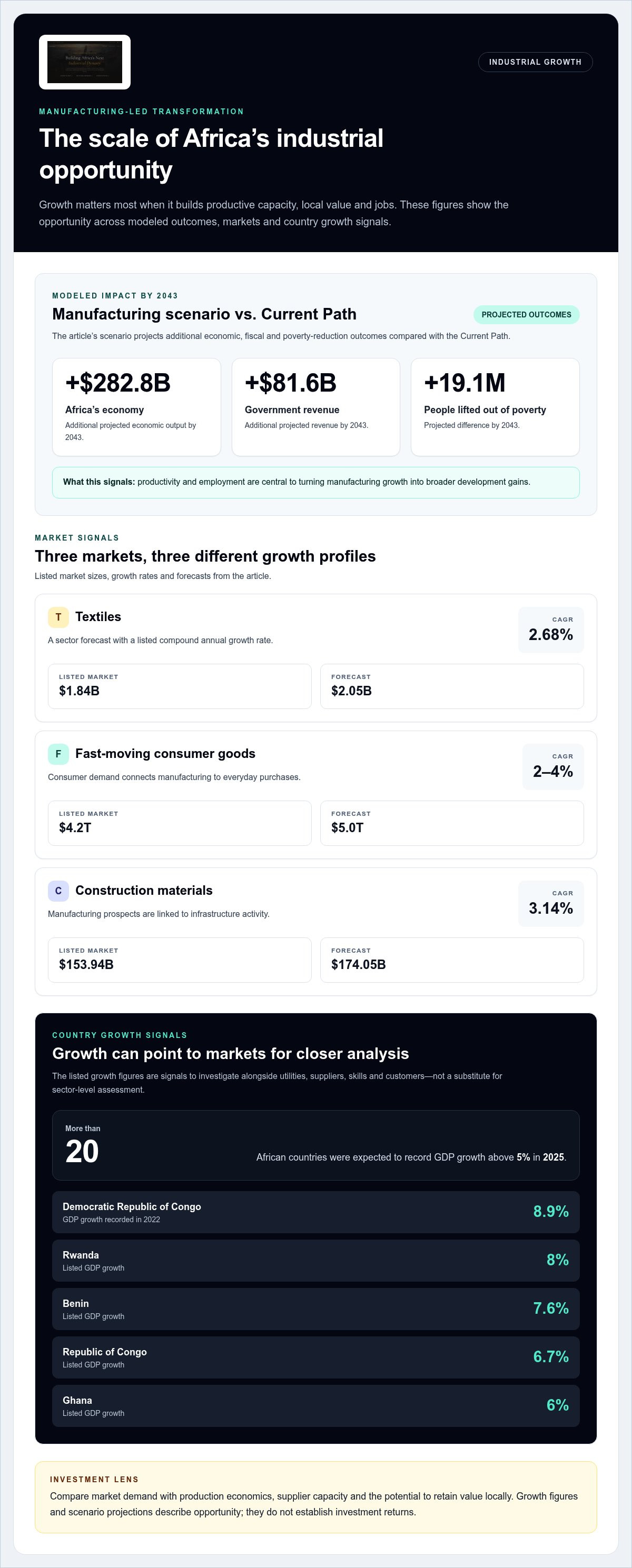
More than 20 African countries were expected to record GDP growth above 5% in 2025. Growth alone, however, does not establish structural transformation. Between 1950 and 2006, industrial productivity gains and movement out of agriculture accounted for about half of developing countries’ catch-up with advanced economies in output per worker. Production capability must deepen alongside economic expansion.
Which African countries offer the strongest opportunities for industrial investment? Ghana, the Republic of Congo, Benin and Rwanda present notable growth signals, with listed GDP growth of 6%, 6.7%, 7.6% and 8%, respectively. The Democratic Republic of Congo recorded 8.9% growth in 2022. These figures help identify markets for closer sector analysis, alongside access to utilities, suppliers, skills and customers.
Sector forecasts provide another lens. The African textiles market is listed at $1.84 billion, with a 2.68% CAGR and a forecast of $2.05 billion. The African pharmaceuticals market is one area investors can assess for potential local production and demand. Investors can assess whether local production can serve demand while building skills and supplier relationships.
Consumer and construction demand also shape industrial prospects. The African FMCG market is listed at $4.2 trillion, with a 2-4% CAGR and a forecast of $5.0 trillion. The construction materials market is listed at $153.94 billion, with a 3.14% CAGR and a forecast of $174.05 billion. These sectors connect manufacturing to everyday consumption and infrastructure activity.
Modeled outcomes illustrate how manufacturing-led growth could affect public finances and living standards. By 2043, the Manufacturing scenario projects an additional US$282.8 billion for Africa’s economy and US$81.6 billion in government revenue, compared with the Current Path. It also projects 19.1 million more people lifted out of poverty, underscoring the importance of productivity and employment.
For investment appraisal, compare market demand with production economics, supplier capacity and the potential to retain value locally. Investors examining the role of strategic industrial capital can consider how long-term financing aligns with these sector and development outcomes.
AfCFTA and cross-border industrial value chains
The African Continental Free Trade Area (AfCFTA) provides a framework for considering production across national markets. If fully implemented, it could raise Africa’s GDP by US$592 billion above the Current Path by 2043. That projection makes regional integration relevant to industrial investment, while remaining dependent on implementation.
Trade costs in Africa are roughly 50% higher than global averages. For manufacturers, these costs can shape where inputs are sourced, goods processed, and finished products sold. A project designed around one domestic market may therefore face different constraints from a value chain that coordinates production and distribution across neighbouring markets.
Agro-processing offers a practical model. Inputs can be processed near their origin, with packaging and other production stages located where suppliers, transport links and buyers make the operation viable. This can retain more economic activity around a project than exporting unprocessed inputs alone. The business case depends on reliable supply, operating costs and access to customers across borders.
To assess a cross-border production chain, map each stage, its location, required inputs and onward transport. Identify bottlenecks, compare potential suppliers and test whether each stage remains viable under different trade and logistics conditions. This helps distinguish a genuinely regional strategy from disconnected national operations.
AfCFTA’s potential is not automatic. Examine how trade arrangements are implemented in relevant markets and how practical conditions affect cross-border movement. Product standards, customs processes, transport links and border procedures can all shape timing and cost. Account for these factors during project design, before selecting facilities and suppliers.
Regional value chains also depend on coordination among governments, manufacturers, logistics operators and suppliers. A manufacturer may need inputs from one market, processing capacity in another and customers across several markets. Clear roles, dependable supply agreements and viable routes can strengthen the chain. AfCFTA provides a continental framework, but project planning determines whether an investment can translate regional access into productive activity.
Inclusive and sustainable industrial policy
Inclusive industrial policy connects investment with reliable infrastructure, supplier development and broadly shared economic opportunity. Reliable electricity access reaches 48% of Africa’s population, making power provision central to project design. Investors can assess energy requirements alongside transport access, workforce needs and local supplier readiness. These conditions influence operating continuity and the economic activity surrounding a facility.
Energy choices also shape industrial resilience. Africa added 2.4 gigawatts of solar capacity in 2024, while renewables account for nearly 15% of total installed capacity. For investors investing in African industrial capacity, project planning should match generation, reliability and industrial demand. They can examine how power infrastructure supports production schedules and whether energy access can extend to connected suppliers.
Climate impact requires proportionate analysis. Africa is responsible for less than 4% of global greenhouse gas emissions, yet industrial investment can advance development while limiting avoidable environmental pressures. Assessing production processes, energy requirements and transport needs at project level keeps sustainability tied to operating decisions.
Key priorities for linking investment to wider economic gains include project preparation, risk-sharing, reliable power and transport, supplier development, commercially viable local processing and regional corridors. A disciplined approach to investing in African industrial capacity assesses these factors together, identifying infrastructure dependencies early and testing supplier readiness and processing viability.
Inclusive outcomes require deliberate design. Map supplier needs, identify where local firms can participate, and connect workforce development to actual production requirements. These steps clarify how a project may distribute economic benefits while supporting industrial performance. For investors considering long-term projects, explore strategic industrial capital.
Vieyra Family Office: Global Investment Management
Vieyra Family Office manages global investments and focuses on African industrialisation, with strategic capital directed toward long-term growth priorities. Its African Industrialization Platform supports industrial parks, energy and telecommunications infrastructure, and refining and recycling capacity to build local capabilities and reduce external dependency. The Office’s investment focus spans infrastructure, mining and resources, energy, technology, telecommunications, real estate, AI and quantitative finance, agriculture, and logistics.
Consider this next step when a project’s ambitions extend beyond establishing production, and require strategic capital aligned with broader development objectives. A considered discussion can begin with the project’s industrial purpose, its investment needs and the outcomes it seeks to support. To discuss your priorities, contact Vieyra Family Office.
Shape the Next Chapter of Industrial Growth
Long-term industrial investment starts with a clear view of a project’s potential: stronger productive capabilities, durable commercial relationships and broader economic participation. Define its purpose, capital requirements and intended outcomes. This gives investing in African industrial capacity a practical direction beyond committing funds.
Vieyra Family Office brings together Global Investment Management, African Industrialization Capital and Strategic Capital Solutions. These offerings provide a relevant point of engagement for investors considering how capital can support African industrial development over time. A discussion can begin with the project’s priorities and its place within a long-term investment strategy.
For a considered conversation about your investment priorities, contact Vieyra Family Office. Thoughtful capital allocation can help lay the foundations for enduring industrial progress.
Frequently Asked Questions
What are Africa’s priority industrial sectors for investment?
Priority sectors include agro-processing, battery-related manufacturing, pharmaceuticals, textiles, chemicals and construction materials. The strongest fit depends on whether a project can secure inputs, technical capability and buyers while deepening domestic processing. For example, a battery-component proposal should assess material access and refining capacity, while a food-processing plan should test supply, storage and distribution. Sector selection should follow value-chain feasibility, not market size alone.
What incentives, taxes, and regulations apply to foreign industrial investors in African countries?
Incentives, tax treatment and regulatory obligations vary by country, sector and project structure. Before committing capital, assess each jurisdiction’s corporate taxation, available investment incentives, permits, ownership conditions, environmental approvals and reporting duties. Model how these apply during construction and operations. Comparable assumptions support project appraisal without treating one market’s rules as universal across the continent.
How do power costs, reliability, and infrastructure affect industrial investment in Africa?
Power and infrastructure affect operational continuity and the delivered cost of manufactured goods. Assess the plant’s load profile, connection arrangements, supply reliability, backup requirements and exposure to interruptions, then test their effects on production schedules. Map roads, ports, storage and telecommunications alongside electricity. A facility close to inputs but far from transport or dependable power has a different cost and operating profile from one connected to established infrastructure.
How do the African Continental Free Trade Area and regional trade agreements affect manufacturing investment?
The African Continental Free Trade Area and regional agreements can shape potential markets for manufactured goods and the location of production stages. For a proposed plant, map intended buyers, input origins, processing locations and routes across target countries. Examine how relevant agreements are implemented in each market, including product and border procedures. This makes regional access an explicit commercial assumption instead of treating a continental framework as automatic market access.
How much investment does Africa need to expand manufacturing capacity?
Investment needs vary with the sector, production scale and existing infrastructure. Project budgets should account for equipment, research, reliable power, transport and workforce development.
What industrial parks and special economic zones are available across Africa?
Industrial parks and special economic zones differ by country and project. Compare their locations and infrastructure, including access to power, transport, suppliers and target markets, with the proposed operation’s needs.


