
The more direct route is not automatically the more consequential one. In direct investment vs fund investment in Africa, the key distinction is whether capital goes into a specific business or project, or is pooled and allocated across investments by a fund manager. Both structures can support jobs and growth, but they differ in investor involvement, diversification, and exposure to individual outcomes.
Direct ownership gives investors a closer connection to the underlying enterprise. Funds, by contrast, provide access to a managed portfolio without requiring investors to select and oversee every holding themselves. The right comparison depends on an investor’s objectives, capacity for involvement, and approach to risk, as well as potential performance.
This article explains how each approach channels capital, influences business development and employment, and shapes performance potential in African markets. It also examines the trade-offs that matter when deciding which structure fits a long-term investment strategy.
Key Takeaways
- Compare whether you want capital tied directly to an enterprise or allocated through a managed fund, then weigh the involvement and diversification each structure brings.
- Assess how investment can strengthen businesses and infrastructure, while recognizing that its contribution to jobs and growth depends on where capital is directed.
- Use Africa’s investment patterns by country and sector to understand concentration, not as a standalone forecast of future performance.
- Evaluate return potential through the underlying assets, investment strategy and structure; historical flows alone do not establish what investors will earn.
FDI as a source of investment capital
Foreign direct investment, or FDI, places capital into an operating business or project. A direct investor may hold an ownership stake, while a fund pools investors’ capital and allocates it across investments under its strategy.
Historical figures illustrate the role of outside capital. In sub-Saharan Africa, the gap between domestic savings and investment was −1.9% of GDP during 1975-1984, and −1.0% of GDP during 1995-2002. FDI can complement domestic investment by enhancing human and physical infrastructure.
For example, a direct investment in an industrial enterprise can finance productive assets and support expansion. A fund can allocate capital across several enterprises, diversifying exposure while leaving investment selection and oversight to its manager.
Liquidity varies by structure. Direct investors may exit by selling to another investor or buyer, while a fund’s exit routes depend on its terms and underlying holdings. Private, unlisted investments generally require a negotiated transaction rather than an exchange sale.
Legal structures and foreign investment rules vary by country and sector. Before committing capital, assess the local entity, ownership rights, required approvals, and capital-transfer rules in each relevant jurisdiction.
Tax treatment depends on the country, investment vehicle, income type, and investor’s residence. Dividends, gains, and fund distributions may be treated differently, so the structure helps determine which obligations apply.
US investors must consider the rules governing the specific security and investment vehicle, alongside US tax-reporting obligations. The investment’s domicile, ownership form, and income flows shape the relevant filings and tax treatment.
Fund fees are set out in the fund documents. Management fees compensate for operating the fund, while carried interest allocates part of investment gains to the manager under agreed terms. The precise mechanics vary.
Currency exposure arises when an investment’s value or income is denominated in a currency other than the investor’s own. Exchange-rate movements and local rules on conversion or repatriation can affect realized returns.
Direct investments can face political, regulatory, and operating risks, including policy changes, licensing constraints, infrastructure limitations, and execution challenges. The impact depends on the country, sector, project, and local operating environment.
Due diligence should cover a company’s finances, ownership, contracts, and operating capacity; a fund manager’s strategy and governance; and local partners’ track records and responsibilities. These checks help investors understand how capital will be deployed and managed.
FDI performance and potential
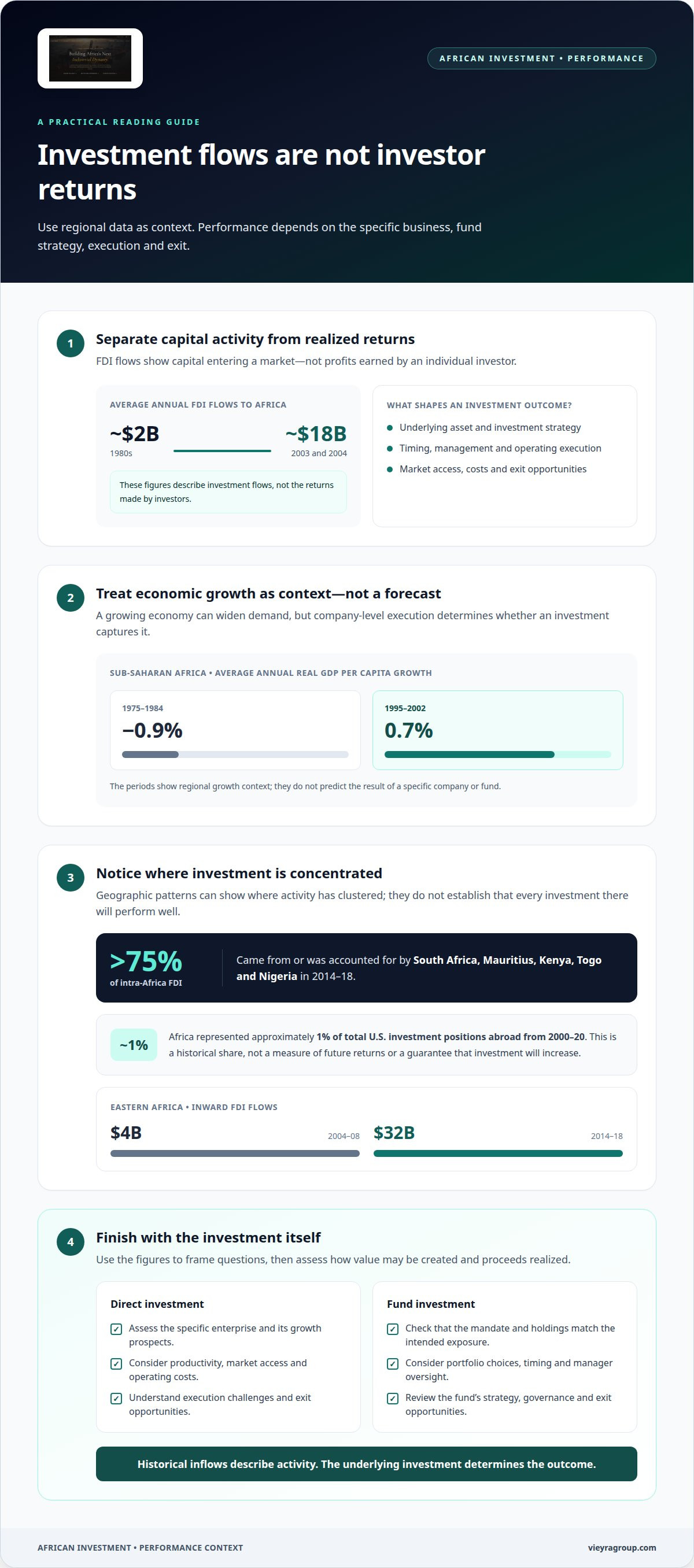
Capital flows indicate investor activity, but they are not returns. Average annual foreign direct investment flows to Africa rose from about $2 billion in the 1980s to about $18 billion in 2003 and 2004. Those figures describe capital entering the continent, not profits earned by individual investors.
Performance depends on the investment itself. A direct investor’s outcome may reflect a company’s productivity, market access, operating costs, and ability to expand. A fund’s results also depend on portfolio choices, investment timing, management, and exit opportunities. As a result, two investments in the same country can have different outcomes.
Regional growth offers context, not a forecast. Sub-Saharan Africa’s average annual real GDP per capita growth was −0.9% during 1975-1984 and 0.7% during 1995-2002. Economic growth can widen demand for goods and services, while company-level execution determines whether a particular investment captures that demand.
Geographic concentration also matters. South Africa, Mauritius, Kenya, Togo, and Nigeria accounted for more than 75 percent of intra-Africa FDI in 2014-18. This concentration may shape where investors find established activity, but it does not establish that every business or fund in those markets will perform well.
Longer-term comparisons require careful interpretation. Africa represented approximately 1 percent of total U.S. investment positions abroad from 2000-20. This indicates a limited share of those positions, not a measure of future returns or a guarantee that investment will increase.
To assess performance potential, separate capital-flow data from realized investor returns. Then examine how the investment creates value, what could constrain its operations, and how proceeds may be realized. For a fund, consider whether its mandate and holdings match the intended exposure. For a direct investment, assess the specific enterprise and its growth prospects. This is more useful than relying on continent-wide inflow totals alone.
Annual FDI inflows: 23.1% (1986-1990), 40.2% (1996-2000); outflows: 25.7%, 35.7%, respectively. Africa’s global share declined over the past three decades; Eastern inward flows rose from $4 billion in 2004-08 to $32 billion in 2014-18.
Which African countries and sectors attract the most foreign direct investment?
Investment is geographically concentrated, but different measures show distinct patterns. African inward FDI stock totaled $734.1 billion in 2014-18. The five African subregions discussed accounted for almost 80 percent of total inward FDI flows. These figures describe regional distribution, not equal investment across every country.
A country’s accumulated FDI stock does not by itself show the opportunities available to a particular investor. Stock measures accumulated investment, while annual flows capture capital entering during a particular period. Investors comparing countries should distinguish these measures, since a large stock does not by itself indicate current inflows or project-level opportunities.
Extractive industries have received a substantial share of investment. They received $197 billion, or 47 percent, of greenfield investment in Africa over the period discussed. A separate measure reports that up to 80 per cent of total foreign direct investment in Africa goes into extractive sectors. The measures differ, but both underscore the prominence of natural-resource projects.
Food and beverages provide a contrasting sector example. During 2016-20, the leading recipients of announced and opened U.S. greenfield investment in the sector were South Africa at $460 million, Egypt at $450 million, Kenya at $220 million, and Ethiopia at $210 million. These country figures show how sector-specific investment can differ from continent-wide patterns.
When comparing direct projects with funds, consider the exposure each creates. A direct investment can focus on a particular country, company, or sector, such as food processing in Kenya. A fund may invest across markets or industries, depending on its mandate. The useful question is not simply which country attracts more capital, but whether the investment’s geography and sector fit the intended strategy.
Investment concentration also matters: resource-heavy capital flows do not represent every opportunity available to businesses. Country-level totals, sector allocations, and the distinction between investment stocks and flows provide a clearer framework for evaluating where capital is directed.
What returns have African private equity and infrastructure funds delivered?
No single return figure represents every African private equity or infrastructure fund. A fund’s outcome depends on its investments, acquisition terms, operating results, holding period, and exit proceeds. Two funds investing in different companies, for example, can produce different results even in the same market.
Private equity funds generally seek to create value through ownership stakes in businesses. Performance may reflect revenue growth, operating improvements, debt levels, and the price received when an investment is sold. When assessing a fund, distinguish realized proceeds from valuations of holdings that remain in the portfolio.
Infrastructure funds have a different underlying exposure. Results may depend on project construction, operating performance, financing arrangements, and the revenue model. A completed energy asset, for example, has a different operating profile from a company still developing a project. Project progress and cash generation therefore matter alongside valuations.
Compare fund returns on consistent terms. First, identify whether the figure is gross or net of fund expenses. Then check whether it includes only completed exits or also estimates for unsold holdings. Finally, consider the fund’s investment period and currency exposure. Without these distinctions, headline comparisons can obscure how results were produced.
Separate historical performance from future potential. A prior exit can show how a manager realized value in one investment, but it cannot establish the result for another company, fund, or market. Review the fund’s strategy, portfolio composition, and exit record together rather than relying on a single reported figure.
For investors considering capital aligned with African industrial development, explore long-term African investment opportunities and assess how the investment’s objectives relate to the intended exposure. The relevant return comparison begins with the assets, the method of value creation, and the basis on which performance is reported.
Returns vary across funds. Private equity results are shaped by business performance and exit value, while infrastructure returns depend on project progress, operations, financing, and revenue generation.
Vieyra Family Office: Global Investment Management
Vieyra Family Office is relevant to investors considering how global portfolio objectives can align with long-term African development. Its Global Investment Management offering manages investments across asset classes. African Industrialization Capital and Strategic Capital Solutions address capital needs connected with broader economic development.
These offerings provide a natural point of consideration when an investor’s priorities extend beyond choosing between a direct investment and a fund. The central question becomes how capital allocation, investment objectives, and African industrial growth fit within a wider strategy. Vieyra Foundation is also part of the institution’s work.
For an investment perspective grounded in global management and African industrialization, contact Vieyra Family Office or visit vieyragroup.com.
Shape an Investment Mandate for the Long Term
The choice between direct investment and fund investment in Africa is clearer when framed around institutional fit: what level of governance, stewardship, and portfolio integration can your investment mandate sustain? Translate that mandate into clear criteria for capital deployment, oversight, and the role African exposure should play in the wider portfolio.
A sound process considers purpose as well as structure. Define what progress would mean for the investment, how decision-making authority should be exercised, and which measures will guide ongoing evaluation. A clearly articulated mandate gives investors a stronger basis for aligning financial objectives with a long-term perspective on African economic development.
For a conversation about your investment priorities and their alignment with African opportunity, connect with Vieyra Family Office. A deliberate next step can help bring greater clarity to the investment choices ahead.
Frequently Asked Questions
What is the difference between direct investment and fund investment in Africa?
Direct investment gives an investor a stake in a specific African business or project; fund investment places capital in a pooled vehicle managed across selected holdings. For example, investing in one manufacturing company creates concentrated exposure, while a fund may hold interests in several businesses. This distinction affects decision-making, diversification, and how closely the investor engages with individual assets.
What legal structures and foreign investment rules apply to investors in major African markets?
Legal structures and foreign investment rules vary by country and sector. Before committing capital, assess the local entity, ownership rights, required approvals, and capital-transfer rules in each relevant jurisdiction.


