

A project’s scale does not establish its readiness; evidence across people, governance, capital, civil works, and infrastructure does. Due diligence for large scale projects is a structured assessment of whether these elements are sufficiently aligned to support development and execution. It brings material risks, unresolved dependencies, and gaps in the project’s foundations into view before they shape consequential decisions.
Strong concepts and ambitious objectives matter, but they cannot replace accountable leadership, a credible funding structure, or a site that can support the proposed work. This guide explains how to assess readiness for due diligence for large scale projects: define the scope, assign clear ownership for each workstream, and examine financial assumptions, site conditions, utilities, access, and construction inputs. The result is a more disciplined basis for deciding what can advance, what needs further work, and where to focus attention.
Key Takeaways
- Build a checklist across financial, legal, operational, commercial, compliance, and technology reviews so material risks and evidence gaps are visible together.
- Give each diligence workstream clear ownership and review, then keep governance focused on evidence, risks, and unresolved questions.
- Test funding readiness through the sources-and-uses schedule, capital stack, and sensitivity analyses, not presentation materials alone.
- Assess site conditions, utilities, access, traffic, and construction-cost assumptions early to identify infrastructure constraints before they affect project decisions.
What Is a Due Diligence Checklist?
Use a checklist to test whether financial, legal, commercial, operational, compliance, and technology evidence supports the proposed program. Organize findings by workstream, evidence, risk, and the decision required.
-
Review Financial and Commercial Matters
Request financial statements, tax returns, and bank records for three years, then reconcile them with forecasts and project assumptions. Assess market demand, evidence from customers or purchasers, contract terms, and third-party relationships. A gap between projected revenue and documented demand is a material warning. Costs vary with scope, jurisdictions, site complexity, and specialist reviews. Record every assumption and its supporting evidence.
-
Examine Legal and Regulatory Records
Review title, easements, use restrictions, and existing agreements for limits on operations, access, or project phasing. The U.S. Securities Act of 1933 established disclosure responsibilities for securities dealers and brokers and included a due diligence defense. Map applicable legal and regulatory obligations by jurisdiction, then identify approvals, contractual duties, and unresolved compliance matters. Restrictions that conflict with the project plan require resolution before commitments advance.
-
Assess Operations and Technology
Test whether operating plans, staffing assumptions, suppliers, and systems can support the proposed program. Examine process documentation, service dependencies, technology architecture, access controls, and data handling, comparing each with the project’s intended operations. Review litigation and third-party relationships alongside management’s claims. Warning signs include undocumented dependencies, inconsistent records, unassigned responsibilities, and systems that cannot support planned activity.
-
Consult Standards and Professional Advisors
Set the review standard from the transaction, project structure, and jurisdictions involved, then assign qualified legal, financial, operational, and technical advisors to relevant workstreams. In the United States, securities-related diligence should account for the Securities Act of 1933 where applicable; legal counsel can assess its relevance to the transaction. No single duration fits every major project: timing follows evidence access, review scope, site complexity, jurisdictional requirements, and the resolution of open issues.
Predevelopment team and governance
Treat predevelopment as the project’s highest-risk phase. Establish team structure and governance before workstreams begin advancing independently.
- Appoint leaders whose experience matches the sector, country, and project mandate. Use more than 5 years of direct sector and country experience as a benchmark for developers, and at least 3 years in the relevant field for project team members. Define who can approve scope, accept evidence, escalate risks, and resolve conflicts. Clear authority prevents parallel teams from making incompatible assumptions.
- Assign an owner and a second reviewer to every diligence workstream. Name accountable leads for legal, commercial, technical, environmental, and operational inquiries, then document each person’s remit and decision rights. A commercial lead, for example, can coordinate revenue assumptions with operating plans, while the reviewer tests their evidence. This separation makes the conduct of diligence more traceable.
- Convene a short weekly governance meeting around three records: the evidence log, risk register, and open-questions list. Require each workstream owner to report material changes, dependencies, and decisions needed. Keep minutes that record the responsible person and next action. This routine exposes stalled inquiries early and directs effort toward issues affecting scope, sequencing, or investment decisions.
- Maintain a prioritized diligence backlog that reflects the project’s larger goals. Review it regularly, generally take work from the top, and assess urgent requests against existing commitments. Representatives from each workstream should discuss unplanned tasks and communicate changes clearly. Avoid adding inquiries without understanding their purpose or decision value. For broader project capital considerations, explore long-term capital perspectives alongside this governance discipline.
Review the diligence backlog regularly against current priorities. Work from the top of the list, and have workstream representatives assess new requests and unplanned tasks against broader goals before adding them.
Capital stack and funding readiness
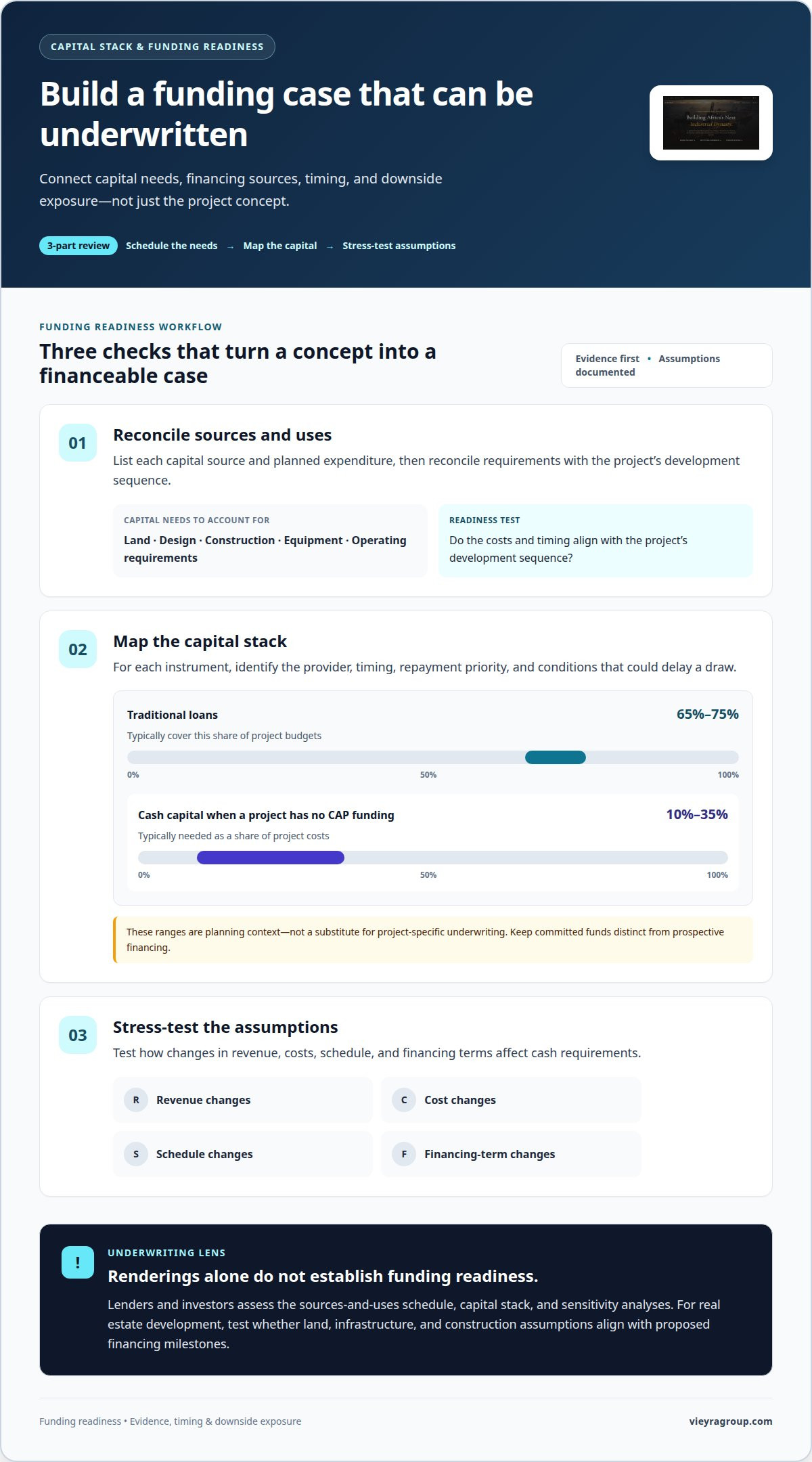
Translate the project concept into a funding case that can be underwritten. A disciplined checklist connects capital needs, financing sources, timing, and downside exposure.
- Prepare a sources-and-uses schedule that identifies each capital source and planned expenditure. Reconcile land, design, construction, equipment, and operating requirements with the project’s development sequence. Lenders and investors assess this schedule, the capital stack, and sensitivity analyses, not renderings alone. For a real estate development, test whether land, infrastructure, and construction assumptions align with proposed financing milestones.
- Map the capital stack by instrument, provider, timing, and repayment priority. Separate committed funds from prospective financing, and identify conditions that could delay each draw. For a new or greenfield project, traditional loans typically cover 65% to 75% of project budgets, while projects without CAP funding typically need cash capital equal to 10% to 35% of costs. Treat these as planning context, not a substitute for project-specific underwriting.
- Stress-test the model against changes in revenue, costs, schedule, and financing terms. Show how each scenario affects cash requirements, debt service, and completion obligations. Sensitivity analysis should reveal which assumptions most affect viability, including construction delays or lower-than-planned operating income. Present the base case alongside downside cases, linking every assumption to its supporting evidence.
- Build funding conditions into the readiness checklist and assign an owner to each outstanding item. Track approvals, equity commitments, lender requirements, and unresolved technical inputs against the financing timetable. Financial close for African utility-scale renewable energy projects usually takes around 6 months, making sequencing and document readiness material to planning. Record dependencies explicitly, then distinguish conditions that block close from items that can proceed in parallel.
Civil and infrastructure due diligence
Diligence requirements depend on the asset. Construction reviews emphasize ground conditions and buildability, energy projects examine sites and utility connections, and infrastructure assessments focus on access and network capacity. Match each review to the project’s physical design, location, and operational dependencies.
- Commission early site diligence covering geotechnical conditions, soils, groundwater, grading, floodplain exposure, traffic, and access. Compare the findings with the site plan and intended construction sequence. Groundwater conditions, for example, can affect foundation design, while limited road access can constrain deliveries and emergency routes. Record each constraint, its design implications, and the decision it requires.
- Assess environmental conditions before committing to a site or finalizing a purchase contract. Connect the findings to the site’s history, proposed uses, and any need for further assessment. Treat environmental findings as inputs to design, schedule, and land decisions, not as a standalone report.
- Map utility capacity and infrastructure connections against project demand. Identify the required electricity, water, wastewater, drainage, and transport interfaces, then establish where each connection meets the project boundary. Align the relevant workstreams on responsibilities, timing, and dependencies before fixing construction assumptions.
- Validate civil works assumptions against design documents, quantities, sequencing, and contractor pricing. Obtain at least two contractor bids to test construction costs, then reconcile differences in scope, exclusions, and schedule assumptions. For energy developments, include grid connection and site access; for transport infrastructure, examine network interfaces and traffic effects. Discuss strategic capital for infrastructure as part of broader project planning.
Vieyra Family Office: Global Investment Management
Vieyra Family Office can be a strategic partner when diligence findings point to long-term investment needs or capital-structure questions. Its Global Investment Management, African Industrialization Capital, and Strategic Capital Solutions offerings align with projects connecting investment decisions to durable economic development.
Consider this next step once the project has defined its governance, assessed funding readiness, and identified how capital could support its objectives. A clear view of scope, risks, and intended outcomes can focus a discussion about strategic capital and investment alignment.
For more information, contact Vieyra Family Office or visit vieyragroup.com.
Move from Assessment to Deliberate Action
Readiness matters when diligence findings support a clear decision: proceed, refine the project, or first resolve a critical dependency. Treat the evidence as a foundation for disciplined execution, not merely a record of review. For due diligence for large scale projects, the next step is to connect established priorities with a capital strategy suited to the project’s long-term purpose.
Vieyra Family Office offers Global Investment Management, African Industrialization Capital, and Strategic Capital Solutions. These offerings provide a relevant point of engagement when a project’s investment needs and development objectives call for strategic consideration. A well-prepared discussion can begin with the project’s intended outcomes, current readiness, and remaining capital questions.
Contact Vieyra Family Office to discuss the project’s strategic capital considerations. With a considered next step, a complex undertaking can advance with greater clarity and purpose.
Frequently Asked Questions
What Are Due Diligence Projects?
Due diligence projects are organized investigations that support consequential investment, transaction, or development decisions. A team might examine a proposed industrial facility before committing capital or assess an acquisition before agreeing to its terms. The work gathers and tests relevant evidence, identifies uncertainties, and clarifies which findings require a decision, further analysis, or a change in direction.
What Exactly Is Due Diligence?
Due diligence is a structured examination of information relevant to a decision, not simply a collection of documents. It compares claims with records, tests assumptions against evidence, and identifies material gaps or exposures. For example, a project forecast can be compared with customer commitments, supplier terms, and delivery capacity to assess whether the proposed operating case is supported.
What Is the Purpose of Due Diligence?
The purpose is to improve decision-making by making material facts, dependencies, and uncertainties visible before a commitment. Findings help decision-makers decide whether to proceed, revise terms, defer a decision, or address an identified issue. In a development proposal, a mismatch between planned capacity and available infrastructure may require a design change before investment approval.
Why Does Background Research Become Difficult at Scale?
Research becomes more difficult as a project spans more entities, locations, contracts, and interdependent workstreams. Records may use different formats or describe the same obligation inconsistently, while a single change can affect several schedules or assumptions. A supplier delay, for instance, may alter construction sequencing, financing needs, and operating plans. Centralized evidence tracking helps teams identify these connections and keep decisions aligned.
What does due diligence for a large-scale project include?
The scope includes reviews tailored to the project’s assets and decision: financial and commercial assumptions, legal rights and agreements, operating capacity, compliance matters, technology, site conditions, and infrastructure dependencies. A proposed facility, for example, may require evidence on land access, utility connections, construction assumptions, and expected demand. The precise scope depends on the project’s structure and principal risks.
What are the key steps in a large-scale project due diligence process?
Start by defining the decision and scope, then assign accountable workstream leads and establish an evidence record. Examine relevant financial, legal, operational, commercial, technical, and site information, connecting findings to risks and dependencies. Resolve priority questions, test how findings affect project assumptions, and give decision-makers clear options, supporting evidence, and outstanding actions.


