
West Africa received about 1 percent of global foreign direct investment inflows in 2023. That modest share places investment in the region’s industrial development in a wider strategic context: market potential must be matched by credible governance, productive infrastructure and pathways that connect national industries to regional trade.
Investors are right to look beyond headline growth and resource endowments. Industrial returns also depend on durable policy frameworks, transport and energy corridors that connect producers to markets, and cross-border integration that supports manufacturing at scale.
This article examines how governance shapes investor confidence, how AfCFTA industrial corridors can influence the movement of goods and productive capacity, and what foreign direct investment examples suggest about opportunities across West Africa. Together, these perspectives offer a practical framework for assessing where industrial capital may support long-term economic development and which conditions matter when evaluating an opportunity.
Key Takeaways
- Assess governance by examining policy consistency and the institutions that shape investor confidence over the life of an industrial project.
- Consider how AfCFTA corridors may connect production sites with suppliers and regional markets, rather than evaluating infrastructure in isolation.
- Use foreign direct investment examples to identify how capital, local partnerships and workforce development can support industrial activity.
- Compare country opportunities through practical factors such as market access, infrastructure and policy conditions before prioritizing an investment.
Investor confidence and governance
Investor confidence depends on whether public policy supports an industrial project beyond its initial approval. West Africa has more than 360 million people, while its projected economic growth rate for 2025 was 4.3 percent. These conditions create opportunity, but population and growth alone cannot establish a project’s viability. Evaluating a West Africa industrial development investment therefore requires attention to policy consistency, institutional capacity, and implementation.
Tax incentives, tax treatment, and investment protections must be assessed under the relevant host country’s framework: West Africa has no single national tax jurisdiction. Tax incentives, industrial lending mandates, and financial regulation are policy tools for encouraging long-term investment, not guarantees. International investors should examine the country’s fiscal framework and protections alongside the project’s export plans and governance arrangements.
Situation: West African countries sought to expand processing and manufacturing, rather than rely primarily on unprocessed goods. Action: The West African Common Industrial Policy (WACIP) was designed and adopted in 2010, with an implementation strategy running through 2030. It set a target of raising the average local raw-material processing rate from 15-20% to 30% by 2030. It also targeted an increase in manufacturing’s average contribution to regional GDP from 6-7% to over 20% by 2030. Intended result: Deeper processing and manufacturing would strengthen regional production. These figures are policy targets, not reported outcomes.
Use WACIP’s targets as a governance lens, not proof of delivery. Compare a project’s inputs with the policy goal of local processing, then assess whether transport, energy, and skilled labour support its production plan. Examine how public agencies coordinate implementation and whether policy direction remains consistent. A West Africa industrial development investment thesis should connect local processing with regional or international export markets. The central test is how stated policy, institutional execution, and the project’s operating model fit together.
AfCFTA industrial corridors
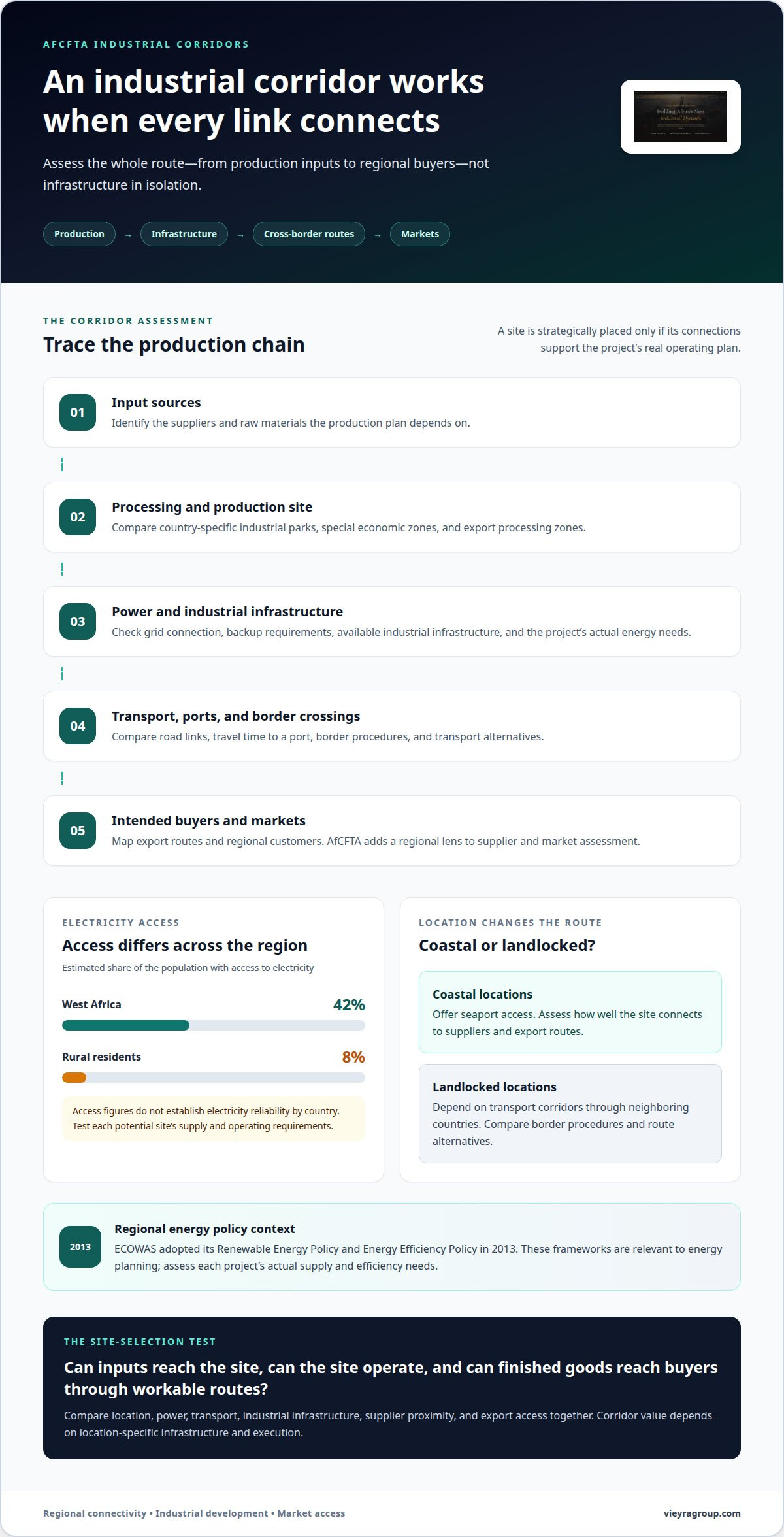
An industrial corridor links production sites with energy, transport routes, logistics hubs, and markets. Under the African Continental Free Trade Area (AfCFTA), this regional perspective matters: manufacturers can assess suppliers and customers across borders, not only within one national economy. A corridor creates investment value when connected infrastructure supports reliable movement from factory gate to buyer.
Electricity access illustrates a key difference across the region. An estimated 42 percent of West Africa’s population had access to electricity, compared with 8 percent of rural residents. These figures describe access, not reliability by country. Compare potential sites through grid connection, backup requirements, road links, travel time to a port, and border crossings. Coastal locations offer seaport access; landlocked locations depend on transport corridors through neighboring countries.
Which industrial parks, special economic zones, and export processing zones are available? The relevant options are country-specific industrial parks, special economic zones, and export processing zones. Evaluate each site by location, access to power and transport, available industrial infrastructure, and proximity to suppliers and export routes.
Situation: Energy access can constrain production beyond major urban centres. Action: ECOWAS adopted its Renewable Energy Policy and Energy Efficiency Policy in 2013, creating regional policy frameworks relevant to energy planning. Result: Investors can include energy supply and efficiency in corridor assessments, while testing each project’s actual operating needs.
Map the production chain before selecting a corridor site. Identify input sources, processing stages, intended buyers, and the routes connecting them. Compare border procedures, port access, and transport alternatives across potential locations. This helps distinguish a strategically placed industrial park from a site disconnected from suppliers or export markets. AfCFTA can inform the regional market assessment, while project economics still depend on location-specific infrastructure and execution.
For investors considering long-term industrial capital alongside corridor development, African industrialization capital is a relevant next step.
Foreign direct investment in West Africa
West Africa received about 1 percent of global foreign direct investment inflows in 2023. This share makes project selection and capital deployment central to the region’s industrial prospects. West Africa industrial development investment can connect external capital with productive capacity when a project has a defined market, operating model, and local implementation plan. A useful example is the West Africa Trade & Investment Hub, which administered $60 million in co-investment funds over five years and aimed to attract $300 million in private-sector investment.
Situation: Manufacturers needed capital to expand production and develop export capacity. Action: The Hub supported Dignity/DTRT, a U.S.-Ghana joint venture, with assistance that helped it hire and train 180 new staff. Result: The example shows how foreign capital and local operations can combine around a specific industrial investment. It does not establish the same outcome for every project.
What steps and permits are required to establish a manufacturing business in West Africa? Requirements depend on the country. The process generally involves selecting a site, establishing the business, arranging land, and obtaining applicable construction, environmental, and operating approvals. Map the requirements for the chosen country and project before committing capital.
What are the costs of land, labor, energy, and logistics for factories in West Africa? Costs depend on location, workforce requirements, energy supply, transport links, and distance from ports and suppliers. Compare these factors across potential sites to understand their impact on operating costs and export competitiveness.
What are the fastest-growing industrial sectors in West Africa? Growth prospects vary by country. Assess opportunities against local inputs, infrastructure, and market access rather than assuming a regional ranking. For West Africa industrial development investment, test whether a sector’s production model can serve identifiable buyers and sustain operations.
Investors can identify a sector, evaluate local partners, and test the production model against export demand. The Hub and Dignity/DTRT illustrate one route, linking investment support with hiring and training. These considerations help assess how foreign direct investment may support industrial capacity without treating individual results as universal.
Which West African countries offer the strongest opportunities for industrial development investment?
No single country leads every industrial investment case. The strongest fit depends on a project’s inputs, workforce, energy needs, transport routes, and intended customers. Compare Nigeria, Ghana, Côte d’Ivoire, and Senegal using the same operational criteria, then prioritize the location that best supports production and market access.
Start with the production model. Determine whether the project depends on local raw materials, imported components, specialized labour, or dependable power. Map the route from suppliers to the factory and onward to domestic, regional, or international buyers. Then examine policy implementation and local partners’ capacity to execute the plan. This country-by-country approach is more useful than treating regional growth as a proxy for project performance.
Situation: Nigeria illustrates both industrial scale and the need for careful sector analysis. Manufacturing industries accounted for 9% of Nigeria’s GDP in 2015. Action: Investors can use this historical indicator as context, then assess current project fundamentals, including input availability and infrastructure. Result: The figure identifies manufacturing as an established part of the economy, but does not by itself rank Nigeria above other countries.
Regional conditions also require attention. Burkina Faso, Mali, and Niger withdrew from ECOWAS in January 2025. For projects relying on cross-border suppliers or customers, this change makes route planning and regional market assumptions important parts of due diligence. It does not determine the outcome of an individual investment, but it underscores why country selection should account for the project’s actual trade relationships.
Use a concise comparison before committing capital:
- Match each country’s industrial base to the project’s sector and inputs.
- Compare site-level energy, transport, labour, and port access requirements.
- Test whether suppliers, partners, and buyers support the intended operating model.
- Review regional trade exposure, including relevant policy and institutional conditions.
For a project spanning several markets, explore strategic industrial investment as part of the country-selection process.
Vieyra Family Office: Global Investment Management
Vieyra Family Office brings Global Investment Management and African Industrialization Capital to long-term investment opportunities. For those assessing a manufacturing project, these offerings are relevant where strategic capital and industrial development objectives intersect.
Strategic Capital Solutions support a considered approach to capital allocation and long-term growth. The Vieyra Foundation pursues philanthropic initiatives in education, maternal health, AI literacy, infrastructure access, scholarships, industrial education, and food security. For institutional matters, Access by Invitation. Frame the opportunity clearly, including its industrial purpose, the market it serves, and the role capital could play.
To discuss an industrial investment opportunity, contact Vieyra Family Office or visit vieyragroup.com.
Turn regional potential into a disciplined investment thesis
Translate the regional outlook into a defined investment thesis. For West Africa industrial development investment, identify the project’s intended contribution, required capital structure, and the conditions needed to sustain operations over time. A clear thesis can align commercial objectives with durable industrial capacity.
Before advancing, bring the project’s assumptions into one decision framework: market demand, operating requirements, governance, and the investment’s relationship to regional production. This helps distinguish a compelling strategic objective from an executable opportunity while keeping long-term value creation central to the assessment.
Vieyra Family Office offers Global Investment Management, African Industrialization Capital, and Strategic Capital Solutions for readers considering how strategic capital may relate to industrial development. To discuss your investment objectives, contact Vieyra Family Office. A carefully formed thesis can provide a sound foundation for the next stage of consideration.
Frequently Asked Questions
How much foreign direct investment does West Africa attract by country and sector?
West Africa received about 1 percent of global foreign direct investment inflows in 2023. That regional share does not indicate how investment divides among individual countries or sectors. For a practical comparison, distinguish announced projects from realized investment, then separate capital by destination country and industry. This reveals whether an opportunity reflects manufacturing capacity, resource extraction, or another economic activity.
What are the main political, currency, regulatory, and security risks for industrial investors in West Africa?
Key risks include shifts in regional political relationships, exchange-rate movements, changes in national rules, and site-specific security conditions. Burkina Faso, Mali, and Niger withdrew from ECOWAS in January 2025, a development relevant to projects relying on regional routes or partners. Assess currency exposure against the project’s revenues and imported inputs, and examine how regulatory changes could affect operations, permits, and supply-chain continuity.
How do West African countries compare on electricity reliability, transport infrastructure, and access to ports?
Electricity access was estimated at 42 percent regionwide and 8 percent among rural residents, but these figures do not compare reliability by country. Compare grid connections, backup needs, roads, travel time to ports, and border crossings; coastal sites have seaport access, while landlocked sites depend on routes through neighboring countries.
What are the fastest-growing industrial sectors in West Africa?
Growth prospects vary by country, so assess sectors against local inputs, infrastructure, and market access rather than assuming a regional ranking. Test whether the production model can serve identifiable buyers and sustain operations.
Which industrial parks, special economic zones, and export processing zones are available in West Africa?
Industrial parks, special economic zones, and export processing zones vary by country. Evaluate each site’s location, access to power and transport, industrial infrastructure, and proximity to suppliers and export routes.


