

The strongest African investment opportunity may not be the fastest-growing market, but the business able to defend its position as that market changes. Economic moat investing in Africa means assessing whether a company has a durable competitive advantage, and whether that advantage can sustain attractive returns over time. The relevant horizon may be five, 10, or 20 years, depending on the strength and persistence of the underlying barriers.
Growth matters, but it does not establish a moat on its own. Returns, stability, market share, and resilience to competition help distinguish lasting advantages from temporary momentum. Economic moat investing in Africa also calls for attention to local markets and regional integration. This article explains what an economic moat is, how to assess business performance and competitive position, and how AfCFTA and country-specific conditions shape an investment case. The aim is a disciplined way to evaluate where durable value may emerge across the continent.
Key Takeaways
- Assess whether strong returns persist through changing conditions, and whether stability, growth, and market share reflect a defensible business advantage.
- Consider how AfCFTA may broaden regional opportunity while accounting for the practical differences between operating across African markets.
- Distinguish a durable competitive advantage from temporary momentum by examining what protects a company’s position and how long those protections may endure.
- Compare country and sector opportunities through local market conditions, industrial potential, and the role of strategic capital in long-term development.
Using ROIC, stability, growth, and market share to identify moats
Economic moat investing in Africa means testing whether a business can defend its position as markets change. Returns, demand stability, growth, and market share together provide stronger evidence than rapid expansion alone.
Measuring Moats Through Returns and Market Position
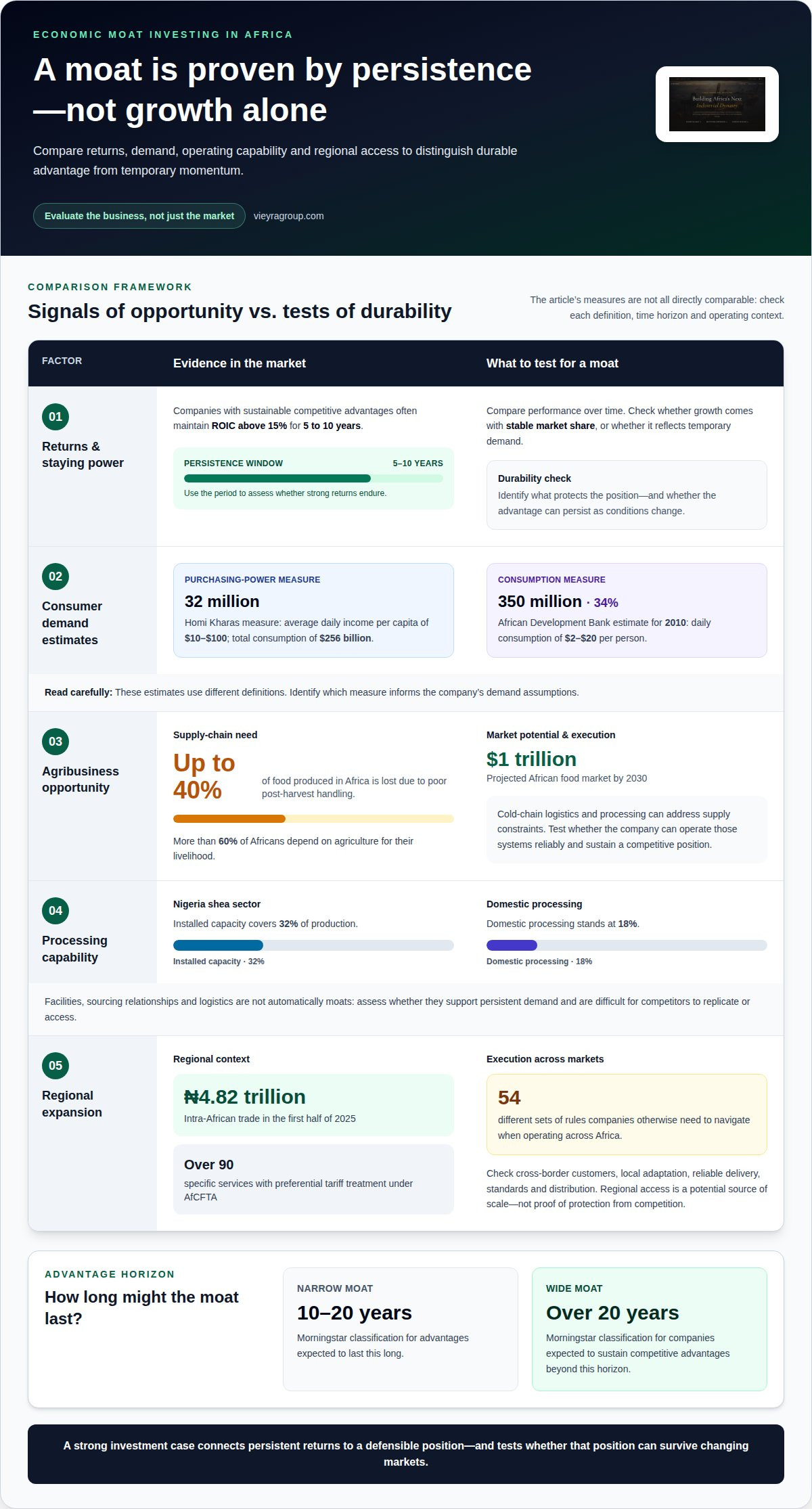
ROIC shows how effectively a company converts invested capital into operating returns, while persistence helps indicate whether its advantages endure. Companies with sustainable competitive advantages often maintain ROIC above 15% for five to 10 years. Compare performance over time, then consider whether growth accompanies stable market share or merely reflects temporary demand. This combined assessment helps investors distinguish a durable position from a passing commercial upswing.
African middle-class estimates depend on the definition used. Homi Kharas’s purchasing-power measure uses average daily income per capita between $10 and $100; it counts 32 million Africans, with total consumption of $256 billion. The African Development Bank counted 350 million people, or 34% of Africa’s population, as middle class in 2010, using daily consumption between $2 and $20 per person. Consumer-market analysis should identify which measure informs its demand assumptions.
Agribusiness shows how market conditions can reveal both opportunity and execution risk. Up to 40% of food produced in Africa is lost because of poor post-harvest handling, and more than 60% of Africans depend on agriculture for their livelihood. Cold-chain logistics and processing can address supply constraints, but a company’s moat depends on whether it can operate those systems reliably. The African food market is projected to reach $1 trillion by 2030.
Barriers to Entry and Market Volatility
Barriers to entry are capabilities or conditions that make a business difficult to replicate, potentially helping it protect returns. Processing facilities, sourcing relationships, and cold-chain logistics may create operational hurdles, but they represent a moat only if they support persistent demand and a competitive position. In economic moat investing in Africa, distinguish an operating advantage from infrastructure competitors can also access.
Regulatory requirements and market volatility can affect expansion costs, timing, and reliability. Nigeria’s shea sector illustrates the processing gap: installed capacity covers 32% of production, while domestic processing stands at 18%. Economic moat investing in Africa should therefore examine how firms manage local rules, supply relationships, and consumer demand, rather than assuming sector growth guarantees durable returns.
African Continental Free Trade Area (AfCFTA)
AfCFTA offers investors a regional lens for assessing whether a company can expand beyond its home market. Companies operating across Africa otherwise need to navigate 54 different sets of rules. This fragmentation can make cross-border growth harder to execute, even where consumer demand is growing. A durable advantage may come from a business’s ability to coordinate suppliers, distribution, and market access across national borders.
Intra-African trade reached ₦4.82 trillion in the first half of 2025. That figure signals substantial trade activity, but it does not establish that every company benefits equally. Investors can examine whether a business already serves customers across borders, adapts its products to local markets, and can sustain reliable delivery. These capabilities may help protect market share as regional commerce develops, while weak execution can constrain expansion.
AfCFTA enables preferential tariff treatment for over 90 specific services. For investors, this creates a reason to study service sectors alongside goods-producing industries. The practical question is whether a company can convert regional access into lasting customer relationships and stronger returns. Assess its competitive position, the durability of demand, and the operational capacity required to serve customers in additional markets.
Governments and businesses both play a role in turning regional arrangements into commercial activity. A company’s advantage may depend on how well it manages cross-border standards, distribution, and differences in consumer needs. Compare performance across markets rather than assuming a larger addressable region will automatically bring growth. A cost advantage matters only if the company can maintain service quality and customer loyalty as it expands.
For moat analysis, treat AfCFTA as a potential source of regional scale, not as proof of protection from competition. Look for firms whose established capabilities make expansion difficult to replicate and whose market position remains resilient as conditions change. Capital directed toward productive capacity can support that assessment; African industrialization capital is relevant where regional opportunity depends on building durable industrial capabilities.
Economic moat definition and competitive advantage
An economic moat is a durable advantage that helps a company defend profits against competitors. It may arise from customer loyalty, lower costs, specialized assets, or difficult-to-replicate capabilities. Morningstar classifies companies expected to sustain competitive advantages for over 20 years as wide-moat companies. Advantages expected to last 10 to 20 years are classified as narrow moats. These horizons help investors consider whether returns rest on enduring strengths or temporary conditions.
A practical test is to identify what would prevent a competitor from attracting the same customers or matching the company’s economics. Consider a patented juicing technology that extracts 30% more juice from an average lemon. Its cost advantage could support lower prices or stronger margins, but only if competitors cannot readily reproduce it. The example shows why a product difference matters only when it can protect returns over time.
African mining illustrates the distinction between resource access and a competitive advantage. The continent holds roughly 30% of the world’s critical mineral reserves, yet more than 70% of its mineral exports leave in raw form. Around 40% of total mineral exports are processed in China. A mining company’s moat therefore depends on more than deposits: processing capability, logistics, reliable operations, and customer access can influence whether value remains local.
Assess whether a company’s capabilities attract customers and endure through market changes. Examine what supports its pricing power, how stable demand is, and how much capital competitors would need to reproduce its operating model. Ask whether growth strengthens its position or simply reflects population growth and rising demand. Industrial development can create defensible capabilities, but expansion alone is not proof of a moat. The key test is whether a clear advantage protects returns as competitors respond and conditions evolve.
Investment opportunities across African countries
African opportunities differ by country, sector, and the capabilities businesses can sustain. A durable advantage depends on local conditions, not continental growth alone.
Durable Advantages Among African Companies
The strongest candidates are companies whose capabilities protect customer relationships and returns within their markets. Specific company names cannot be identified from the available facts, but sector indicators help direct analysis. Africa has 1.1 billion registered mobile money accounts in 2026, while its fintech market is expected to reach $47 billion in revenue by 2028. Investors can assess whether companies convert that reach into trusted, recurring services and defensible market positions.
Education offers another lens: the African e-learning market is projected to reach $7.7 billion by 2033, with a 9.1% CAGR. These projections indicate potential sector expansion, not that every company will succeed. Compare businesses by their ability to retain users, adapt to local needs, and sustain operations as competition grows. Those firm-level qualities, rather than a country or sector label, indicate a possible advantage.
Country and Sector Diversification
Diversification means spreading exposure across countries and sectors whose economic drivers differ. It matters because Africa comprises 54 countries, each with its own economic profile and investment climate. Africa’s real GDP growth is projected at 4.0% in 2026 and 4.1% in 2027; Kenya and Ethiopia have projections nearing 5.8% in 2026. These differences can inform comparisons, not replace company analysis.
Investors can compare consumer-facing technology with other sectors, then examine each country’s political landscape, local culture, and consumer behaviour. For example, healthcare has an annual financing gap of $245 billion in 2026, and more than 70% of pharmaceuticals consumed in Africa are imported. Such conditions may reveal needs, while regulation, execution, and local demand shape commercial outcomes.
For international investors, the practical step is to compare country and sector exposures by their underlying drivers, rather than treating African markets as uniform. The fact that seven of the ten fastest-growing economies were in Africa in 2025 highlights the continent’s varied growth prospects, not uniform investment success. Explore African industrialization capital as a consideration for investment analysis focused on productive capacity and long-term development.
Vieyra Family Office: Global Investment Management
Vieyra Family Office is a natural next step for investors assessing durable African opportunities alongside global portfolios. Its Global Investment Management offering addresses investment management across asset classes, while African Industrialization Capital and Strategic Capital Solutions align with long-term growth projects and economic development. These offerings are relevant when analysis moves beyond identifying a company’s advantage to considering capital allocation and broader investment strategy.
For investors evaluating how an enterprise can build lasting productive capacity, African Industrialization Capital is relevant. Global Investment Management provides a broader portfolio context, while Strategic Capital Solutions address strategic capital deployment. The appropriate focus depends on the investment objective and the opportunity’s role in a wider strategy.
To discuss investment priorities, contact Vieyra Family Office or visit vieyragroup.com.
Turn Durable Advantage Into a Long-Term Investment Lens
For investors pursuing economic moat investing in Africa, the next step is to turn analysis into a clear investment thesis. Specify which capabilities could protect a business, what evidence would show they are strengthening, and which developments could weaken them. This discipline keeps the focus on durable value creation rather than headline growth alone.
A considered investment approach connects company-level analysis with portfolio priorities. Determine how an opportunity fits broader objectives, what role its market plays in the strategy, and how progress will be assessed over time. This perspective can guide capital allocation while allowing assumptions to be revised as markets and businesses evolve.
Vieyra Family Office offers a setting for considering these priorities alongside long-term investment objectives. Explore a strategic investment discussion and continue building an informed perspective on Africa’s opportunities. Durable investment thinking begins with disciplined questions and develops through sustained attention.
Frequently Asked Questions
What Is an Economic Moat?
An economic moat is a business characteristic that helps protect a company from competitive pressure. It may include customer switching costs, a trusted brand, proprietary technology, or a network that becomes more useful as participation grows. For example, customers may stay with a service because switching disrupts established workflows. Investors look for evidence that this protection affects business performance; a popular product alone is not proof.
How do companies build economic moats?
Companies build moats by developing capabilities that competitors cannot easily copy or replace. A business might strengthen customer relationships through dependable service, cultivate a trusted brand, or extend its distribution reach. In African markets, local knowledge can help companies adapt products and operations to distinct consumer preferences. The test is whether these capabilities reinforce customer retention and commercial strength over time, rather than merely creating a temporary sales advantage.
Investment in Africa: Who Profits from the Boom?
Businesses that meet persistent needs and turn demand into sound operations are better placed to benefit from economic expansion. Sector choice alone does not identify likely beneficiaries: execution, customer trust, cost discipline, and reliable supply all matter. A technology company, for example, must turn adoption into a durable business model, while an industrial firm must manage its production chain effectively. Assess the company, not just the growth narrative.
What does an economic moat mean in investing?
In investing, a moat helps assess a business’s quality and resilience; it does not guarantee investment performance. Even a strong company may be an unsuitable investment if its market price already reflects unusually high expectations. Investors should consider both the source of competitive protection and the assumptions built into the valuation. This distinction separates business quality from the price paid for ownership.
How can investors assess a company's moat in African markets?
Examine how a company earns customer loyalty, retains suppliers, and responds to local competition. Compare its operating performance with its own history and relevant businesses, accounting for differences in market structure and currency exposure. Test the investment thesis against practical disruptions, such as a new entrant, changing customer preferences, or a distribution breakdown. A credible moat has identifiable mechanisms that remain relevant under those conditions.
How do currency risk and inflation affect moat investing in Africa?
Currency movements can change the value of overseas earnings and the cost of imported inputs. Inflation can raise wages, transport, and production expenses. A company with pricing power may pass some increases on to customers, but its ability to do so depends on competition and affordability. Examine where revenue and costs arise, how contracts are structured, and whether margins remain resilient as conditions shift.


