
The most consequential philanthropic decision is not simply how much to give, but how deliberately each commitment advances a defined mission. One workable framework for strategic philanthropic capital allocation directs 60-80% of charitable donations to core priorities and the remaining 20-40% to satellite opportunities, preserving focus while allowing room to respond to emerging needs.
That balance matters because charitable capital must serve a purpose while respecting financial capacity. A clear mission helps identify which causes merit sustained support, while disciplined investment and grant planning can align giving with a family’s long-term objectives. Involving people with relevant community knowledge is just as important: funders should not assume they alone can prescribe the most effective solutions.
This article explains how to define a philanthropic mission, structure giving to advance it, and connect charitable commitments with financial management. It also examines the trade-offs between stable core funding and flexible opportunities, helping families account for immediate needs as well as enduring ambitions.
Key Takeaways
- Strengthen charitable commitments by considering how funding can unlock additional resources, and review multi-year grant commitments annually.
- Define a philanthropic mission around clear goals, shaped with the knowledge of community members, leaders, and people directly affected by the issues.
- Coordinate giving with investment and financial planning, using regular impact reviews to inform how capital is deployed over time.
- For long-term initiatives focused on African industrialization, Vieyra Family Office’s African Industrialization Capital is a relevant avenue for strategic capital.
1. Applying the multiplier effect to charitable giving
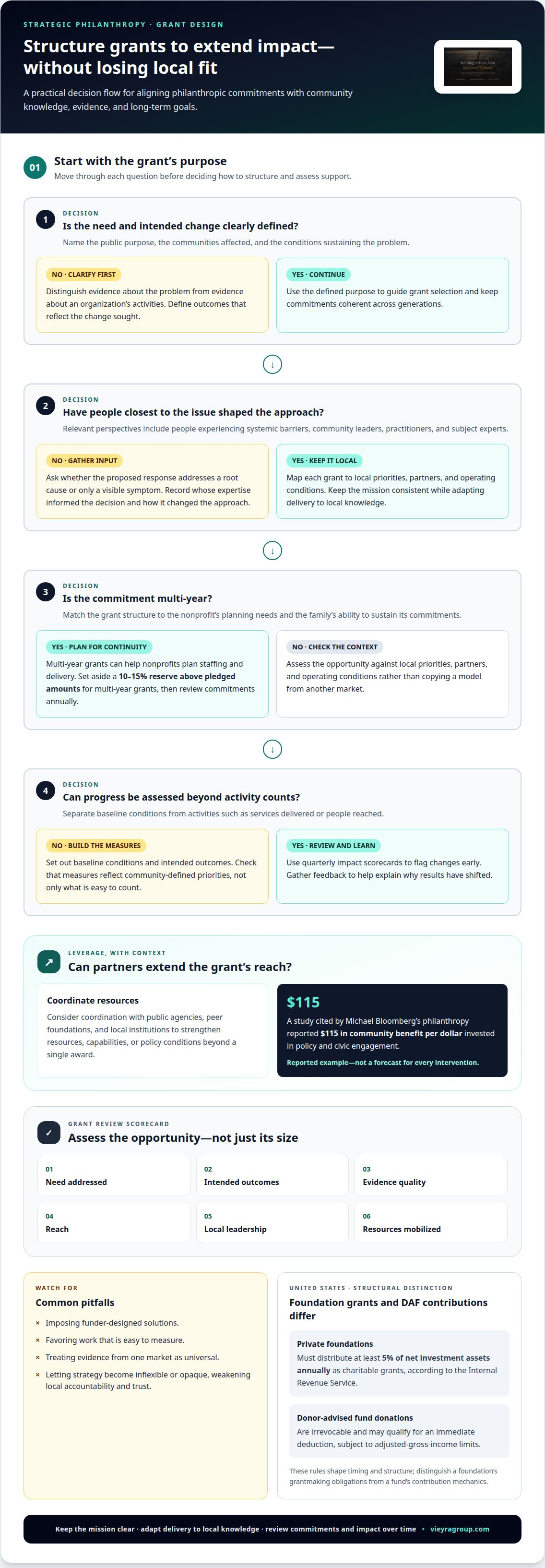
Multiplying charitable giving means structuring grants to strengthen resources, capabilities, or policy conditions beyond a single award. Funders can coordinate with public agencies, peer foundations, and local institutions to extend a program’s reach. A study cited by Michael Bloomberg’s philanthropy reported $115 in community benefit per dollar invested in policy and civic engagement. Treat this as a reported example, not a forecast for every charitable intervention.
Multi-year grants help nonprofits plan staffing and delivery, while a commitment reserve protects pledged support. Set aside 10-15% above pledged amounts for multi-year grants, then review commitments annually. Across markets, map each grant to local priorities, partners, and operating conditions rather than copying one model. Keep the mission consistent while adapting delivery to local knowledge.
In the United States, private foundations must distribute at least 5% of net investment assets annually as charitable grants, according to the Internal Revenue Service. Donor-advised fund donations are irrevocable and may qualify for an immediate deduction, subject to adjusted-gross-income limits. These rules shape timing and structure, so distinguish a foundation’s grantmaking obligations from a fund’s contribution mechanics.
Evaluate opportunities with a scorecard covering the need addressed, intended outcomes, evidence quality, reach, local leadership, and resources mobilized. Track baseline conditions separately from activities, such as services delivered or people reached. Quarterly impact scorecards can flag changes early, while feedback helps explain why results have shifted.
Assess nonprofit effectiveness by reviewing mission alignment, governance, delivery capacity, and evidence that programs reach their intended communities. To understand financial health, examine revenue concentration, liquidity, obligations, and spending patterns over time. Consider financial statements alongside community perspectives: organizational scale alone does not demonstrate results.
Common pitfalls include imposing funder-designed solutions, favoring work that is easy to measure, and treating evidence from one market as universal. Strategic philanthropy can also become inflexible or opaque, undermining local accountability and trust.
Balance immediate relief with long-term change by maintaining capacity for urgent needs while sustaining grants that address underlying causes. For multigenerational philanthropy, document the mission, decision principles, and review process. This helps future stewards preserve shared priorities while adapting to changing community needs.
2. Choosing philanthropic causes and defining a mission
A durable philanthropic mission starts with a defined public purpose, not a catalogue of worthy causes. Identify the change you seek, the communities affected, and the conditions sustaining the problem. For example, a family prioritizing educational opportunity can distinguish access, learning, and employment outcomes. That clarity turns a broad concern into priorities that guide grant selection and maintain coherence across generations.
Gather perspectives before deciding on an intervention. People experiencing systemic barriers, community leaders, practitioners, and subject experts bring knowledge funders may lack. Their input can show whether a proposed response addresses a root cause or only a visible symptom. Record whose expertise shaped the decision and how their contributions changed the proposed approach.
Amartya Sen’s capability approach offers another lens: assess what people are actually able to be and do. Applied to a health mission, this means looking beyond service counts to whether people can access care and make meaningful choices. Use this lens to test whether measures reflect community-defined priorities. Make the values behind each assessment explicit, discuss them with affected people, and revise them as circumstances change.
To keep priorities relevant, compare potential causes using a concise framework: mission fit, local knowledge, structural importance, and a credible path to progress. Separate evidence about the problem from evidence about an organization’s activities, since they answer different questions. Do not choose a cause only because its outcomes are easy to count or familiar to donors. Let the mission guide allocation without prescribing solutions to those closest to the work.
For families seeking to connect philanthropic purpose with long-term development priorities, a sustained philanthropic mission can provide a useful starting point for structured deliberation.
Philanthropy can serve as society’s risk capital, supporting efforts to address the systemic causes of poverty and other social ills. Strategic philanthropy starts with a clear vision and goals, shaped by input from people with different perspectives.
Approach philanthropy with curiosity and humility: solutions to most issues are not simple. Build strategies on the expertise of people experiencing systemic barriers, community leaders, and subject experts, rather than prescribing solutions to them.
3. Aligning philanthropy with financial management
A family office can align charitable commitments with investment policy by treating giving as part of its capital plan. Begin by mapping assets, liquidity needs, planned distributions, and the mission’s time horizon. Foundations often base giving budgets on asset growth, particularly the previous year’s S&P 500 performance. A disciplined plan also considers how market changes affect available grant capital and continuity.
Compare grants, impact investments, and direct gifts by purpose, risk, time horizon, and expected return. Grants support charitable activity without repayment; impact investments seek measurable social outcomes alongside financial performance. Direct gifts can suit individuals supporting a particular organization or education initiative. Select the form that best matches the intended outcome and the recipient’s capacity to use it.
In the United States, cash charitable contributions may be deductible up to 60% of a donor’s adjusted gross income, according to the Internal Revenue Service. Donations of long-term appreciated securities may be deductible at fair market value up to 30% of adjusted gross income, also according to the Internal Revenue Service. Administrative costs depend on the giving structure, governance, filing complexity, and professional support; fees depend on the case and are provided after a quote request.
Build the allocation plan in sequence: define available charitable capital, identify priority outcomes, choose funding instruments, set decision authority, and establish review dates. Then connect each commitment to the organization’s financial calendar, liquidity needs, and grant schedule. For foundations, annual tax filings typically require 4-8 hours with an accountant or attorney.
Use quarterly impact scorecards to compare planned outcomes with delivery, expenditure, and relevant evidence. Track financial measures, such as committed and disbursed funds, separately from program measures, such as services delivered or changes experienced. Families can then adjust future allocations in light of both investment capacity and social performance, maintaining financial discipline without relying on a single market indicator.
4. What are the main strategies for allocating philanthropic capital?
A philanthropic portfolio can combine stable commitments with capacity for emerging needs. One approach reserves 5-10% for emergency response, protecting funds for crises without displacing established priorities. Organize commitments by time horizon: immediate response over 0-1 year, medium-term work over 1-3 years, and long-term initiatives over 3+ years. This structure clarifies when capital is intended to produce results.
A core-satellite portfolio places 60-80% of charitable donations in core causes, with the remaining 20-40% directed to satellite opportunities. Core funding supports sustained priorities; satellite allocations permit exploration of new interventions, partnerships, or changing needs. Review each satellite commitment against the mission and evidence, so flexibility does not become a series of disconnected grants.
A related model allocates 70-80% of the giving budget to core causes and reserves 20-30% for dynamic opportunities. These ranges describe alternative frameworks, not portions to combine automatically. Choose the structure that reflects governance, risk tolerance, time horizon, and the ability to assess results. A family supporting education, for example, might maintain core commitments while testing a community-led approach to access.
Across all models, do not design solutions without the people expected to implement or experience them. Funder-designed interventions imposed on nonprofits or communities can weaken local ownership and overlook practitioners’ knowledge. Involve affected communities in decision-making, assess how organizations and networks work together, and keep allocation criteria transparent and open to revision.
Use a written portfolio policy to record the purpose of each allocation, its horizon, decision authority, and review criteria. Revisit the balance when community needs or the evidence changes, while distinguishing temporary emergency funding from long-term commitments. For capital strategies connecting charitable priorities with sustained development, explore long-term capital approaches.
Vieyra Family Office: African Industrialization Capital
Vieyra Family Office’s African Industrialization Capital supports strategic capital deployment for industrial development across Africa. It is relevant when philanthropic priorities intersect with broader development objectives and capital decisions need to reflect long-term economic development.
Vieyra Family Office also offers Strategic Capital Solutions and Global Investment Management, alongside the philanthropic work of the Vieyra Foundation. These offerings serve distinct purposes: the right fit depends on whether the priority is philanthropy, investment management, or strategic capital for development initiatives.
For a considered discussion of how these priorities may align, contact Vieyra Family Office.
Give enduring purpose a clear next direction
The next step is to define how philanthropic purpose should shape future capital decisions. A durable framework can guide both the causes supported and how financial resources contribute to long-term development across generations. Strategic philanthropic capital allocation is more coherent when charitable objectives and investment decisions are considered together, with room for disciplined adaptation as priorities evolve.
Vieyra Family Office brings together Global Investment Management, African Industrialization Capital, and Strategic Capital Solutions. These offerings are relevant to families considering how investment management and development-focused capital relate to broader objectives. The appropriate direction starts with clarity about purpose, time horizon, and the communities a family intends to support.
To discuss how these priorities may inform your next decisions, contact Vieyra Family Office. Thoughtful stewardship today can help shape a purposeful legacy for generations to come.
Frequently Asked Questions
What is strategic philanthropic capital allocation?
Strategic philanthropic capital allocation means deliberately directing charitable resources toward defined social outcomes, guided by purpose, financial capacity, and time horizon. For example, a family may coordinate grants with investments that advance a shared development objective while keeping charitable decisions distinct from commercial return expectations. Each commitment should have an intended result and a clear rationale for how that capital is used.
How do foundations set philanthropic funding priorities and goals?
Foundations set priorities by translating their purpose into specific outcomes and establishing governance for selecting and reviewing commitments. Document which issues are in scope, what evidence informs decisions, who participates, and how progress will be reviewed. For a family foundation, recording these principles helps trustees apply consistent criteria as membership changes while retaining room to respond to new community needs.


