
Seventy-one percent of family offices engage in philanthropy, yet only 41 percent have a formal written strategy, according to Foundation Source and Campden Wealth’s July 2026 research. That gap raises a central question: how can a family office philanthropic strategy bring coherence to giving and remain durable across generations? Good intentions alone may not prevent giving from becoming fragmented across causes, family members, and charitable vehicles.
Families often want philanthropy to express shared values, even as priorities change between generations and outcomes resist simple measurement. A considered strategy turns purpose into manageable priorities, sets expectations for participation and accountability, and clarifies how charitable capital relates to investment activity without replacing it.
This article explores how family offices can align philanthropic purpose, decision-making, capital deployment, and continuity. It also considers the Vieyra Foundation within the wider Vieyra Family Office, where philanthropy is a distinct dimension of stewardship aligned with global investment and a focus on African industrialisation. The goal is a practical framework for giving that reflects enduring purpose and allows thoughtful evolution.
Key Takeaways
- Define a family office philanthropic strategy around purpose, priorities, decision rights, and learning, while preserving room for responsive giving.
- Match each form of charitable capital to its intended role, time horizon, governance needs, and approach to learning.
- Clarify which decisions require family agreement and which can be delegated. Use written principles and reporting to support continuity.
- Build a reviewable strategy by listening across generations, setting focused objectives, and revisiting priorities as circumstances evolve.
- Keep philanthropy distinct yet strategically aligned with broader stewardship, as reflected in the Vieyra Foundation’s place within the Vieyra Family Office.
Family Office Philanthropic Strategy and Its Goals
A family office philanthropic strategy is a framework for turning shared purpose into philanthropic priorities, decision rights, and a disciplined process for learning and adaptation. Strategic philanthropy is not defined by requiring every gift to fit a long-term plan. It means the family has set out how charitable activity relates to its enduring values and how significant decisions will be made.
This distinction leaves room for responsive giving. An urgent need may justify a timely contribution outside established priorities. A strategy helps the family consider the reason for the gift, who has authority to approve it, and what it means for other commitments. It can also bring coherence to charitable activity over time and connect stewardship of wealth with a considered legacy, without expecting every family member to hold identical views.
Philanthropy is a distinct form of stewardship, complementary to investment management rather than a substitute for it. A gift can express generosity, solidarity, or a family commitment without being assessed as an investment. The wider institutional context of a family office, including its potential roles in wealth management and philanthropic coordination, is outlined in this Family Office Overview.
How Is a Strategy Different from a Giving Plan?
A giving plan usually covers implementation: annual budgets, grant calendars, and individual gift decisions. A strategy sets the direction for that operational work. It defines the purpose and priorities behind those choices while allowing plans to change as family circumstances, opportunities, or needs develop.
For example, a family might agree that its giving should reflect a shared commitment to long-term social contribution, while delegating annual allocations and specific decisions through an agreed process. Written principles can explain why some requests fit the family’s priorities and others do not. That record makes decisions easier to explain, revisit, and carry forward, while leaving room for discretion over individual gifts.
Why Bring Philanthropy into the Family-Office Conversation?
Within a family office, philanthropy intersects with family governance, financial administration, and long-term stewardship. Coordinating the relevant expertise can clarify who authorizes charitable decisions, how they are documented, and when they are reviewed. It also connects family values with the practical responsibilities of giving, while keeping philanthropic intent distinct from investment mandates.
A shared framework supports continuity without requiring agreement on every cause or method. Family members can take on defined roles, contribute different perspectives, and understand how final decisions are reached. This is particularly useful across generations, where a common purpose may endure even as priorities evolve. The wider institutional context also informs the principles of global investment management for sovereign-scale family offices. Strategic coordination does not mean treating every charitable decision as an investment. It means giving philanthropy a deliberate place in the family’s governance and legacy.
How Should a Family Office Structure Philanthropic Purpose and Capital?
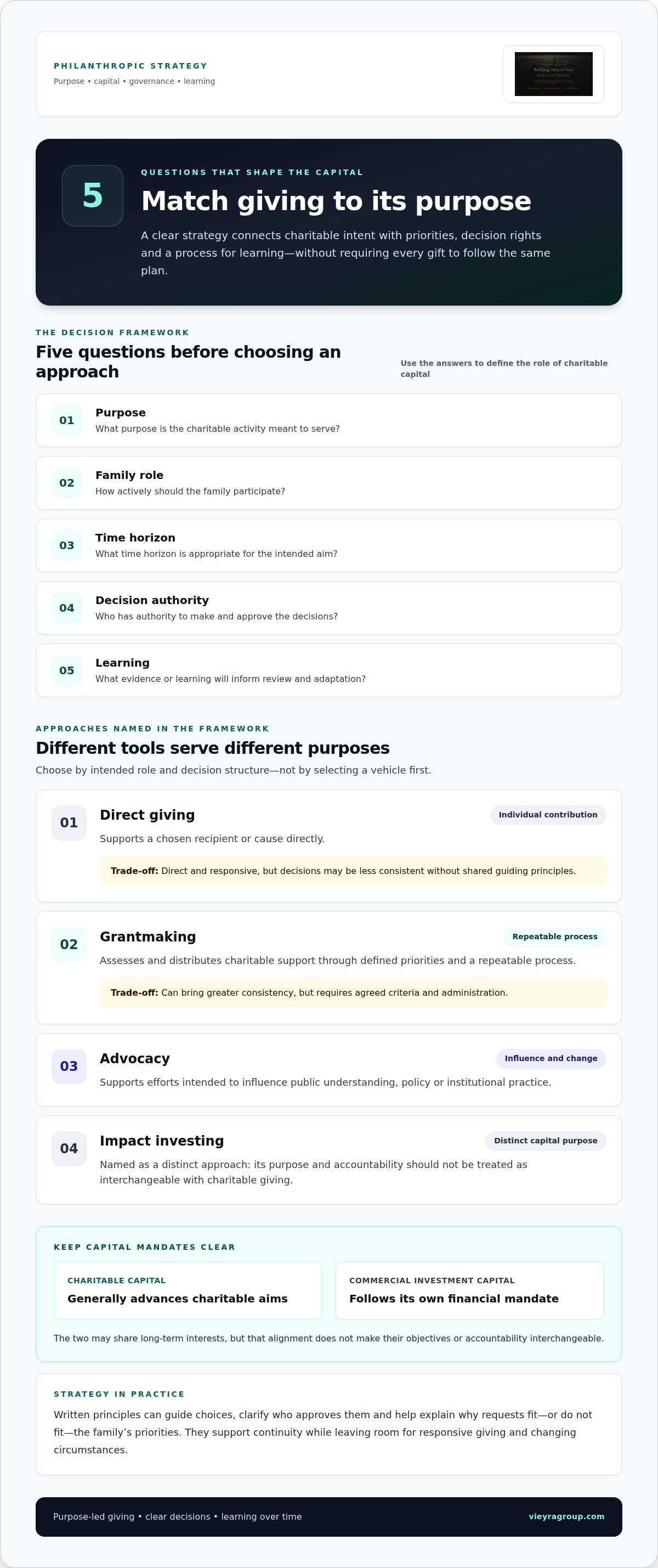
Once purpose is clear, the next task is to decide what charitable capital should achieve and which form of activity best serves that aim. A sound family office philanthropic strategy addresses five connected questions: What purpose is being served? What role should the family play? What time horizon is appropriate? Who has decision-making authority? What will the family learn from the activity? The answers help match capital to a defined function without assuming one approach is always preferable.
A family responding to a specific need might make a direct gift, while an objective that requires repeated assessment and support may call for a grantmaking process. Advocacy and impact investing serve different purposes. The distinction matters: philanthropic capital is generally deployed to advance charitable aims, while commercial investment capital follows its own financial mandate. The two may share long-term interests, but that alignment does not make their objectives or accountability interchangeable.
Which Philanthropic Approaches Serve Different Purposes?
Each approach has a different decision structure and set of trade-offs. Compare options by asking who makes the decision, what kind of contribution is involved, and what evidence or learning will inform review. This functional comparison helps match an approach to its intended role, rather than choosing a vehicle first and searching for a purpose afterward.
| Approach | Purpose and decision structure | Principal trade-off |
|---|---|---|
| Direct giving | Supports a chosen recipient or cause through an individual contribution. | Direct and responsive, but decisions may be less consistent without shared principles to guide them. |
| Grantmaking | Assesses and distributes charitable support through defined priorities and a repeatable process. | Can bring greater consistency, but requires agreed criteria and administration. |
| Advocacy | Supports efforts intended to influence public understanding, policy, or institutional practice. | May address underlying conditions, but its influence can be difficult to assess on the same timetable as a discrete gift. |
| Impact investing | Deploys investment capital with an intention to pursue social or environmental objectives alongside financial considerations. | Requires an explicit investment mandate and evaluation approach. It is not simply another form of grant. |
How Can Purpose and Investment Strategy Relate?
Institutional coherence does not require all family capital to pursue the same objectives. Philanthropy can express values through charitable support, while investment management follows a separate mandate. Both may still reflect a long-term perspective. Where aims overlap, the family can describe the connection while preserving distinct decision rights, performance expectations, and accountability for each form of capital.
This distinction matters when considering African industrialisation. Philanthropic and commercial activity may relate to a shared long-term interest without becoming the same instrument. Strategic philanthropy for African industrialisation explores this relationship. To see how these capital perspectives fit within Vieyra Group’s broader investment context, readers can explore the group’s institutional focus.
Legal and tax implications vary by jurisdiction and giving structure. Treat these as part of implementation rather than assuming one jurisdiction’s rules apply universally. A review process can record the assumptions, decision authority, and learning criteria attached to each approach, then revisit them as purpose or circumstances change.
How Do Governance and Generational Participation Strengthen Philanthropic Strategy?
A philanthropic mandate becomes durable when family members can see how it guides decisions. Governance establishes who sets priorities, who may authorize commitments, who oversees administration, and how the family learns from its activity. In a family office philanthropic strategy, these distinctions help prevent uncertainty from resting with a single decision-maker while preserving appropriate family oversight.
The framework need not be elaborate or uniform. A family might reserve changes to its core purpose or major commitments for collective agreement, delegate decisions within agreed parameters, and assign administration and reporting to designated professionals. The key is to make authority clear before a consequential request arises.
What Should Philanthropic Governance Clarify?
Written principles should explain the mandate, decision rights, and review process in language family members can understand. A practical framework distinguishes oversight from administration: family members set direction and exercise agreed authority, while specialists may support research, records, financial processes, or reporting according to their roles.
Governance can specify:
- Who establishes priorities and approves changes to them.
- Which commitments require family agreement and which may be delegated.
- Who coordinates administration, documentation, and financial records.
- When the family reviews activity, decisions, and lessons learned.
A regular meeting cadence, concise decision records, and reporting against agreed priorities help preserve institutional memory. Set a schedule that suits the family’s decision-making needs. Consistency matters more than adopting a prescribed structure. Broader questions of continuity and oversight also arise in family office governance for wealth preservation.
How Can Family Members Participate Across Generations?
Participation is most meaningful when it comes with a defined responsibility. Younger family members might study an issue, compare proposals against shared criteria, present research, or recommend a course of action. These roles help develop judgment and show how decisions are made, without assuming that participation automatically grants authority to approve commitments.
Families can make deliberation more constructive by assessing proposals against common questions: Does the request fit the agreed purpose? What contribution is being sought from the family? What information would help assess progress? When perspectives differ, members can identify whether the disagreement is about values, priorities, evidence, or the proposed method. That distinction turns a broad dispute into a question the family can examine.
Not every generation needs to reach the same conclusions. A coherent mandate provides a shared reference point, and agreed decision rights determine how choices are resolved. Periodic review gives the family a chance to consider whether its principles still reflect its values and whether participation is preparing members to steward the work responsibly. Continuity depends not on eliminating differences, but on making them discussable within a clear process.
How Can a Family Office Turn Philanthropic Intent into a Reviewable Strategy?
A reviewable strategy gives a family a practical route from broad values to decisions it can explain and revisit. The sequence matters: jumping from a statement of purpose to a list of causes can leave priorities, authority, and measures of progress unclear. A family office philanthropic strategy should connect listening, focus, governance, implementation, and learning, in a way that matches the family’s capacity and intended contribution.
The aim is not to make every philanthropic outcome predictable. It is to establish what the family intends to contribute, how it will act, and what evidence or experience will inform future decisions. Philanthropic measures should reflect the purpose being pursued, because evidence is useful only when it illuminates the contribution the family set out to make.
What Are the Core Steps in Strategy Development?
Begin by listening, not selecting causes. Record the values family members share, the perspectives on which they differ, and the role they want to play. Then turn that understanding into a focused mandate, with boundaries that make trade-offs visible and responsibilities clear enough to guide implementation.
- Document the foundation. Capture shared values, distinct views, relevant experience, and the family’s intended role in addressing its chosen concerns.
- Set focused priorities. Select a manageable number of objectives that reflect the family’s capacity, time horizon, and intended contribution. State what falls outside the mandate as well as what belongs within it.
- Define execution. Identify appropriate forms of support, who may recommend or authorize commitments, and what information should accompany a decision.
- Establish review. Set a rhythm for considering activity, emerging evidence, changing circumstances, and whether the strategy remains fit for purpose.
These steps create a working framework, not a fixed prescription. A priority may remain relevant even as the approach changes in response to learning or shifting conditions. Recording the reason for a change helps distinguish considered adaptation from a departure made without reference to the mandate.
How Should a Family Office Assess Progress?
Assessment should separate what the family did from what changed. Commitments made, decisions completed, or support delivered document activity; they do not, by themselves, establish broader outcomes. Select measures after defining the objective. Consider qualitative learning and relevant evidence alongside numerical indicators where useful.
For each priority, ask what the family can reliably observe, what information would support a sound review, and which factors lie beyond its influence. Outcomes may reflect the actions of many people and institutions, along with wider conditions. Reporting should describe the family’s contribution and the limits of the available evidence, rather than claim sole attribution without support.
A disciplined review can show whether the approach remains appropriate, what the family has learned, and what merits further inquiry. To explore how institutional priorities can inform long-term capital perspectives, explore Vieyra Group’s institutional approach.
How Does Vieyra Family Office Connect Philanthropy with Long-Term Stewardship?
For a multigenerational family office, philanthropy can express enduring purpose while remaining a distinct part of institutional stewardship. Vieyra Family Office offers a context-specific example: it operates at sovereign scale, manages global investments, and focuses on African industrialisation. Through the Vieyra Foundation, it pursues philanthropic initiatives aligned with the family office’s investment strategy.
That alignment describes a relationship between philanthropic purpose and the wider institutional outlook. Charitable and commercial capital are not interchangeable, and philanthropic decisions do not need to be evaluated as investments. Each has its own role and rationale, even where long-term aims relate. In the Vieyra context, the connection to African industrialisation is part of the broader strategic perspective.
What Does Strategic Alignment Mean in the Vieyra Context?
Strategic alignment is about coherence, not uniformity. A family office can manage investment activity according to its investment objectives while its philanthropic activity expresses purpose through a separate charitable channel. A shared institutional context can inform both without erasing the differences in their mandates, decision-making, or assessment.
This distinction offers a useful principle for families considering how their own activities relate. Identify where charitable purpose and investment strategy reflect a common long-term outlook, then state clearly where responsibilities and expectations diverge. That clarity makes alignment meaningful without turning philanthropy into a proxy for commercial activity or suggesting that one form of capital can do the work of the other.
For a globally invested African family office focused on industrialisation, long-term stewardship extends beyond a single capital-allocation decision. It includes how institutional purpose carries across generations and how distinct activities fit within a wider outlook. The Vieyra Foundation is part of that philanthropic context, alongside investment activity focused on African industrialisation.
What Can Readers Take Forward?
The central lesson is structural: an enduring philanthropic approach needs a clear mandate, governance suited to the family, meaningful participation across generations, and a review process that supports learning. Families can use these elements to ask practical questions: Which priorities are shared? Who has authority over different kinds of decisions? How will family members contribute? What evidence will inform review, and what limits should be acknowledged when interpreting it?
A considered family office philanthropic strategy connects purpose, governance, and long-term stewardship without requiring every generation to share identical views or every form of capital to pursue the same objective. It gives the family a basis for making decisions consistently while allowing its approach to evolve deliberately as circumstances and understanding change.
For more on Vieyra’s institutional perspective on long-term stewardship, explore Vieyra Family Office.
Shape a Legacy That Can Evolve with Purpose
The next step is to turn the family’s intentions into a framework for real decisions. Identify which responsibilities must be explicit, whose perspectives should inform them, and which questions will prompt future review. A durable family office philanthropic strategy need not anticipate every circumstance. Its value is in giving generations a considered basis for adapting without losing sight of purpose.
Vieyra Family Office offers one institutional perspective on this kind of stewardship. As a multigenerational African family office operating at sovereign scale, it manages global investments with a focus on African industrialisation. Through the Vieyra Foundation, it pursues philanthropic initiatives aligned with its investment strategy. This alignment shows how charitable purpose can sit within a wider institutional outlook while retaining its distinct role.
For families shaping their own approach, clarity today can lay the groundwork for thoughtful participation and continuity tomorrow. Explore Vieyra Family Office to consider how a long-term institutional perspective may inform the stewardship of your family’s purpose.
Frequently Asked Questions
What is a family office philanthropic strategy?
A family office philanthropic strategy is a framework for directing charitable activity toward defined purposes and priorities, with clear governance and periodic review. It helps family members understand why certain opportunities receive support and how decisions are made. For example, a written mandate can guide the assessment of an unexpected request while leaving room for a timely response. The strategy gives individual decisions a shared context without prescribing every gift in advance.
How does a family office decide which philanthropic causes to support?
A family office can select causes by comparing family values with the needs it hopes to address and the contribution it can responsibly sustain. Start by assessing proposed areas against shared criteria, such as relevance to the family’s purpose, available expertise, time horizon, and capacity to remain engaged. If several causes fit, prioritise those where the family can make a coherent contribution rather than spreading its attention too thinly.
Can a family office combine philanthropy with impact investing?
Yes. A family may pursue charitable activity and impact investing in related areas, but the capital serves different mandates. A charitable contribution supports a philanthropic purpose; an impact investment is assessed under its stated financial and impact objectives. For example, a family could support a cause through giving while separately considering an investment opportunity connected to a similar long-term concern. Assess each decision on its own terms.
How can younger generations participate in family philanthropy?
Younger family members can contribute through learning and defined responsibilities suited to their experience. They might prepare a briefing on a proposed cause, explain how a request relates to family priorities, or observe a decision meeting and discuss its rationale afterward. Families can expand these responsibilities as members build knowledge and judgment. Clear boundaries make participation substantive while keeping recommendation, approval, and administration roles distinct.
What is the difference between a family foundation and a family office?
A family foundation is generally a vehicle through which charitable resources are held or distributed, while a family office is a broader institution that may coordinate aspects of a family’s financial and administrative affairs. Their functions can intersect, but they are not synonymous: a foundation focuses on philanthropic activity, whereas a family office may address a wider range of family needs. Their precise legal and operational arrangements vary by jurisdiction and structure.
How should a family office measure philanthropic impact?
Start with the objective, then identify evidence that can reasonably indicate progress toward it. A record of contributions or activities shows what the family did, while information about subsequent change may help assess broader outcomes. These are not equivalent. For example, making a grant does not by itself establish its eventual effect. Reporting should combine relevant numerical indicators with qualitative learning and acknowledge other influences that make attribution uncertain.
Why should a family office review its philanthropic strategy?
Review helps a family determine whether its priorities and methods remain relevant as circumstances, knowledge, and family participation change. It also creates an opportunity to retain useful lessons rather than letting decisions become disconnected over time. A review need not mean frequent redirection: the family may reaffirm its mandate, adjust an approach, or clarify responsibilities. Recording why it maintains or changes course strengthens institutional memory and continuity.


