
Is a fund strategic because of the sectors it names, the institution that supplies its capital, or the mandate governing each allocation? For readers researching strategic investment funds Africa, the distinction matters. Public grants, retail mutual funds and institutional investment vehicles may appear side by side in search results, but they serve different purposes and carry different responsibilities.
A fund’s label rarely explains its purpose in enough detail. The source of capital, decision-making authority, investment horizon and approach to risk offer a clearer picture. This article provides a framework for distinguishing fund types and assessing whether a mandate aligns with an investor’s objectives and institutional capacity.
It examines how capital structures, governance and risk shape long-term value, and how patient investment can support African industrialisation without confusing development objectives with grant-making. It also places philanthropic activity, including the work of the Vieyra Foundation, in its proper relation to investment capital. Use the framework to assess where institutional capital may contribute while maintaining investment discipline and a clear understanding of each vehicle’s purpose.
Key Takeaways
- Strategic investment funds Africa describes vehicles and mandates shaped by strategic objectives, not one standardised fund structure.
- Compare pooled funds, direct institutional investment and public programmes by examining who provides capital, who allocates it, and what outcomes it seeks.
- Use a consistent assessment framework to evaluate mandate clarity, governance, institutional alignment, risk and reporting.
- Distinguish stated ambitions from evidence of execution, and account for the conditions of each jurisdiction before committing capital.
- Consider how long-term institutional capital can support African industrialisation while maintaining investment discipline and clear boundaries between investment and philanthropy.
Strategic Investment Funds in Africa: What Do They Fund?
Strategic investment funds Africa describes capital vehicles or mandates organised around strategic objectives in African markets. The term covers different institutional arrangements; it is not, by itself, a standardised legal category. To understand a vehicle, look beyond its name: identify the purpose guiding capital allocation, who supplies and controls the capital, and which outcomes the vehicle is designed to pursue.
Mandates may prioritise industrialisation, infrastructure or productive capacity because these areas can influence the conditions in which businesses, supply chains and regional markets develop. A strategic objective can shape sector focus, investment horizon and the balance between financial return and wider economic contribution. It does not establish that a project will achieve its intended impact or determine the legal and financial terms of deployment.
A fund’s stated purpose describes why capital is allocated; its legal and financial structure determines how that capital is governed, deployed and returned. Keeping these questions separate helps distinguish investment vehicles from public programmes and philanthropic initiatives, even when they share development aims.
How strategic investment differs from a conventional Africa fund
A broadly focused regional fund may seek exposure to companies across African markets, with investments selected according to its stated objective and portfolio approach. A mandate-led vehicle gives a defined strategic priority greater weight in allocation decisions, such as a particular sector, development objective or longer investment horizon. Neither approach is inherently superior. Suitability depends on the institution’s objectives, risk tolerance and required form of exposure.
The Commonwealth Africa Fund is an example of a retail mutual fund offering exposure to African companies across multiple sectors. It illustrates one way to invest in the region, not a template for institutional strategic capital or the wider category. The distinction lies in mandate and structure, not simply in whether a vehicle uses an Africa-focused label.
Investment funds, grants and philanthropy are not interchangeable
Investment capital is deployed with an expectation of financial return, although the return profile and repayment arrangements depend on the instrument and its terms. Public grants, by contrast, are awarded under programme conditions for specified public or policy objectives and are not ordinarily structured to seek financial return. Their terms may include defined activities, milestones and reporting obligations. The U.S.-Africa Strategic Investment Program, launched by the U.S. Department of State in July 2026, is one example of a grant and cooperative-agreement opportunity, not a definition of strategic investment funds as a whole.
Philanthropic funding also serves public-benefit purposes, but it belongs to a distinct capital pool with its own purpose and governance. Through the Vieyra Foundation, Vieyra Family Office pursues philanthropic initiatives aligned with its broader investment strategy. Those initiatives should not be conflated with investment capital. Philanthropy may complement investment by addressing related objectives through a different funding logic, while each retains clear boundaries, accountability and expectations.
Which Fund Structures and Mandates Shape Strategic Investment in Africa?
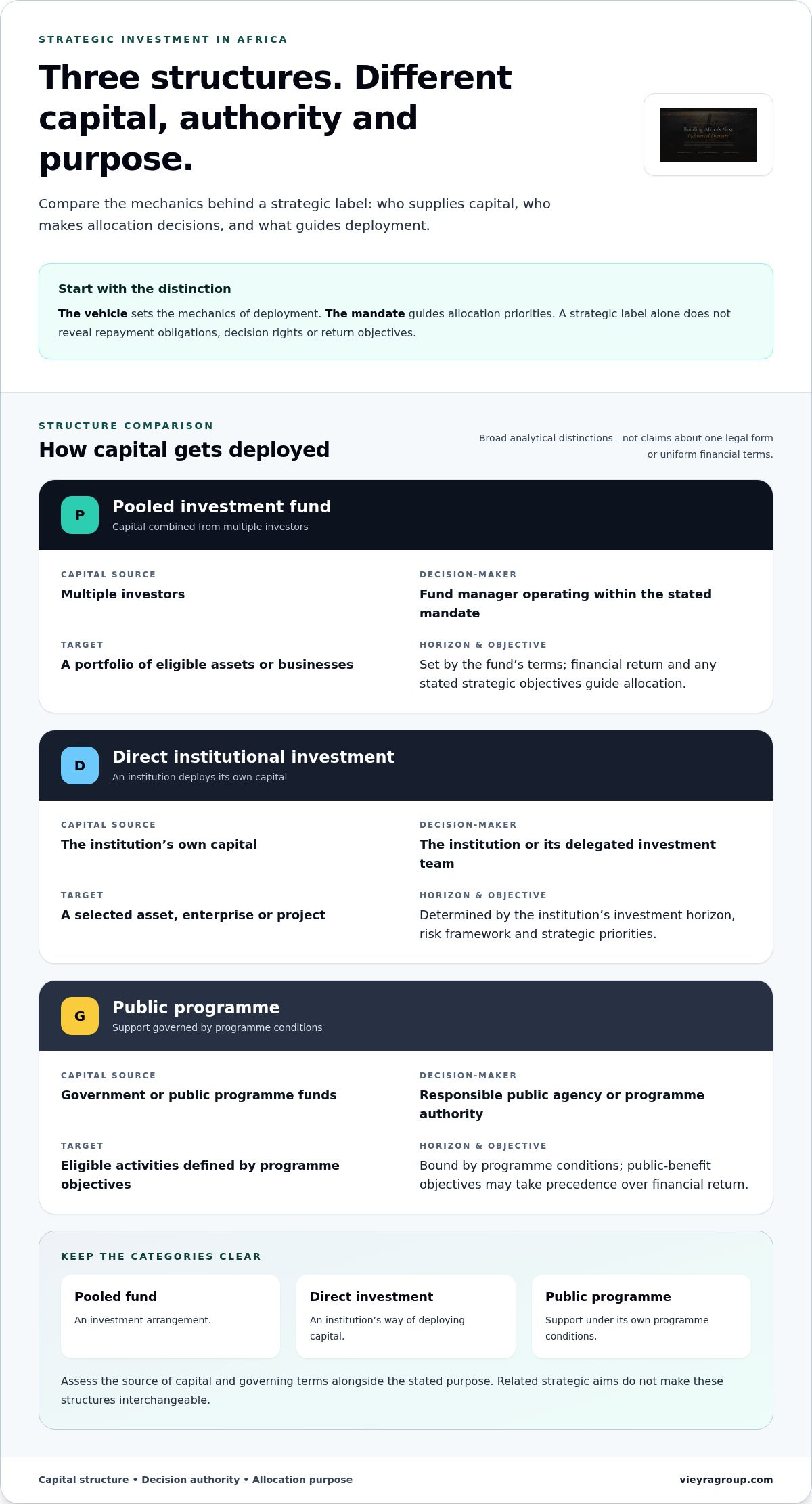
Different structures can pursue related strategic aims while assigning capital, authority and accountability in distinct ways. To compare strategic investment funds Africa effectively, separate the vehicle, which sets the mechanics of deployment, from the mandate, which guides allocation priorities. The categories below are broad analytical distinctions, not claims about one legal form or uniform financial terms.
| Category | Capital source | Decision-maker | Typical target | Time horizon and objective |
|---|---|---|---|---|
| Pooled investment fund | Multiple investors | A fund manager operating within the stated mandate | A portfolio of eligible assets or businesses | Set by the fund’s terms; financial return and any stated strategic objectives guide allocation |
| Direct institutional investment | An institution’s own capital | The institution or its delegated investment team | A selected asset, enterprise or project | Determined by the institution’s investment horizon, risk framework and strategic priorities |
| Public programme | Government or public programme funds | The responsible public agency or programme authority | Eligible activities defined by programme objectives | Bound by programme conditions; public-benefit objectives may take precedence over financial return |
These distinctions help prevent category errors. A pooled fund is an investment arrangement, direct investment describes how an institution deploys capital, and a public programme may provide grants or other support under its own conditions. Assess the source of capital and governing terms alongside the stated purpose. A strategic label alone does not reveal repayment obligations, decision rights or return objectives.
How mandate and vehicle work together
The vehicle determines how capital is assembled and deployed; the mandate guides where and why it is allocated. A single objective, such as expanding productive capacity, could be pursued through a pooled portfolio or direct institutional commitments, each with different governance and execution mechanics. These are illustrative possibilities, not descriptions of a specific investment. Compare who makes decisions, how priorities are applied and what evidence is reported.
Mandates may specify priorities by sector, geography, business stage or intended strategic outcome. Their precision matters: broad language can leave substantial discretion, while a more defined remit can narrow the eligible opportunity set. Neither automatically produces stronger performance. Ask whether the mandate gives decision-makers clear priorities while remaining consistent with the institution’s risk capacity and investment horizon.
How African industrialisation can shape capital allocation
Industrialisation can orient analysis toward productive capacity. For example, an investor might assess whether an investment could contribute to manufacturing capability, infrastructure or more connected regional value chains. These are strategic themes, not guaranteed outcomes. Commercial viability, execution conditions and the risks specific to each market and sector still require assessment.
The African Continental Free Trade Area may inform analysis of regional integration and potential cross-border value chains, but it does not remove market-specific considerations. Institutional capital can be directed with a long-term view while retaining investment discipline. For a considered perspective on private capital in African industrialisation, Vieyra Family Office’s global investment management is grounded in a focus on African industrialisation. Explore Vieyra’s strategic capital perspective.
How Should Institutions Compare Strategic Investment Funds in Africa?
Comparing strategic investment funds Africa requires more than reviewing a fund’s name, sector focus or stated ambition. Institutions need to determine whether the mandate is clear enough to guide capital allocation, whether governance supports disciplined execution, and whether reported evidence substantiates the claims made. Assess strategic funds by mandate, governance, risk and evidence, not labels alone.
Start with five questions:
- Mandate clarity: Are eligible sectors, geographies, investment stages and intended objectives defined clearly enough to guide decisions? Identify where discretion remains broad and how it is governed.
- Governance: Who approves investments, oversees performance and addresses conflicts of interest? Establish how accountability works across decision-makers and capital providers.
- Alignment: Does the fund’s operating horizon suit the institution’s objectives, liquidity needs and capacity to bear risk? A long-duration ambition may not fit capital that must remain readily accessible.
- Risk: Examine country, currency, political, execution and concentration exposures in relation to the specific mandate and markets. Consider how risks may interact rather than reviewing each in isolation.
- Reporting: What financial and non-financial information is reported, how often, and against what baseline? Determine whether reporting lets investors assess progress, setbacks and changes in assumptions.
Assess governance, accountability and alignment
Governance analysis should establish decision rights, oversight responsibilities and processes for identifying and managing conflicts. It should also clarify how actual allocations are reviewed against the stated mandate. Shared language does not establish alignment: the fund’s time horizon and objectives should be consistent with the capital provider’s commitments. A broader perspective on family office governance for wealth preservation can help situate these questions within long-term stewardship.
Assess risk and the evidence behind impact claims
Evaluate risk in the context of the relevant country, currency exposure, political environment, execution pathway and portfolio concentration, rather than treating it as uniform across the continent. Strategic claims also require careful distinctions: intended impact describes an aim, outputs record what an activity produces, and longer-term outcomes concern the changes that follow. Baselines, defined indicators and consistent reporting make these layers easier to assess. Avoid claims that go beyond the evidence. For a structured view of sovereign investment risk management in Africa, consider how risk oversight supports institutional stewardship.
Compare reported execution with the original objectives. Review whether capital was deployed as intended, whether material risks or delays were disclosed, and whether outcome measures are linked to credible evidence rather than aspiration alone. This helps institutions assess financial suitability and strategic contribution without treating a development purpose as proof of results.
What Risks and Practical Questions Matter Before Capital Is Deployed?
Due diligence for strategic investment funds Africa should connect the purpose of the capital to the conditions under which it will be deployed and overseen. A continent-wide label cannot replace jurisdiction-specific analysis. Examine the operating environment, counterparties, execution capacity and relevant legal, tax and regulatory considerations for each proposed investment. The discipline is to connect the mandate to practical controls before commitment, then test that connection throughout the investment horizon.
A disciplined sequence from mandate to deployment
Use these steps to structure institutional review. Tailor the analysis to the vehicle, opportunity and relevant jurisdiction; a general checklist cannot replace specific due diligence.
- Define the mandate and constraints. State the strategic objective in terms that can guide allocation decisions. Identify eligible opportunities, intended markets or sectors, investment horizon and constraints, including liquidity needs and the institution’s capacity to absorb risk. Clarify what falls outside the mandate as well as what qualifies.
- Examine governance and execution capacity. Map who can approve, deploy and oversee capital, and how accountability is maintained. Assess counterparties, their roles and capacity to perform, alongside the project’s implementation requirements. Consider jurisdiction-specific conditions and obtain legal, tax and regulatory analysis for each relevant jurisdiction. Do not assume conclusions transfer unchanged across borders.
- Set controls for approval and review. Establish decision criteria, documentation expectations and monitoring responsibilities before capital is committed. Define how progress, material changes and departures from the approved plan will be reviewed. Deploy capital according to the mandate and agreed approvals, not simply because resources are available.
Monitoring value creation over a long horizon
Monitoring should distinguish financial performance from development or industrialisation indicators. Financial measures can track performance against the investment’s objectives and assumptions; strategic indicators may relate to productive capacity or other outcomes specified by the mandate. Choose measures according to what the capital is intended to achieve and what evidence can be gathered reliably. A metric should illuminate progress, not imply a causal result that the available information cannot support.
Periodic review helps institutions test whether original assumptions remain credible, implementation is proceeding as planned and emerging risks require a change in oversight. Records should capture results and material setbacks, with reporting that allows decision-makers to compare execution against approved objectives. If indicators or circumstances change, document the rationale. This preserves accountability without treating long-term value creation as a fixed forecast.
For institutions considering how disciplined allocation can serve long-term African industrialisation, explore Vieyra Family Office’s strategic capital approach, informed by a multi-generational perspective on investment stewardship.
How Does Vieyra Family Office Approach Strategic Capital for Africa?
Vieyra Family Office is a multi-generational African family office operating at sovereign scale. Its perspective on strategic capital reflects the responsibilities of long-term stewardship: investment decisions sit within a broader view of wealth, economic development and the productive foundations that can support future growth. This institutional outlook offers a useful lens for readers assessing strategic investment funds Africa, where mandate and horizon matter as much as the vehicle’s label.
Global investment stewardship with an African industrialisation focus
Vieyra manages global investments across a range of asset classes, with a focus on strategic capital for African industrialisation. These commitments are connected by a stewardship perspective, not by an assertion that global diversification guarantees a particular result in African markets. Global investment management provides a wider institutional context for capital allocation, while African industrialisation remains a strategic focus directed toward long-term growth and economic development.
Industrialisation is a strategic orientation, not a promised outcome. Its relevance lies in the role productive capacity can play in wider economic development, while each investment remains subject to its own mandate, risks and execution conditions. An ambition can inform priorities, but it is not evidence that an outcome has already been achieved.
For further context on how global portfolio oversight relates to enduring institutional responsibilities, Vieyra’s discussion of global investment management for sovereign-scale family offices considers the principles that inform this perspective. The emphasis is on stewardship across asset classes and generations, alongside a focused commitment to African industrialisation.
A considered path for institutional engagement
For institutional readers, the questions are practical: Is the mandate clear? Do governance and decision-making support accountable allocation? Are the investment horizon and risk considerations consistent with the strategic objective? These questions help distinguish a long-term commitment to industrialisation from a broad aspiration, while recognising that strategic vehicles can use different structures and pursue different outcomes.
Vieyra’s global investment management and strategic capital focus provide the institutional context for this approach. The Vieyra Foundation pursues philanthropic initiatives aligned with the broader investment strategy. Its public-benefit work may complement that strategy, but philanthropy is not investment capital and should be assessed according to its distinct purpose and governance.
For institutions considering long-term capital stewardship in relation to African industrialisation, explore Vieyra Family Office’s institutional approach.
Carry Strategic Intent Into Long-Term Capital Stewardship
The enduring test for strategic investment funds Africa is whether a clear purpose can guide decisions through changing conditions without losing accountability. Institutions can make that purpose durable by translating it into allocation principles, governance practices and measures suited to their own horizon. This creates a basis for deliberate capital stewardship, rather than relying on ambition alone to define progress.
Vieyra Family Office brings a multi-generational African family-office perspective and operates at sovereign scale. Its global investment management is paired with a strategic focus on African industrialisation, connecting a broad investment outlook with long-term economic development priorities. The emphasis is on holding both perspectives together while assessing each allocation on its own mandate and merits.
For institutional readers considering how long-term capital can serve strategic objectives, explore Vieyra Family Office’s approach to strategic capital. A well-considered mandate can help turn patient capital into a lasting commitment to Africa’s productive future.
Frequently Asked Questions
What is a strategic investment fund in Africa?
A strategic investment fund in Africa is an investment vehicle or institutional capital mandate directed toward objectives in African markets, rather than a single standardised structure. To understand a particular vehicle, compare its mandate with its investment policy and governing documents. For example, a stated focus on industrial development should be checked against eligibility rules, allocation authority and reporting commitments. The label alone cannot establish how capital is managed or what outcomes are expected.
Are strategic investment funds in Africa the same as government grants?
No. A government grant generally supports activities under programme-specific eligibility and use conditions, while investment capital is committed under financial or institutional objectives. To distinguish them, examine whether the documents describe an award for eligible costs or capital allocated with an expectation of financial performance. A government funding opportunity may appear in searches for strategic investment funds Africa, but its terms do not define institutional investment vehicles more broadly.
How do Africa-focused mutual funds differ from strategic institutional capital?
An Africa-focused mutual fund pools investor capital into a portfolio under its stated objective and product terms. Strategic institutional capital refers more broadly to allocations guided by an institution’s priorities and governance, and may use different structures. An institution assessing whether a publicly available portfolio suits its needs may apply different criteria from a long-term capital provider. Compare decision authority, liquidity, time horizon and reporting before treating the two as equivalent.
What sectors do strategic investment funds in Africa support?
Sector priorities vary by mandate, so do not assume a particular industry from an Africa-focused label. A mandate might identify infrastructure or productive capacity as priorities, while its eligible investments may be narrower. Read the current primary materials to distinguish broad themes from specific investment criteria. Then compare the stated scope with disclosed holdings or completed investments, where available, since a stated priority alone does not show where capital has been deployed.
How can investors assess risk in African investment funds?
Start by identifying the relevant country, sector and project, then assess risks in that context rather than applying one regional assumption. A practical review might consider currency exposure alongside the currency of revenues and obligations, then examine counterparties, governance, execution capacity, liquidity and concentration. Assess the political and regulatory context applicable to the investment, and whether reporting gives sufficient visibility into changes that could affect the original assumptions.
Can strategic investment funds contribute to African industrialisation?
They can be designed to direct capital toward industrial development, but their contribution depends on what is financed and how the mandate is executed. An institution could assess whether a fund defines its industrialisation objective in observable terms, such as increased productive capacity, and whether its reporting supports that assessment. Separate intended contribution from verified outcomes, and avoid attributing wider economic change to a fund unless credible evidence supports the connection.
How does philanthropy differ from investment capital in African development?
Philanthropy pursues a public-benefit mission, while investment capital is allocated under financial or institutional objectives. Related aims do not make them the same pool of capital. In practice, their budgets, decision criteria and measures of progress should remain distinct. The Vieyra Foundation pursues philanthropic initiatives aligned with Vieyra Family Office’s investment strategy. Its philanthropic role should be considered separately from the family office’s global investment management and strategic capital allocation.


