
The strongest alternative to a development bank loan may not be another loan. When a lender’s mandate, process, or repayment terms do not fit a project, the better option may involve a different allocation of risk, ownership, or capital duration. Alternatives to development bank loans include commercial and private credit, equity, grants, impact investment, and blended finance. These instruments serve different purposes and are not interchangeable.
Project sponsors need capital that matches a project’s requirements, particularly when its scale or public purpose exceeds what one financing source can accommodate. The central question is not simply where to borrow. It is how the financing terms interact with project economics, risk exposure, governance, and long-term objectives.
This guide compares the principal financing alternatives, explains their trade-offs, and shows how multiple sources may fit within a broader capital structure. It also considers how strategic capital can complement public resources and private investment in projects supporting industrialization and long-term development priorities.
Key Takeaways
- Assess alternatives to development bank loans by their fit with the project’s mandate, scale, risk allocation, and financing timeline.
- Distinguish debt from equity: repayment obligations, ownership participation, and governance implications differ materially.
- Compare financing structures across tenor, currency, collateral, control, and exposure to project, sponsor, sovereign, construction, and market risks.
- Separate core funding needs from risk mitigation, technical assistance, and public-benefit objectives before designing a capital structure.
- Consider strategic capital as a complement to public resources and private investment, particularly when long-term industrialization goals shape project priorities.
Alternatives to Development Bank Loans: When Should a Project Look Beyond Them?
Development bank lending generally refers to financing provided by institutions established to support economic development, often through loans and other financial instruments aligned with public or development objectives. Mandates, eligibility criteria, due diligence, and approval processes vary across institutions and differ from those of commercial banks, private investors, and philanthropic funders. Multilateral, regional, bilateral, and national institutions may serve different markets and priorities. An overview of Development Finance Institutions (DFIs) provides useful context for understanding this range.
A financing source is the provider of capital; a financing structure is how different forms of capital, repayment, risk, and control are arranged for a project. This distinction matters because a project may need a different provider, a redesigned capital structure, or a combination of both.
What counts as an alternative to a development bank loan?
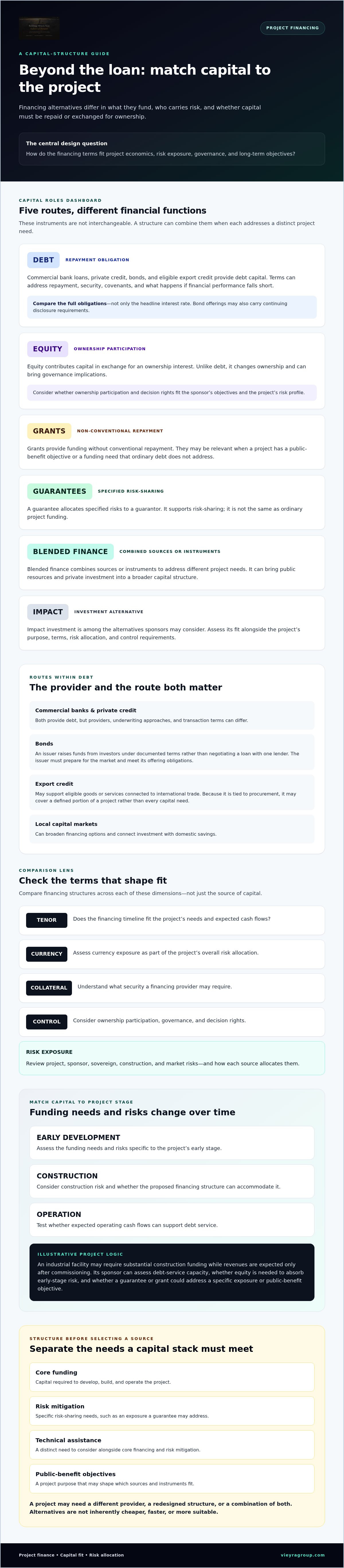
Alternatives to development bank loans include instruments with distinct economic functions, not interchangeable versions of the same product. Debt provides capital that generally must be repaid; equity contributes capital in exchange for an ownership interest; guarantees allocate specified risks to a guarantor; and grants provide funding without conventional repayment. Blended finance combines sources or instruments to address different project needs. Any of these may complement development bank finance, depending on the project and the parties involved.
Why project sponsors consider other sources of capital
A sponsor may look beyond a development bank when the institution’s mandate does not fit the project, a financing need falls outside a lender’s parameters, or the proposed allocation of construction, market, or currency risk is difficult to reconcile. Timing and project stage matter too: early development, construction, and operation bring different risk profiles and funding needs. These constraints do not, by themselves, mean that a project is unbankable.
Bankability concerns whether expected cash flows, contractual arrangements, sponsor capacity, and risk controls can support financing. Institutional fit concerns whether a particular capital provider can participate under its mandate and process. A project may be commercially viable but unsuitable for one provider, or have public value while its revenue model remains insufficient for conventional debt. Alternatives are not inherently cheaper, faster, or more suitable. Assess their costs, obligations, and decision rights against the project’s economics.
Consider an industrial facility with substantial construction needs and revenues expected only after commissioning. Its sponsor could assess whether projected operations can service debt, whether equity is needed to absorb early-stage risk, and whether a guarantee or grant could address a specific exposure or public-benefit objective. These are capital-design questions, not reasons to assume that a particular instrument will be available or resolve the underlying risks.
For African projects, the assessment also includes how financing supports productive capacity and long-term development objectives. The broader case for the mandate for private capital in African industrialization helps frame the potential roles of public and private resources. Compare the available instruments by repayment terms, control implications, risk allocation, and fit with the project’s stage and purpose.
Which Alternatives to Development Bank Loans Could Finance a Project?
Alternatives to development bank loans extend beyond choosing one lender over another. Each source creates a different relationship between repayment, ownership, risk, and project control. Debt creates a repayment obligation, equity exchanges capital for ownership and governance participation, while grants and guarantees support funding or risk-sharing without functioning as ordinary loans. A project’s financing design can combine these roles instead of relying on one instrument.
Debt, private credit, and capital markets
Commercial bank loans and private credit both provide debt, but their providers, underwriting approaches, and transaction terms can differ. In either case, the lender assesses borrower and project risks, then sets conditions that may cover repayment, security, covenants, and the consequences of financial underperformance. Terms vary by transaction, so sponsors should compare the full set of obligations rather than focus only on the headline interest rate.
Bond issuance offers another route to debt capital. Instead of negotiating a loan with one lender, an issuer raises funds from investors under documented terms. Repayment obligations and continuing disclosure requirements depend on the offering. This route requires the issuer to prepare for the market and meet its obligations. It is not automatically more accessible or less costly than a loan.
Export credit may support eligible purchases of goods or services connected to international trade, subject to the relevant arrangement and requirements. Because it is tied to procurement, it may fund a defined portion of a project rather than meet every capital need. Local capital markets can also broaden financing options and connect investment with domestic savings. The World Bank’s discussion of local capital markets for development explains their role in financing investment.
Equity, blended finance, and non-loan support
Equity contributes risk-bearing capital without scheduled loan repayments, but investors receive an ownership interest and may hold governance rights. Existing owners may be diluted, and an investor’s participation can influence oversight and strategic decisions. Equity can be relevant when a project’s development stage or revenue profile cannot prudently support more debt, but it changes the distribution of control and future value.
Blended finance combines capital from parties with different objectives or risk tolerances. A project, for example, could combine commercial debt and equity with a guarantee covering a specific exposure, if the transaction and participating parties support that design. The combination does not remove underlying risks; it allocates them differently.
- Grants provide non-repayable support for defined purposes, often linked to public or development objectives.
- Guarantees cover specified risks under agreed conditions and may support participation by other financiers.
- Blended finance coordinates multiple sources rather than naming one standalone instrument.
These distinctions matter when deciding how to allocate strategic capital. A structure should reflect the project’s economics, governance needs, and development purpose. For projects aligned with long-term industrialization objectives, Vieyra’s strategic capital approach connects capital allocation with enduring growth priorities.
How to Compare Development Finance Alternatives Without Overlooking Risk
Assess a financing offer as a package of obligations, rights, and risk allocation, not by its headline return or stated purpose alone. To compare alternatives consistently, use the same project assumptions and record how each structure affects cash flow, control, currency exposure, and resilience under adverse conditions.
Match financing terms to project economics
Start with the project’s development and operating schedule. Map expected construction spending, commissioning, revenue generation, and major maintenance against repayment dates or investor return expectations. Debt payments that begin before reliable operating cash flow is available can create pressure, even when projected returns look attractive. Model delays, lower demand, and cost overruns to see whether the project could still meet its obligations.
Assess currency separately. If financing is denominated in one currency and project revenues are earned in another, exchange-rate movements can increase the effective repayment burden or reduce available cash. Projected returns alone do not establish whether financing is suitable. Revenue, timing, cost, and risk-allocation assumptions also need to hold up under downside scenarios.
Compare control, risk sharing, and development objectives
Debt generally preserves ownership while creating repayment obligations and potentially requiring security or covenants. Equity avoids scheduled loan repayment but can involve dilution, governance rights, and shared participation in future value. Neither is inherently preferable. The relevant question is whether the claims on cash flow and decision-making fit the sponsor’s objectives and the project’s risk profile.
Identify who bears each material exposure. Construction risk concerns delivery, cost, and schedule. Demand risk concerns whether users or customers generate expected revenues. Operational risk arises during ongoing performance. Policy and sovereign exposures may affect the operating environment, while currency risk can arise when revenues, costs, and obligations are denominated differently. A guarantee or other risk-sharing arrangement may reallocate a defined exposure, but it does not eliminate the underlying project risk.
For African projects, assess sovereign investment risks alongside the project’s other long-horizon exposures and responsibilities.
A comparison matrix can expose mismatches before negotiations advance. Record the proposed terms, then test them against a consistent set of project scenarios.
| Dimension | Questions for comparison |
|---|---|
| Tenor | Does the financing period reflect construction, commissioning, and operating life? |
| Repayment | When are payments due, and how do they relate to forecast cash flows? |
| Currency | Do funding, revenues, and principal obligations align, or create foreign-exchange exposure? |
| Control | What ownership, governance, covenant, or decision rights accompany the capital? |
| Collateral | What assets or other security may be pledged, and what are the implications if obligations are unmet? |
| Risk allocation | Who bears construction, market, operational, policy, sovereign, and currency risks? |
Legal, tax, and regulatory treatment can vary by jurisdiction, transaction, and investor. Have appropriately qualified professionals review these points before finalizing a structure. This comparison helps determine whether alternatives to development bank loans fit the project’s economics and long-term development objectives.
A Practical Framework for Structuring Capital Beyond Development Bank Loans
Capital structuring begins with the project, not a preferred instrument. For sponsors assessing alternatives to development bank loans, a disciplined process can separate the amount required to build and operate an asset from additional capital or support needed to manage risk, strengthen execution, or pursue public objectives. Use the sequence below as a framework, not a universal formula. Project stage, jurisdiction, revenue model, and institutional roles all shape the design.
- Define the project and its stage. Specify what is being developed, where it stands in planning, construction, or operation, and what each funding tranche would pay for. Separate core uses of proceeds, such as construction or equipment, from technical assistance, risk mitigation, and activities that advance public-benefit objectives.
- Establish the economic and operational profile. Set out expected cash-flow timing, revenue sources, operating costs, and the investment horizon the project requires. Identify key delivery conditions, including construction milestones and when operations are expected to generate revenue. Use these assumptions to test whether proposed obligations can be supported.
- Map material risks and constraints. Identify project, sponsor, construction, demand, operational, currency, and sovereign exposures, then assess how each could affect delivery or financing capacity. Record constraints arising from the project’s mandate, procurement, jurisdiction, or counterparties. Qualified advisers familiar with the relevant jurisdiction should review legal, tax, and regulatory implications.
- State the public objectives alongside commercial requirements. Clarify which outcomes are central to the project, such as industrial capacity or access to essential infrastructure, and how they relate to its operating model. This helps distinguish commercially funded needs from objectives that may require separate support, without assuming that public value alone ensures repayment capacity.
- Assign each capital source a defined function. Map proposed contributions to specific uses, risk positions, and decision-making roles. Debt may fund needs supported by forecast repayment capacity; equity may absorb risks that cannot prudently be carried as fixed obligations; guarantees may address specified exposures; and concessional components may support defined objectives. The arrangement depends on the actual terms and participation of each party.
- Test dependencies and establish governance. Determine whether one source depends on another, whether commitments are synchronized with project milestones, and what happens if a component is delayed or unavailable. Capital stacking is a design choice, not simply the accumulation of funds. Coherent documentation, clear accountability, and an agreed approach to oversight help prevent conflicting obligations and decision rights.
For projects linked to African industrialization, the development of private capital markets in Africa provides broader context for considering how domestic and international capital may contribute to long-term investment. A sound financing architecture should respond to the project’s economics and public purpose, rather than impose a standard sequence on every jurisdiction or sponsor.
Explore Vieyra’s strategic capital perspective on financing large-scale initiatives and long-term growth.
Where Strategic Capital Fits Among Alternatives to Development Bank Loans
Strategic capital is defined by the purpose it serves and the objectives it supports, rather than by a standardized loan or single financial product. It can form part of a wider financing architecture alongside development finance, private investment, or public resources. Its contribution depends on alignment among the project’s needs, the capital provider’s objectives, the proposed investment horizon, and the responsibilities each party is prepared to assume.
Strategic capital is defined by purpose and alignment
For sponsors weighing alternatives to development bank loans, this distinction helps avoid treating every capital source as a substitute lender. Strategic capital can complement an existing financing plan or support a broader investment purpose. Define its role in relation to the project’s economics and long-term aims. The term alone does not establish a particular instrument, repayment arrangement, governance right, or risk allocation.
Alignment matters when a project’s development period, commercial returns, and public value unfold on different timelines. A provider with a long-term investment orientation may assess capital allocation over a wider horizon than immediate cash generation alone. That perspective does not remove execution, market, or policy risks, or guarantee that a project will achieve its intended outcomes. It helps frame whether the project’s purpose and investment horizon are compatible.
A long-term institutional perspective on African industrialization
Vieyra Family Office manages global investments and allocates strategic capital toward African industrialization and long-term growth projects. Its multi-generational orientation is relevant to initiatives whose development and economic contribution may extend beyond a short financing cycle. This institutional perspective connects investment objectives with industrial development and long-term growth.
In a broader capital plan, strategic capital may sit alongside development finance, private investment, or public resources, with each source assigned a distinct purpose and role. The central discipline is coherence: evaluate proposed capital against project requirements, risk capacity, governance, and the outcomes the sponsor seeks to advance. A long horizon can shape priorities, but sound project economics and accountable implementation remain essential.
For sponsors, the practical question is whether strategic capital could contribute to a financing architecture designed around the project’s scale, industrial purpose, and long-term objectives. The answer depends on the project and jurisdiction. Base the assessment on the project itself, not assumptions about any one category of capital.
Explore Vieyra’s strategic capital perspective on investment, African industrialization, and long-term growth priorities.
Carry Capital Decisions Into Long-Term Planning
Treat financing design as part of the project’s institutional legacy. Capital choices shape not only how an asset is funded, but also the incentives, responsibilities, and capacity that remain through development and operation. Test whether proposed terms support durable value creation, accountable governance, and a clear connection to the project’s purpose.
Vieyra Family Office is a multi-generational African family office operating at sovereign scale. It manages global investments and allocates strategic capital toward African industrialization and long-term growth projects. This orientation offers a perspective on how capital strategy can serve enduring economic priorities, without treating any single source as a universal answer.
As you refine the financing architecture, consider how each capital partner’s objectives and investment horizon relate to the project’s future. Explore Vieyra’s strategic capital perspective and consider how alternatives to development bank loans may fit within a broader vision for sustainable, long-term development.
Frequently Asked Questions
Can a project combine development bank financing with private capital?
Yes. A project can combine development bank financing with private capital when the participants’ requirements and the financing plan are compatible. One source might fund a defined project component while another supports a separate phase or risk position. Coordinate disbursement conditions, security interests, reporting duties, and default remedies, because one financier’s commitment may depend on actions by another.
Are grants a true alternative to development bank loans?
Grants can fund eligible project costs because they generally do not require repayment, but they are not equivalent to a loan or a source of unrestricted capital. The funder may define the grant’s purpose, permitted uses, reporting conditions, and disbursement milestones. A grant might support a discrete public-benefit activity while other funding covers construction or operating costs. Its value depends on how well it fits the project’s needs.
What is the difference between development finance and development bank lending?
Development finance is the broader field of funding intended to advance economic or social development. It can include public resources, private investment, philanthropic support, guarantees, equity, and lending. Development bank lending is one channel within that field, provided by institutions with development-related mandates. The distinction matters when a project has development objectives but needs support beyond a direct loan, such as project preparation or a defined risk-sharing arrangement.
How does currency risk affect alternatives to development bank loans?
Currency risk arises when a project’s revenues, costs, and financing obligations are denominated in different currencies. If a facility earns local-currency income but must repay foreign-currency debt, depreciation can increase the local-currency amount required for repayment. Sponsors can model exchange-rate scenarios, compare funding and revenue currencies, and assess whether available risk-management measures are appropriate. These exposures can materially affect which alternatives to development bank loans are sustainable.
Can private capital support projects with public development objectives?
Yes. Private capital can participate when a project’s development purpose is compatible with an investable structure and the investor’s objectives. For example, an industrial project may advance productive capacity while generating revenue from customers. Public benefit does not, by itself, establish commercial viability. Sponsors should explain how the project earns income, allocates risk, and measures its intended development contribution. Clear accountability can help keep those objectives visible during implementation.
What information is needed to compare financing alternatives for a project?
Prepare a project brief identifying the development stage, proposed uses of funds, implementation schedule, expected revenue sources, and principal operating costs. Include forecasts under expected and adverse conditions, along with information on ownership, existing commitments, major contracts, and material risks. A worked example showing how a construction delay affects cash needs and scheduled payments can reveal whether a financing proposal remains workable when assumptions change.
Does strategic capital mean a project does not need development banks?
No. Strategic capital can complement development bank participation, private investment, or public resources; it does not automatically replace any of them. A project may need different forms of support at different stages, depending on its economics, development purpose, and risk profile. Assess whether each source has a clear role and whether the combined commitments are coherent. One capital provider should not be assumed to meet every project need.


